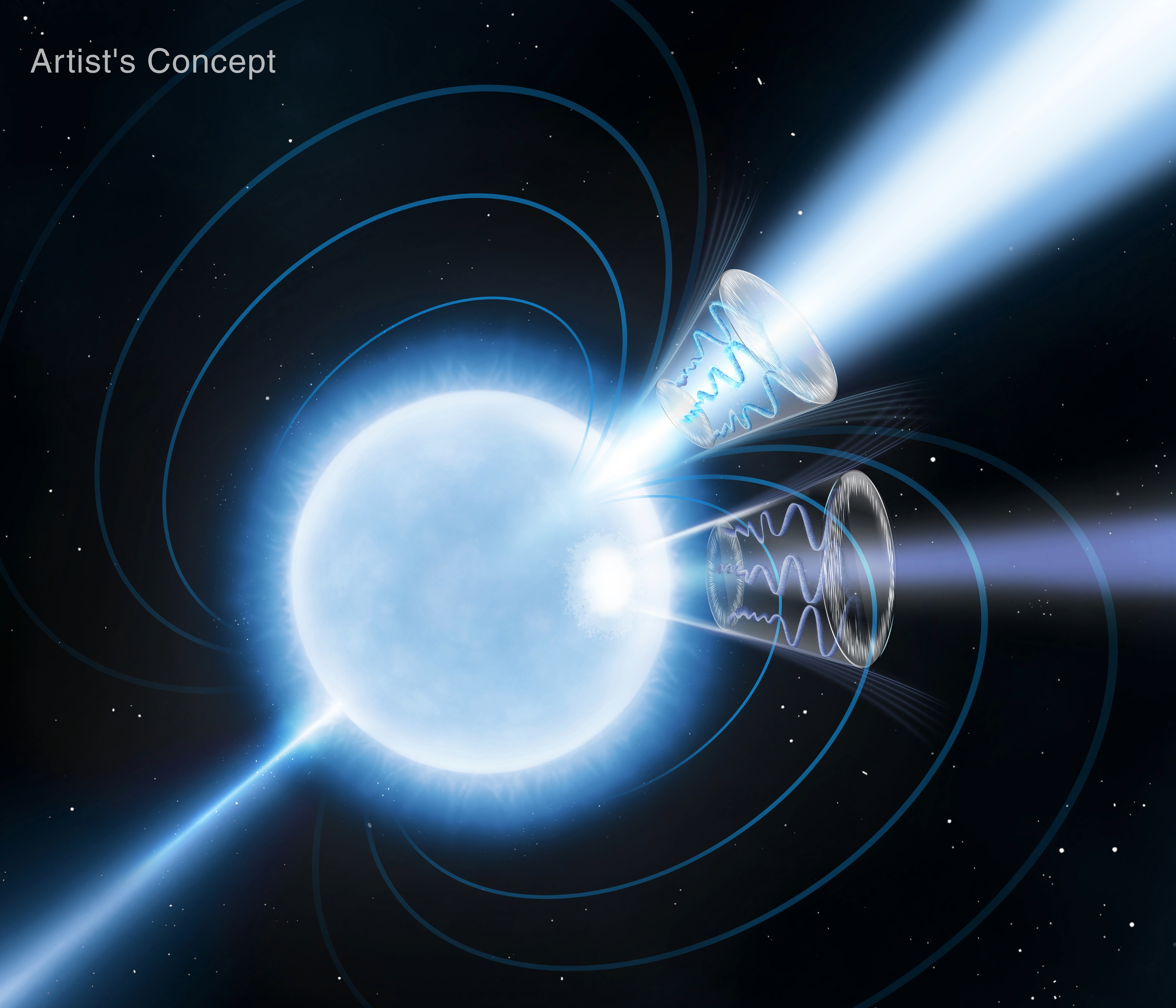
NASA's Imaging X-ray Polarimetry Explorer achieved an unprecedented observational milestone by studying the magnetar 1E 1547-5408 for over 140 hours between March and April 2025. The mission collected the most extensive polarimetry data yet on this extreme stellar remnant, potentially confirming a theoretical prediction about quantum electrodynamics that physicists have calculated for nine decades.
Magnetars rank among the universe's most violent objects. They form from the collapsed cores of massive stars and generate magnetic fields billions of times stronger than Earth's. The magnetar 1E 1547-5408 sits roughly 9 kilometers across yet possesses magnetic strength so intense it warps the fabric of spacetime itself.
IXPE measures the polarization of X-rays emitted by celestial objects. This technique reveals how magnetic fields influence radiation at extreme energies. By analyzing the polarization patterns from 1E 1547-5408, scientists gain direct insight into how the magnetar's electromagnetic environment reshapes photons traveling through near-empty space.
The observation addresses a phenomenon called vacuum birefringence, predicted by quantum electrodynamics theory since the 1930s. In sufficiently strong magnetic fields, empty space itself should behave like a polarizing medium, altering X-ray polarization as radiation passes through. No direct observation has confirmed this effect until potentially now.
IXPE launched in December 2021 as a collaborative mission between NASA, the Italian Space Agency, and several international institutions. The observatory's specialized detectors capture X-ray polarization data impossible to obtain with traditional X-ray telescopes that only measure intensity and wavelength.
The magnetar observations represent IXPE's deepest investigation into quantum effects in extreme environments. Success here opens pathways for testing other fundamental predictions about matter and radiation in the cosmos's most