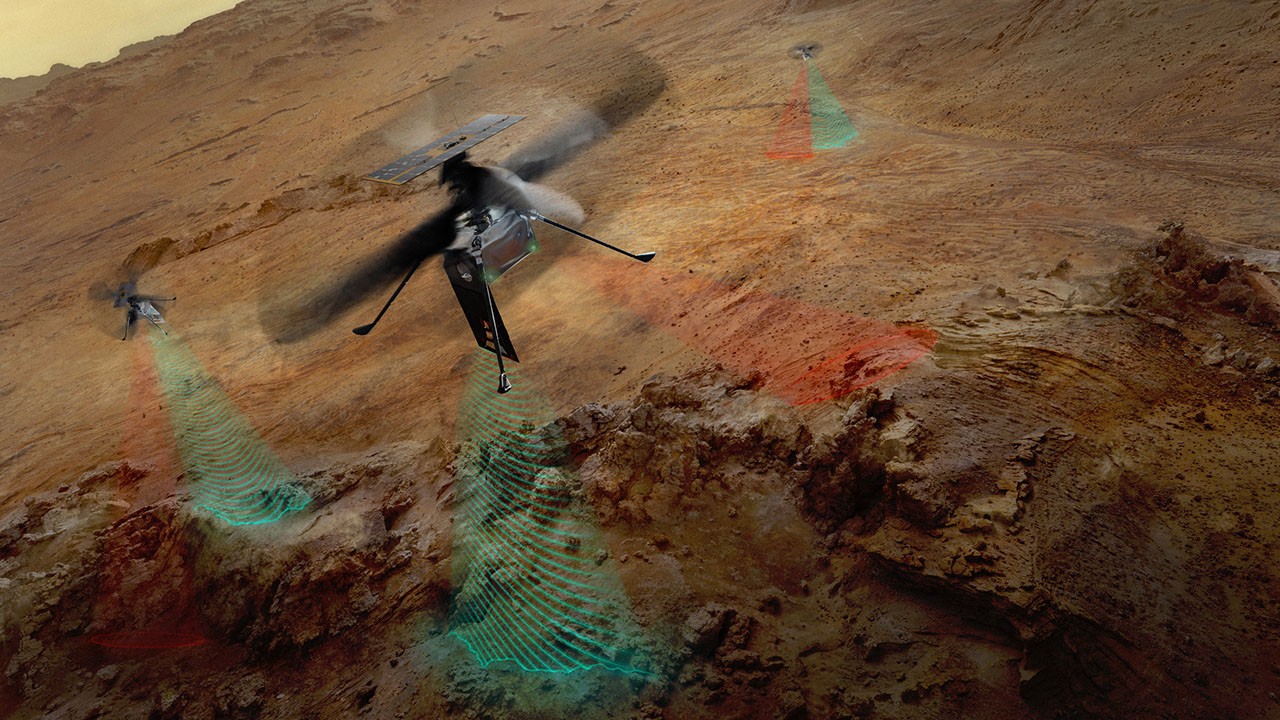
NASA is developing the SkyFall mission, a fleet of three rotorcraft designed to conduct aerial surveys of Mars while gathering subsurface and surface data simultaneously. The helicopters will operate together to map geological features and detect buried structures beneath the Martian regolith using integrated sensor packages.
Each SkyFall helicopter carries dual instruments. Large antennas transmit radar signals that penetrate the Martian surface, revealing subsurface composition and potential water ice deposits. Near-infrared cameras capture high-resolution imagery of rocks, dust, and terrain features, providing context for ground-level geology.
This multi-platform approach represents a departure from single-rover exploration. Rather than waiting for a rover to traverse kilometers of terrain, three airborne units can cover vast areas efficiently while gathering complementary datasets. The helicopters' aerial vantage point enables rapid reconnaissance across multiple sites, accelerating the search for signs of past microbial life and evaluating future human landing zones.
SkyFall builds on lessons from Ingenuity, the small helicopter that exceeded expectations during its 2021-2024 mission with the Perseverance rover. Ingenuity proved that powered flight operates reliably in Mars' thin atmosphere, despite comprising just one percent of Earth's sea-level pressure. SkyFall helicopters will be considerably larger and carry substantially more sophisticated instrumentation than their predecessor.
The mission addresses critical gaps in Mars exploration. Ground-penetrating radar from orbit cannot achieve the resolution necessary for detailed subsurface mapping, while rovers move slowly across challenging terrain. Flying helicopters with integrated sensor suites compress timelines and expand spatial coverage without ground-based constraints.
Subsurface data collection proves particularly valuable for identifying hydrothermal systems where ancient microbes could have thrived. The combination of radar penetration and infrared spectroscopy allows NASA scientists to characterize rock types, detect