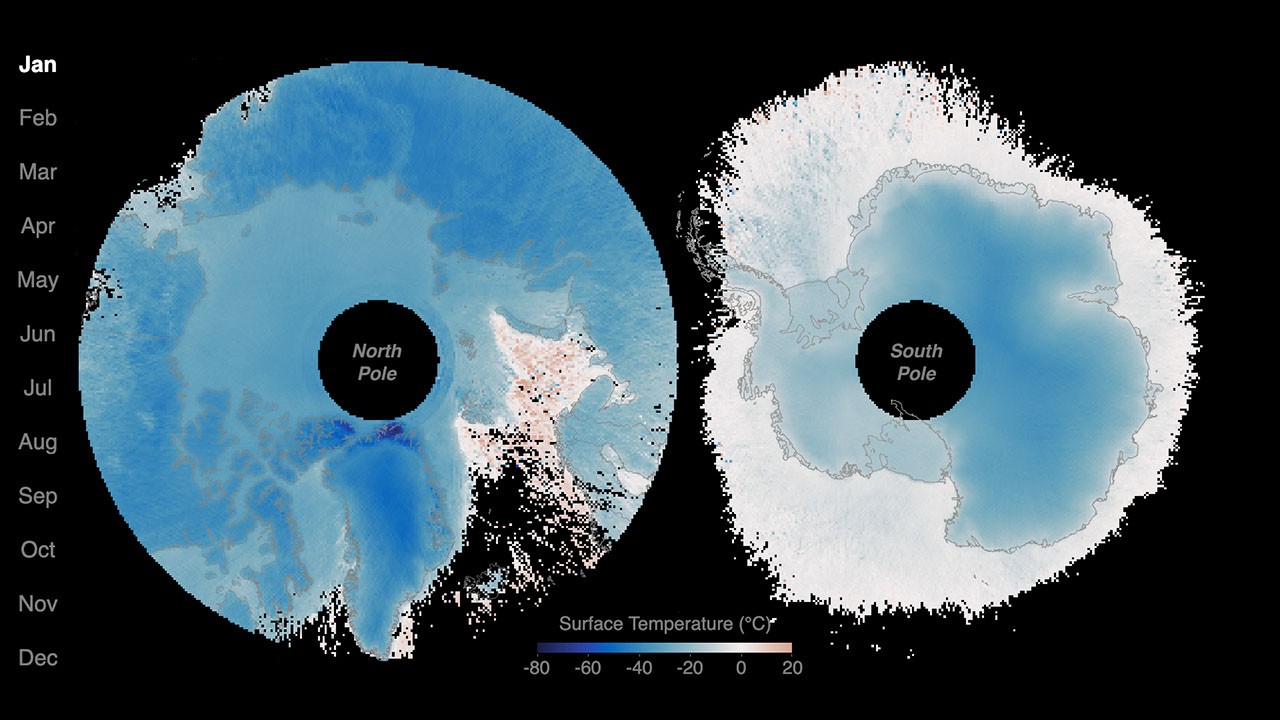
NASA's Polar Radiant Energy in the Far-InfraRed Experiment, or PREFIRE, has delivered two years of thermal data showing dramatic seasonal temperature variations across Earth's polar regions. The mission operates two small satellites equipped with infrared sensors that measure heat radiation escaping from the Arctic and Antarctic.
The animations reveal patterns previously invisible to older instruments. PREFIRE detects far-infrared radiation, a wavelength that carries roughly half of all heat energy leaving Earth's polar zones. Ground-based instruments and conventional satellites miss much of this emission, making PREFIRE the first mission to comprehensively map polar thermal radiation across seasons.
The data shows the Arctic and Antarctic respond differently to seasonal cycles. Winter brings extreme heat loss from open water and ice surfaces. Summer patterns shift dramatically as ice melts and albedo changes alter how much solar energy the poles absorb and radiate back to space. These seasonal swings drive global climate patterns and ocean circulation.
Understanding polar heat radiation matters for climate modeling. The poles amplify warming through feedback loops. Melting ice exposes darker ocean water, which absorbs more sunlight instead of reflecting it. This absorbed energy must eventually radiate away, and PREFIRE quantifies exactly how much escapes. Climate models rely on accurate polar thermal budgets to predict how quickly ice will disappear and how ocean temperatures will shift.
PREFIRE launched in February 2024 as part of NASA's Earth System Observatory initiative. The two satellites cruise at about 435 miles altitude, orbiting Earth from pole to pole. Their infrared radiometers scan the surface every 10 seconds with precision never before achieved at polar regions.
The mission operates a lean budget and compact design. Each spacecraft weighs less than a microwave oven but captures thermal signatures ground instruments cannot reach. NASA released the animations to help scientists and the public visualize what had remained abstract in data