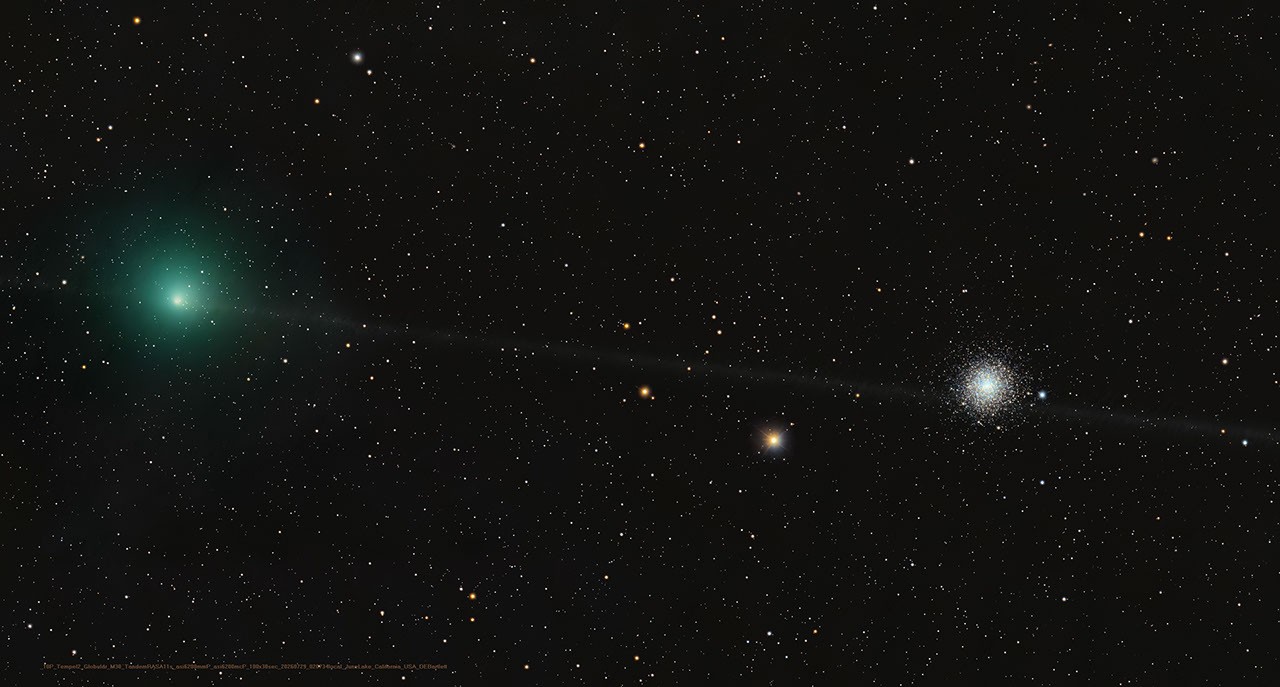
# A Messier Moment for Tempel 2
NASA's Astronomy Picture of the Day featured comet Tempel 2 on August 8, 2026, capturing the icy wanderer during a particularly active phase of outgassing. The comet, formally designated 9P/Tempel, belongs to the Jupiter family of periodic comets and orbits the Sun roughly every 5.3 years, making it one of the most frequently observable short-period comets from Earth.
Tempel 2 earned its place in astronomical history when NASA's Deep Impact spacecraft conducted a kinetic impact experiment on the comet's surface in July 2005. That collision, which struck the nucleus with a 372-kilogram impactor traveling at 37,000 kilometers per hour, excavated a crater and ejected subsurface material, revealing pristine cometary composition beneath the weathered outer layer. The resulting debris plume and impact crater provided unprecedented direct observations of cometary internal structure.
The comet's appearance during August 2026 demonstrated the dynamic nature of these icy bodies as they approach perihelion and solar heating intensifies sublimation along their surfaces. Comets exhibit variable brightness and morphology depending on their distance from the Sun and their orientation relative to Earth. The "Messier" reference in the title likely alludes to the complexity of the coma and tail structure during this particular apparition, terms familiar to comet observers who catalog such objects.
Tempel 2 continues to serve as a valuable laboratory for planetary scientists studying cometary volatile chemistry, dust production rates, and nucleus outgassing patterns. Each apparition offers fresh observational data that refines models of cometary behavior and evolution through repeated solar passages.
The periodic returns of Tempel 2 make it accessible for both professional observatories and dedicated amateur astronomers