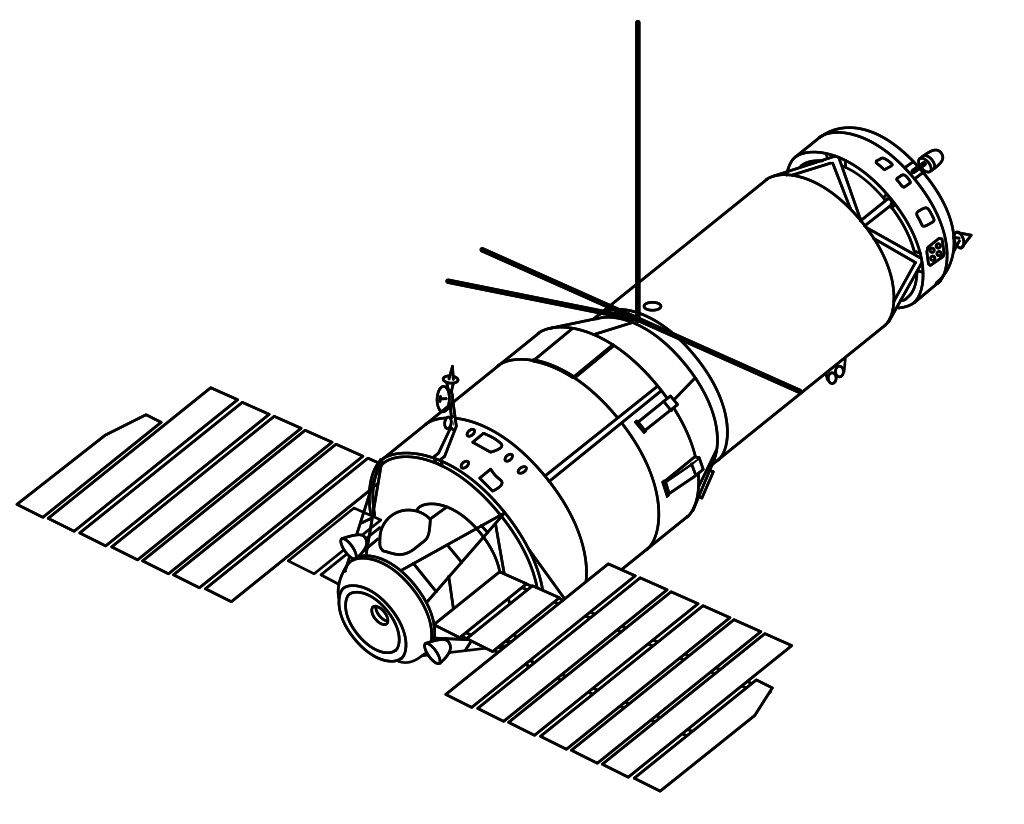
The Soviet Union's Salyut 5 reconnaissance space station reentered Earth's atmosphere and burned up on August 8, 1977, ending operations for one of the USSR's most secretive orbital platforms.
Salyut 5 belonged to the Almaz program, a classified military initiative that operated throughout the 1970s. The station launched in June 1976 and served as an orbiting reconnaissance platform for Soviet defense interests. Unlike the civilian Salyut stations, Almaz spacecraft carried advanced imaging systems designed to conduct surveillance from orbit.
The station hosted two crewed missions during its operational lifetime. Cosmonauts Vladimir Dzhanibekov and Oleg Makarov docked with Salyut 5 in July 1976 for a twelve-day mission. A second crewed visit followed in February 1977, when cosmonauts Vladimir Kovalyonok and Aleksandr Aleksandrov spent nearly 50 days aboard conducting military reconnaissance operations.
Salyut 5's reentry marked the conclusion of the crewed Almaz program. The station completed its reconnaissance objectives before controllers allowed it to naturally deorbit. The final decay trajectory brought the spacecraft back through the dense atmosphere, where friction and heat caused structural failure and fragmentation.
The Almaz program represented the Soviet Union's parallel approach to space militarization during the Cold War. While American military operations focused on the classified Manned Orbiting Laboratory concept and later reconnaissance satellites, the Soviets pursued crewed military stations. Salyut 5 demonstrated that orbital reconnaissance platforms could operate reliably in space for extended periods while supporting human crews performing classified observations.
The reentry of Salyut 5 concluded an era of Soviet crewed military spaceflight. Subsequent reconnaissance missions relied on unmanned satellites rather than crewed