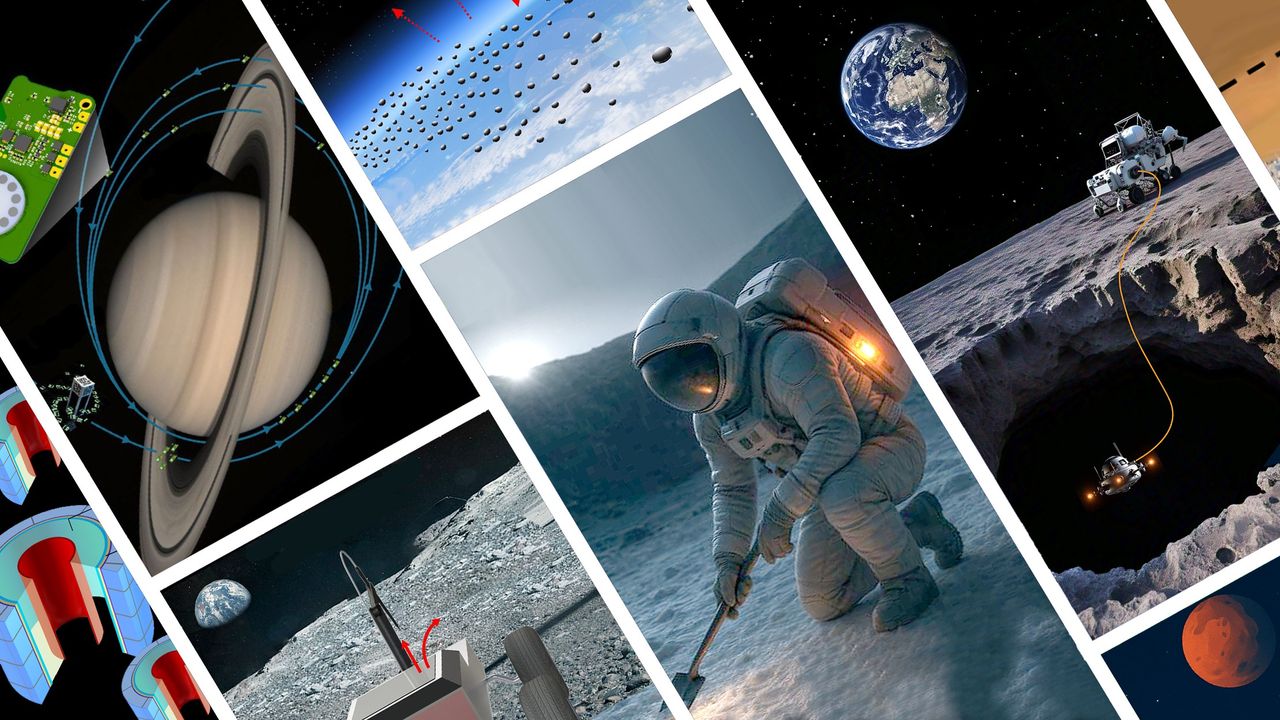
NASA's Innovative Advanced Concepts program has selected 18 bold technology proposals for funding, ranging from swarms of miniature satellites destined for Saturn to other experimental spacecraft designs that push the boundaries of current engineering. The agency announced the winners of this year's Phase I awards, which provide initial research grants to explore concepts that remain years or decades away from operational deployment.
One standout proposal involves launching thousands of femtosatellites, diminutive spacecraft weighing just grams each, toward the Saturn system. These tiny probes would operate as coordinated swarms, potentially revolutionizing how NASA conducts planetary exploration. Traditional single large orbiters give way to distributed networks capable of simultaneous observations across vast distances. The concept draws inspiration from biological swarm behavior, where coordination emerges from simple local interactions rather than centralized control.
The Innovative Advanced Concepts program, managed by NASA's Space Technology Mission Directorate, exists to fund high-risk, high-reward research that falls outside mainstream space initiatives. Phase I awards typically provide $150,000 to $200,000 per proposal. Concepts selected represent the early stage of development, often requiring fundamental breakthroughs before reaching Phase II or eventual mission-readiness.
NASA administrator details the strategic value of such investments. Early-stage funding cultivates the next generation of space technologies that will define exploration for decades ahead. The portfolio spans propulsion systems, materials science, sensing technologies, and novel spacecraft architectures. Each proposal underwent rigorous peer review by scientists and engineers who evaluate technical feasibility, innovation potential, and alignment with NASA's exploration goals.
The 18 chosen concepts include approaches to landing heavier payloads on Mars, generating power in extreme environments, and developing new methods for in-situ resource utilization. Advanced propulsion concepts also feature prominently. Some proposals explore nuclear thermal rockets that could cut transit times to distant planets. Others investigate electric propulsion systems with higher specific impulse than conventional thrusters.
The femtosat swarm concept for Saturn exploration represents a departure from traditional architecture. Instead of one flagship orbiter, dispersed networks could gather atmospheric data, image moon systems, and detect radiation environments simultaneously. Communication between individual units ensures coordinated observations. Loss of individual units degrades performance gracefully rather than causing total mission failure, a significant advantage over monolithic spacecraft designs.
Practical barriers remain substantial. Engineers must solve problems in miniaturization, autonomous navigation, inter-unit communication across planetary distances, and power generation for sustained operation. Yet the Phase I funding supports preliminary research into these challenges, establishing whether the basic physics and engineering prove viable.
Previous Innovative Advanced Concepts awards have led to technologies now used in operational missions. Early-stage research into ion propulsion systems, for instance, eventually enabled efficient deep-space probes. Advanced solar panel designs emerged from similar conceptual funding. The pipeline from abstract idea to deployed technology typically spans a decade or longer, making consistent investment in early concepts essential.
The 2024 awards reflect NASA's strategy to maintain technological momentum across diverse mission architectures. As the agency pursues lunar return through Artemis and eventual human Mars missions, parallel investments in unconventional concepts ensure backup approaches and emerging capabilities remain available. The femtosat swarms may never reach Saturn, but the research into coordinated autonomous systems promises applications across Earth orbit, lunar operations, and interplanetary exploration.