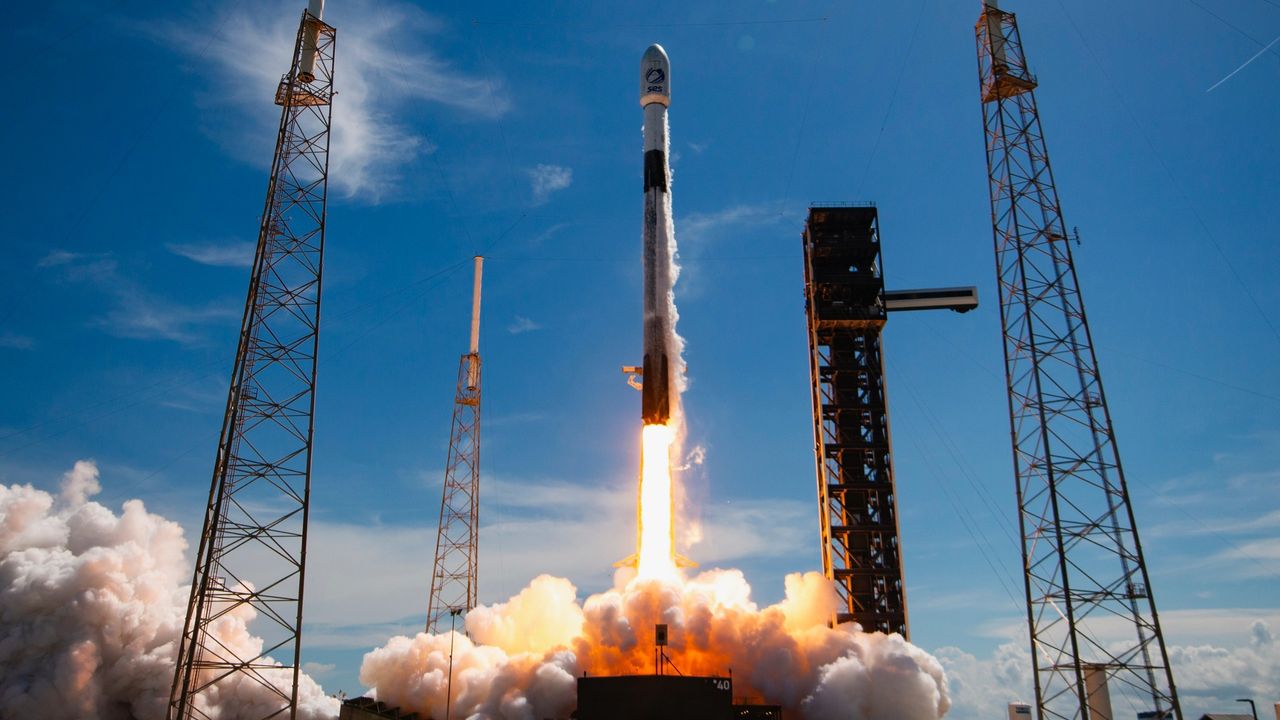
SpaceX marked a historic milestone today, September 13, when its Falcon rocket family achieved its 700th orbital launch. The mission carried three telecommunications satellites belonging to SES's O3b mPOWER constellation, delivering them to medium Earth orbit.
The three O3b mPOWER satellites join an expanding network designed to provide high-speed, low-latency internet connectivity across Africa, the Middle East, Asia-Pacific, and Latin America. SES, a Luxembourg-based satellite operator, has invested heavily in the mPOWER constellation to compete in the global broadband market alongside other mega-constellations like SpaceX's Starlink and Amazon's Project Kuiper.
The 700th Falcon launch represents an extraordinary achievement in spaceflight cadence and operational reliability. SpaceX has built the Falcon 9 and Falcon Heavy into the workhorse vehicles of commercial space, launching more orbital missions than any other rocket family in history. The company achieved this milestone through rapid reusability, with Falcon 9 first stages landing and reflying dozens of times. The architectural advantage of reusable boosters has enabled SpaceX to scale launch frequency while reducing costs per mission.
For the O3b mPOWER constellation, this latest deployment continues SES's phased rollout of next-generation satellite technology. The constellation differs from low Earth orbit mega-constellations by operating at approximately 8,000 kilometers altitude, a sweet spot that provides lower latency than geostationary satellites while covering broader regions than traditional satellite networks. Each mPOWER satellite carries advanced digital beamforming payloads to dynamically allocate capacity where demand exists.
The telecommunications satellite market has undergone rapid transformation over the past decade. Traditional geostationary operators like SES have pivoted toward medium and low Earth orbit systems to address competition and serve growing demand for mobile backhaul, enterprise connectivity, and direct consumer broadband. O3b Networks, now wholly owned by SES, pioneered the medium Earth orbit concept and has evolved that vision into mPOWER as older satellites reach end of life.
SpaceX's achievement of 700 launches underscores how commercial spaceflight has matured from novelty to essential infrastructure. The company flew its first orbital mission in 2008 with Falcon 1, reaching orbital velocity on the fourth attempt. The subsequent decade saw methodical development of Falcon 9 and the Dragon spacecraft. By 2015, SpaceX landed the first orbital-class rocket booster, validating the reusability concept that would enable the launch cadence now reaching 700 missions.
The density of SpaceX missions reflects demand across government, commercial, and international sectors. National security launches for the Space Force and Space Development Agency share manifests with commercial communications operators, Earth observation companies, and international customers. This diversity of payloads and launch partners has cemented the Falcon family's role as the foundation of modern spaceflight operations.
As SpaceX continues advancing Starship development and increasing Falcon launch frequency, the company targets even higher mission rates. The telecommunications market represented by today's O3b mPOWER deployment demonstrates how global broadband demand continues driving orbital infrastructure growth. Each launch carries not just satellites but the expanding capability to connect remote regions and support digital transformation worldwide.