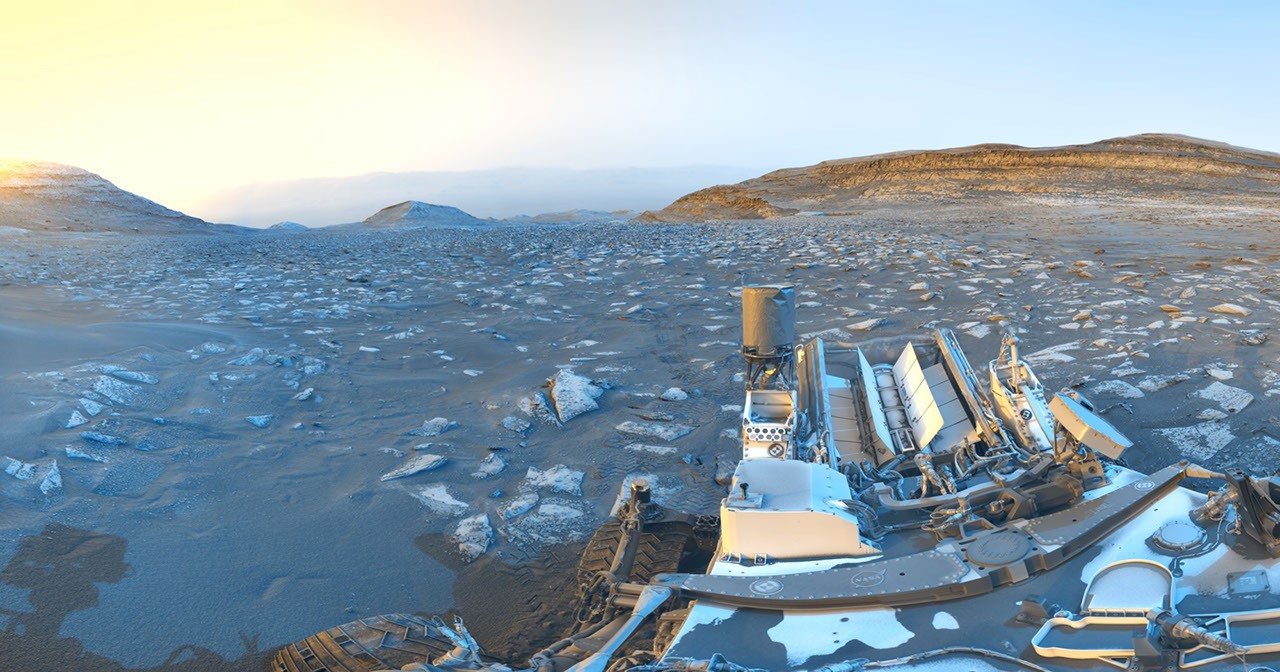
NASA's Curiosity rover has reached a milestone that few instruments ever achieve. On September 2, 2026, the six-wheeled rover completed its 5,000th Martian day, or sol, on the red planet. The rover parked at a location nicknamed "Chocolatal," a sand ridge in Gale Crater, and celebrated by capturing panoramic images using its black-and-white navigation cameras at different times of day.
The first panorama came on August 30, 2026, at 9:56 a.m. local Mars time. The second followed on September 2 at 5:39 p.m. local Mars time. These dual perspectives create what NASA calls a "postcard" from Mars, a visual record of the landscape as seen from Curiosity's vantage point after nearly 14 years of continuous surface operations.
Launched on November 26, 2011, Curiosity touched down in Gale Crater on August 5, 2012. Its primary mission was designed for two years. The rover has now operated nearly seven times longer than planned, making it one of the most durable planetary exploration assets humanity has deployed. The rover's success stems from robust engineering, careful operational planning by the Jet Propulsion Laboratory, and ongoing power supplied by its radioisotope thermoelectric generator.
Curiosity's scientific mandate remains unchanged after 5,000 sols. The rover investigates Mars' past habitability by studying rock formations, measuring atmospheric composition, and detecting organic compounds. Its 17 cameras and 10 scientific instruments have revealed that Gale Crater once held liquid water and possessed conditions compatible with microbial life. The rover has also tracked seasonal methane variations in Mars' atmosphere and documented fluctuations in atmospheric radiation levels critical for planning human missions.
The rover's longevity reflects both engineering excellence and the austere Martian environment itself. Unlike Earth, Mars experiences minimal bacterial decay, extreme cold, and low atmospheric pressure. These conditions preserve rover components far longer than terrestrial equipment would survive. Dust accumulation on Curiosity's solar panels has been offset by occasional dust-removal events tied to seasonal wind patterns. The radioisotope power source provides steady energy independent of sunlight or dust cover.
Reaching 5,000 sols represents a watershed moment in Mars exploration history. Only two rovers have ever exceeded 1,000 sols on Mars. The Soviet Venera landers explored Venus but operated for hours, not years. The American Spirit rover operated for 2,208 sols before a dust storm in 2009 cut its power supply. Opportunity, Spirit's twin, ran for 5,352 sols before losing power in 2018. Curiosity's persistence places it among the most productive scientific instruments ever sent beyond Earth.
The rover continues its climb up Mount Sharp, the central peak of Gale Crater, investigating younger geological layers for signs of changing environmental conditions. Each sol logged extends humanity's understanding of Mars' climate history and the search for evidence of ancient life. The postcard from Chocolatal stands as testament to years of successful rover operations and the robust science still flowing from this aging but capable explorer.