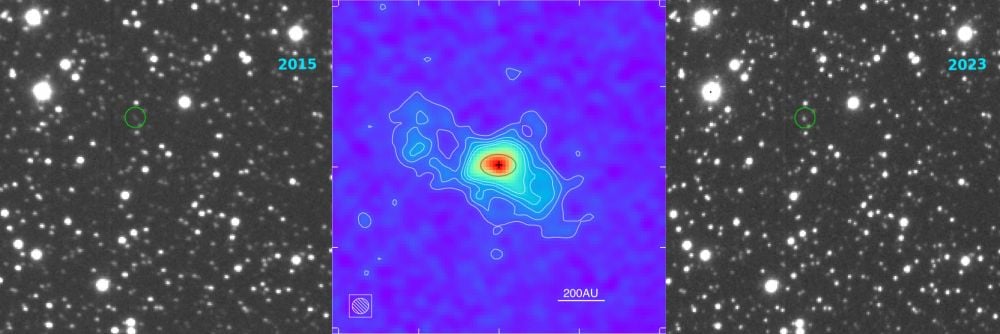
Sakurai's Object, a white dwarf star located roughly 16,000 light-years away, has undergone a resurrection that defies stellar death itself. Over the past three decades, the star brightened sixfold, a transformation captured in real time by astronomers tracking one of the most violent and rare processes in stellar evolution.
The discovery began with an amateur astronomer noticing the star's unexpected increase in luminosity thirty years ago. New research now confirms the mechanism behind this resurrection. Sakurai's Object experienced what astrophysicists call a Very Late Thermal Pulse, a thermonuclear detonation in the star's outer layers that reignites fusion long after the star should have died.
White dwarfs represent the dense, Earth-sized remnants left behind when stars like our Sun exhaust their fuel and shed their outer atmospheres. They cool slowly over billions of years, becoming colder and dimmer until they fade into black dwarfs. Sakurai's Object had already completed this process. It had already become a white dwarf. Then physics intervened.
A Very Late Thermal Pulse occurs when a shell of helium near the star's surface suddenly ignites under extreme pressure and temperature. This flash reignites hydrogen fusion in the outer layers, creating a temporary but dramatic energy surge. The result reverses stellar evolution itself. Sakurai's Object transitioned from white dwarf back into a Wolf-Rayet star, a rare, ultra-hot star type characterized by intense stellar winds that blow material away at thousands of kilometers per second.
Observations from the Atacama Large Millimeter Array, or ALMA, captured the expanding shell of ejected material generated by this pulse. The data revealed an asymmetric outflow of gas and dust expanding away from the star's surface. This expanding shell serves as direct evidence of the pulse's power and the dramatic redistribution of the star's outer layers.
The rarity of observing such events in real time cannot be overstated. Very Late Thermal Pulses occur unpredictably in an extremely small fraction of white dwarfs. Most of stellar evolution unfolds on timescales of millions or billions of years, invisible to human observers. Sakurai's Object presents a laboratory for studying core processes in stellar physics on a human lifetime. The thirty-year baseline of observations captures evolutionary changes that would normally require geological epochs to witness.
This resurrection also tests theoretical models of stellar structure and evolution. Physicists have long predicted Very Late Thermal Pulses should exist, based on the physics of degenerate matter and thermonuclear reactions. Sakurai's Object provides the observational confirmation. The star's behavior validates decades of computational models.
The ongoing transformation continues. Sakurai's Object remains unstable, with its brightness continuing to fluctuate. Future observations will track whether the star stabilizes as a Wolf-Rayet star or enters another phase of evolution entirely. The star's trajectory over the coming years will refine our understanding of the final acts of stellar death and rebirth.
This "born again" star demonstrates that stellar death rarely follows a simple path. Even after becoming a white dwarf, a star can be reanimated by physics written into matter itself.