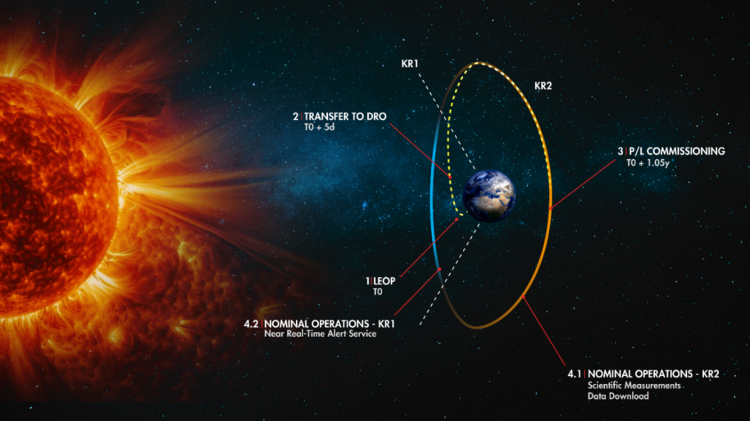
A tiny satellite orbiting the Moon is revolutionizing how Earth prepares for solar storms. The HENON CubeSat, operating from a distant retrograde orbit around the Moon, extends advance warning time for hazardous space weather events by a factor of ten compared to current methods.
HENON, built by the European Space Agency and Italian company Argotec, carries a magnetometer instrument that detects the magnetic signatures of approaching solar wind disturbances. By positioning itself roughly 60,000 kilometers from Earth on the opposite side of our planet's lunar orbit, the 27-liter satellite gains a critical vantage point. It observes incoming solar material before it reaches Earth's magnetic field, providing hours of additional warning instead of the mere minutes available from satellites stationed at the inner Lagrange point L1.
Space weather poses genuine threats to modern infrastructure. Solar flares and coronal mass ejections hurl billions of tons of plasma across the solar system at speeds exceeding 1,000 kilometers per second. When these events strike Earth's magnetosphere, they trigger geomagnetic storms that disable satellites, degrade GPS signals, disrupt power grids, and interfere with high-frequency communications used in aviation and finance. The 1859 Carrington Event, a solar superstorm in the pre-industrial age, caused spectacular auroras visible at the equator. If such an event struck today, economic losses would reach trillions of dollars.
Current space weather forecasting relies primarily on the DSCOVR satellite, positioned at the L1 point about 1.5 million kilometers from Earth. DSCOVR carries the Advanced Composition Explorer and the Magnetometer instrument, detecting approaching disturbances roughly 15 to 60 minutes before impact. That window allows power companies to stabilize grids and operators to safeguard sensitive electronics, but the margin remains razor-thin for complex protective procedures.
HENON's distant retrograde orbit solves this timing problem. By stationing the instrument where solar wind perturbations arrive first, forecast teams gain eight to ten hours of advance notice. This extended window permits utilities to implement comprehensive protective protocols, airlines to reroute flights away from polar regions where radiation exposure intensifies, and satellite operators to power down sensitive equipment or adjust orbital parameters.
The magnetometer aboard HENON detects fluctuations in the interplanetary magnetic field that precede the arrival of coronal mass ejections. The Moon's position serves as nature's ideal early-warning platform. Unlike L1, which sits directly between the Sun and Earth, the distant retrograde orbit allows the satellite to observe approaching solar wind structures while Earth remains shielded by the lunar body itself.
HENON represents a shift in space weather infrastructure strategy. Rather than relying solely on sun-facing satellites, space agencies now deploy distributed networks of observation platforms. The ESA's Advanced Composition Explorer, NASA's SOHO spacecraft, and upcoming missions including the ESA's Vigil satellite will operate at different vantage points, creating redundancy and extending warning times further.
The 10-fold increase in solar storm prediction time transforms how civilization protects itself from the Sun's violent outbursts. Infrastructure operators transition from reactive emergency response to proactive asset protection. The tiny CubeSat orbiting the Moon demonstrates that strategic positioning, not size, determines capability in space weather forecasting.