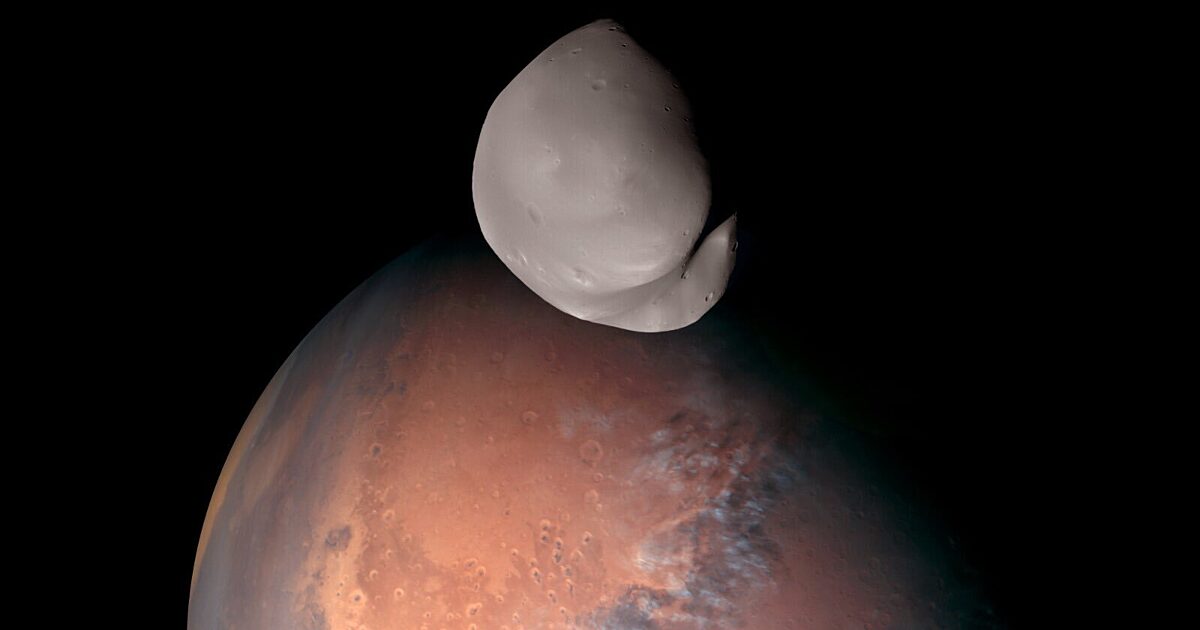
# The Martian Moons: Ancient Relics Hold Secrets to Solar System History
Mars orbits with two small companions that have puzzled astronomers for centuries. Phobos and Deimos, named after the ancient Greek gods of fear and panic, represent some of the most unusual celestial bodies in our solar system. Unlike Earth's Moon or Jupiter's large Galilean satellites, these Martian moons are small, irregularly shaped, and geologically primitive. Yet scientists believe they hold answers to fundamental questions about how our planetary system formed.
Phobos, the larger moon, measures just 22 kilometers across at its widest point. It orbits Mars every 7.6 hours, closer to the planet than any other moon in the solar system. This proximity creates intense gravitational stress. Mars stretches and compresses Phobos constantly, heating its interior through tidal friction. Over millions of years, this process will tear Phobos apart. Eventually, Phobos will either collide with Mars or fragment into a ring system around the planet.
Deimos orbits much farther out. It takes 30 hours to complete one revolution around Mars and measures only 12 kilometers across. Unlike Phobos, Deimos appears stable for the foreseeable future, though it will eventually drift beyond Mars' gravitational influence and escape into the solar system.
Their origins remain contested. One theory proposes that both moons are captured asteroids. This hypothesis explains their irregular shapes and compositions, which differ from the Martian surface. Another model suggests they formed from material ejected when a massive impact struck early Mars, similar to the giant impact theory that explains Earth's Moon formation. Recent spectroscopic data hints that Phobos' composition differs from typical asteroid material, complicating the capture scenario.
These mysteries matter because Phobos and Deimos preserve pristine records of the early solar system. Unlike planets, which have undergone geological processing and internal differentiation, these small bodies retain primitive compositions. Chemical and mineralogical analysis of their surfaces could reveal the conditions and composition of the solar nebula, the disk of gas and dust from which all planets formed.
NASA's Mars Reconnaissance Orbiter and India's Mangalyaan spacecraft have gathered detailed imagery of both moons, but direct sampling remains elusive. The Japanese space agency JAXA plans to send the Martian Moons eXploration mission, or MMX, to collect samples from Phobos and return them to Earth. This mission, scheduled for 2026 launch and sample return around 2031, represents humanity's first attempt to retrieve material from a Martian moon.
The MMX sample return will revolutionize planetary science. Laboratory analysis of unaltered Phobos material will enable isotopic dating, detailed mineralogy, and organic compound detection impossible from orbital instruments. These results will either confirm the asteroid-capture theory or force scientists to develop new formation models for Martian moons.
Understanding Phobos and Deimos also matters for human exploration. Both moons could serve as waypoints for crewed Mars missions, offering lower gravity environments for fuel depots or scientific stations. Their composition affects whether they contain water ice or other resources exploitable for life support.
The two small moons of Mars represent accessible laboratories for unraveling Solar System history. Their exploration bridges planetary geology, orbital mechanics, and the hunt for humanity's next frontier.