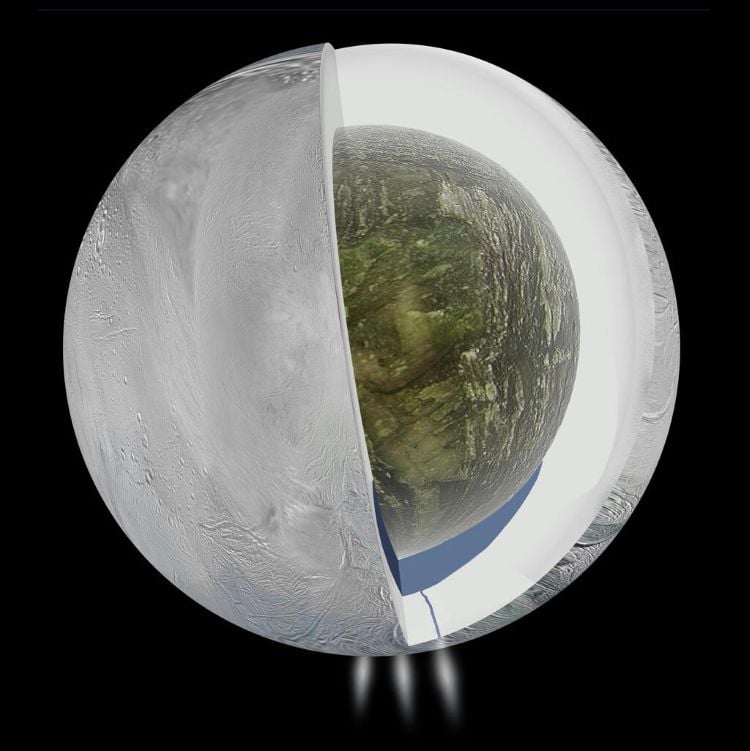
Icy moons orbiting Jupiter and Saturn hold some of the solar system's most tantalizing secrets: vast subsurface oceans that could harbor microbial life. Europa, Ganymede, and Enceladus represent humanity's best bets for finding extraterrestrial organisms beyond Earth. Yet a new analysis reveals a harsh thermal reality that constrains where these life-supporting oceans can form and persist across the solar system.
A research team studying the thermal evolution of icy bodies has determined that impact events, particularly collisions that crack and fracture icy crusts, trigger rapid cooling processes that prevent or destroy subsurface oceans. The work centers on a fundamental problem in planetary science: how do moons retain liquid water beneath frozen exteriors for billions of years?
The answer hinges on internal heat. Tidal heating, generated by gravitational friction as moons orbit their parent planets, provides the energy that melts ice from below. This same mechanism warms Europa as Jupiter pulls and stretches the moon, and it heats Enceladus as Saturn's gravity kneads the satellite. Without this continuous energy source, subsurface oceans would freeze solid within millions of years.
Impact cratering disrupts this delicate thermal balance. When asteroids or cometary bodies collide with icy moons, the fracturing of the crust exposes warmer interior material to the cold vacuum of space. This sudden exposure accelerates heat loss through the newly fractured regions, cooling the interior far faster than the tidal heating can compensate. The result: oceans that would otherwise remain liquid become prone to freezing.
This research carries direct implications for Europa Clipper and JUICE, the Jupiter Icy Moons Orbiter mission managed by the European Space Agency. Both spacecraft are designed to investigate whether subsurface oceans remain active today and whether they contain the chemical ingredients necessary for life. The thermal modeling suggests that heavily cratered moons in the outer solar system may have lost their oceans billions of years ago, while younger or less heavily impacted bodies retained theirs.
The findings reshape expectations for where to search for life. Enceladus, despite its smaller size, retains a robust subsurface ocean. Researchers hypothesize that younger geological activity or a lower impact rate has allowed tidal heating to overcome radiative cooling. Europa's ocean persists beneath an icy shell that appears relatively young in geological terms, suggesting that impact events have not yet stripped away enough of the moon's internal heat.
Saturn's moon Titan, with its methane lakes and complex organic chemistry, presents a different puzzle. While Titan likely hosts a subsurface water ocean, its thick nitrogen atmosphere and cryogenic surface temperatures create conditions fundamentally distinct from the rocky-core moons.
Understanding impact-driven thermal loss matters for the next generation of ocean world exploration. NASA and ESA are planning additional missions to Europa and Enceladus throughout the 2030s and 2040s. If subsurface oceans exist today, liquid water samples or chemical signatures in plumes could provide direct evidence of life. This research narrows the search space: focus on moons young enough, or protected enough, to have survived the battering that characterized the early solar system.