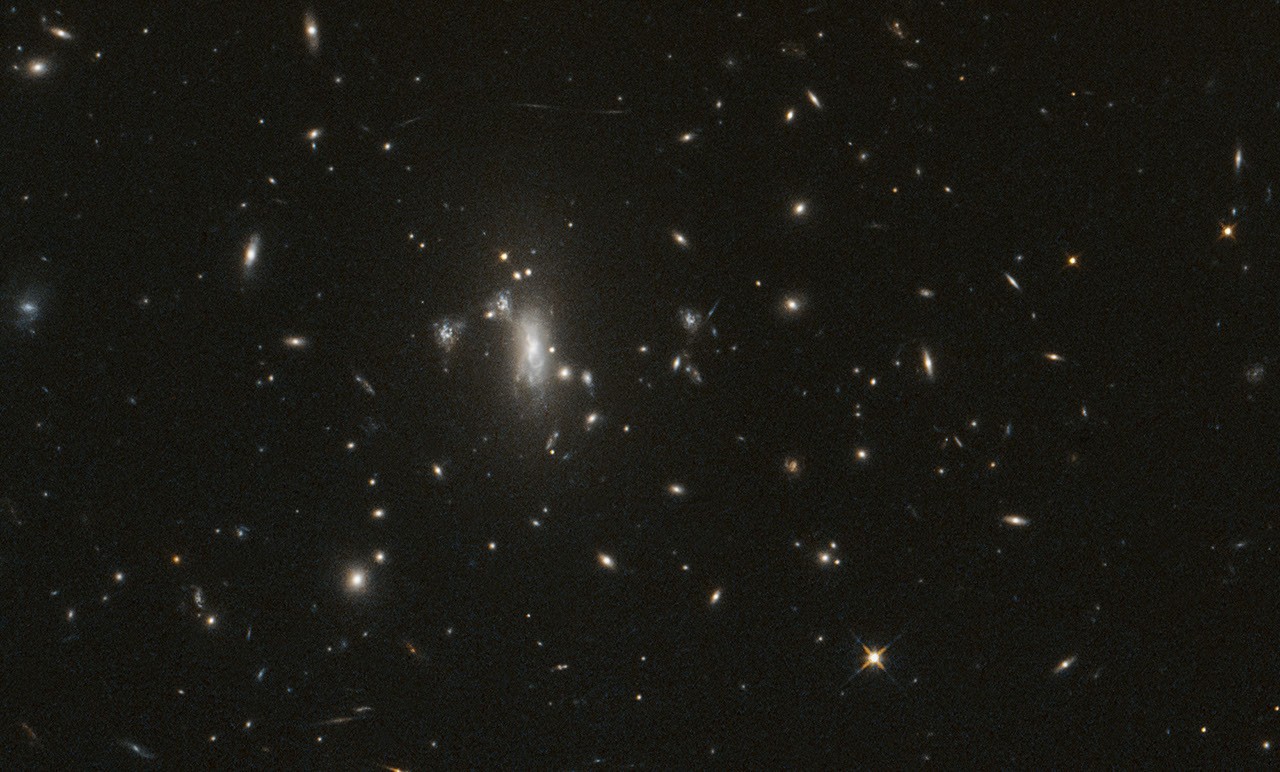
NASA's Hubble Space Telescope reached a historic landmark on September 19, completing its 200,000th orbit around Earth. The aging observatory, now in its 36th year of operations, has traveled over 5 billion miles in its elliptical path since launch in 1990. That same day, Hubble's instruments captured data on a gravitationally lensed supernova, the type of observation that demonstrates why this mission continues to deliver discoveries despite its age and technical challenges.
The milestone comes as Hubble records its 1.7 millionth observation of the cosmos. These observations have reshaped astronomy and cosmology repeatedly. Hubble's measurements of distant supernovae led to the 1998 Nobel Prize-winning discovery that the universe's expansion accelerates, driven by dark energy. The telescope's observations of galaxy evolution, star formation in nebulae, and the chemical composition of exoplanet atmospheres remain unmatched in precision.
The supernova observation Hubble made on orbit 200,000 exemplifies the telescope's unique capability. Gravity lenses occur when massive galaxy clusters bend light from distant objects, magnifying them and sometimes splitting them into multiple images. A lensed supernova appears as multiple images arriving at Earth at different times because light travels different path lengths through the warped spacetime around the massive lens. By observing these time delays, astronomers measure the universe's expansion rate independently. This technique operates as a cosmic yardstick that complements other methods like the James Webb Space Telescope's observations of distant galaxies.
Hubble's longevity defies expectations. Engineers designed the mission for 15 years. Five servicing missions by Space Shuttle astronauts upgraded its instruments and replaced failed components, extending its life. After the final servicing mission in 2009, no further repairs have been possible. The spacecraft now operates with remaining gyroscopes degrading and some scientific instruments aging. NASA engineers implemented new operational modes to compensate, allowing Hubble to continue observations with reduced capability but unchanged scientific ambition.
The telescope orbits at 380 miles altitude within Earth's upper atmosphere, where thin air slowly drags the spacecraft downward. Eventually, in perhaps the 2030s, Hubble will reenter Earth's atmosphere and burn up. Before that endpoint arrives, the James Webb Space Telescope, launched in 2021, now shares observational duties. Webb operates at the L2 point, 930,000 miles from Earth, and observes primarily in infrared wavelengths. Hubble's strength in ultraviolet and visible light remains essential for many science programs.
Hubble's 200,000 orbits represent continuous operation through changing administrations, evolving technology, and unexpected challenges. The observatory has survived failures that could have ended its mission, including a spherical aberration in its primary mirror that nearly crippled it in 1993 before astronauts installed corrective optics. It operated through the Space Shuttle Columbia disaster in 2003, which suspended servicing missions for years. Each obstacle prompted innovation from NASA engineers and mission teams.
The observation of a gravitationally lensed supernova on this milestone orbit carries symbolic weight. Such observations require the precise targeting and stable pointing that Hubble has maintained across decades. As the telescope approaches the end of its operational life, these observations continue feeding the research that justifies its existence and inspires next-generation astronomy missions.