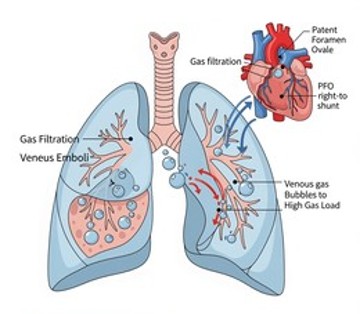
NASA assembled a specialized working group in August 2026 to investigate three interconnected health threats facing astronauts on deep-space missions. The Office of the Chief Health and Medical Officer convened the group to examine decompression sickness, venous thromboembolism, and the role of a common heart condition in spaceflight medical risk.
The focus reflects growing urgency as NASA prepares for sustained lunar operations and eventual Mars missions under the Artemis program. Each hazard presents distinct challenges in the microgravity environment of space.
Decompression sickness occurs when nitrogen bubbles form in the bloodstream after pressure changes. During extravehicular activity, astronauts transition from the pressurized cabin environment to the suit's lower pressure. Current prebreathe protocols attempt to purge nitrogen from the body before EVA, but the working group examined whether existing testing procedures adequately predict which astronauts face elevated DCS risk. The condition can cause joint pain, paralysis, or death if severe.
Venous thromboembolism represents a different but equally serious threat. Blood clots form in veins during spaceflight, potentially breaking free and lodging in the lungs. Microgravity reduces fluid movement, blood vessel tone weakens, and immobility during missions increase clot formation risk. The working group reviewed documented in-flight VTE cases and assessed whether current countermeasures prove sufficient for longer duration missions.
The third element involves patent foramen ovale, a hole between heart chambers present at birth in roughly one in four people. The condition typically remains asymptomatic on Earth. In space, however, a PFO creates a pathway for nitrogen bubbles from decompression sickness to bypass the lungs and enter the arterial circulation, potentially causing stroke or other neurological damage. This mechanism transforms PFO from an incidental finding into a spaceflight-relevant medical risk factor.
The working group's charge integrates findings from previous NASA medical reviews. Earlier investigations established protocols for EVA preparation and documented VTE cases in astronauts. This 2026 convening synthesized that knowledge while examining whether current screening and risk-mitigation strategies account for the PFO factor in astronaut populations.
The implications extend across Artemis planning. NASA must decide whether astronauts with PFO require restricted flight assignments, modified prebreathe procedures, enhanced in-flight monitoring, or pharmaceutical interventions. These decisions affect crew selection and mission design for lunar surface operations where EVA becomes routine rather than exceptional.
The working group's recommendations will shape medical certification standards for future astronauts. Additional diagnostic testing for PFO may enter the astronaut medical evaluation process. New prebreathe protocols might account for individual cardiac anatomy. In-flight monitoring equipment could detect early VTE signs, enabling treatment before clots reach critical locations.
Long-duration spaceflight in the Artemis era demands this level of medical specificity. Lunar missions require multiple EVAs over weeks on the surface. Mars missions demand months of transit and surface operations where medical evacuation becomes impossible. Astronauts with marginal risk profiles acceptable for brief International Space Station visits become liabilities on deep-space missions where crew autonomy and health resilience matter absolutely.
The working group's analysis represents NASA's commitment to evidence-based medicine for exploration. Data trumps assumption. The agency compiles observed medical events, applies physiological knowledge, and adjusts protocols accordingly. This approach protects astronauts while enabling the sustained human presence beyond Earth that exploration demands.