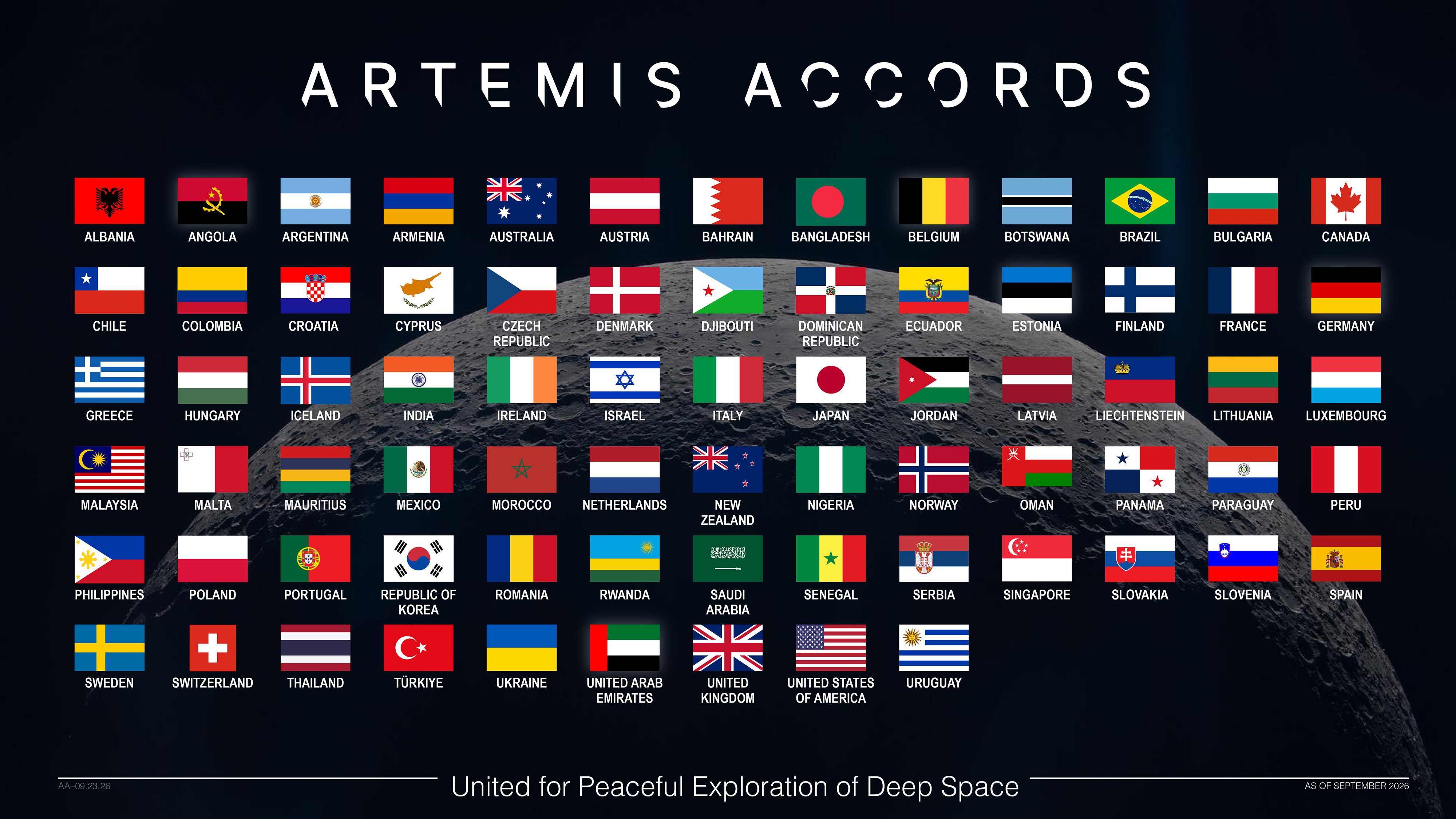
The Republic of Croatia formally joined the Artemis Accords framework on Wednesday, becoming the 74th nation to commit to a set of principles governing peaceful space exploration and resource use on the Moon and beyond. NASA Deputy Administrator Matt Anderson presided over the signing ceremony in Zagreb alongside U.S. Department of State representatives.
The Artemis Accords establish guidelines for sustainable lunar exploration and establish norms for space conduct modeled on the 1967 Outer Space Treaty. Signatories agree to several commitments: conducting space activities for peaceful purposes, establishing safety zones around landing sites to prevent harmful interference, and sharing scientific discoveries openly with the international community. The framework does not require nations to participate in NASA's Artemis program directly, but rather reflects shared values about responsible space exploration.
Croatia's accession reflects growing international alignment behind a U.S.-led vision for lunar exploration as NASA accelerates its timeline to return humans to the Moon through the Artemis program. The Croatian government joins fellow European Union members and NATO allies who have already signed, strengthening NATO's collective position on space governance. This expanded coalition demonstrates that space exploration principles can transcend geopolitical divisions and unite nations around exploration objectives.
The Artemis Accords program launched in 2020 with eight founding signatories. Since then, nations from every inhabited continent have joined, ranging from Australia and Japan in the Asia-Pacific region to European countries like Italy, France, and Poland. Brazil and South Korea represent signatories from other major regions. This geographic distribution underscores that Artemis represents a global commitment rather than a narrow alliance arrangement.
The accords address practical operational concerns. Nations agree to respect safety zones established around landing sites, preventing interference with equipment and scientific activities. They commit to responsible resource extraction, ensuring that activities comply with international law and do not cause harmful environmental change. Signatories also pledge to render emergency assistance to space explorers in distress, codifying humanitarian principles in extraterrestrial contexts.
For Croatia specifically, the accession signals alignment with Western space policy and creates pathways for potential participation in collaborative scientific missions. Though not a spacefaring nation with independent launch capability, Croatia gains access to a framework enabling participation in international space activities and research partnerships. The country's addition to the signatory roster strengthens European representation as the European Space Agency coordinates with NASA on deep space exploration objectives.
The Artemis program itself targets landing humans on the Moon's south polar region by the mid-2020s, focusing on establishing sustainable exploration infrastructure. Multiple Artemis missions will precede crewed landings, including unmanned lunar orbit tests and lander demonstrations. International cooperation through the Accords structure supports these objectives by establishing transparent rules for site selection, resource use, and data sharing.
As private companies increasingly participate in lunar activities through NASA contracts and international ventures, the Accords provide a governance framework addressing questions about commercial mining, property rights, and environmental preservation. Croatia's signature adds another voice to this evolving international consensus on space conduct as humanity prepares for expanded lunar presence.