# Swiss Engineers Develop Advanced Shock Isolation System for Spacecraft Payloads
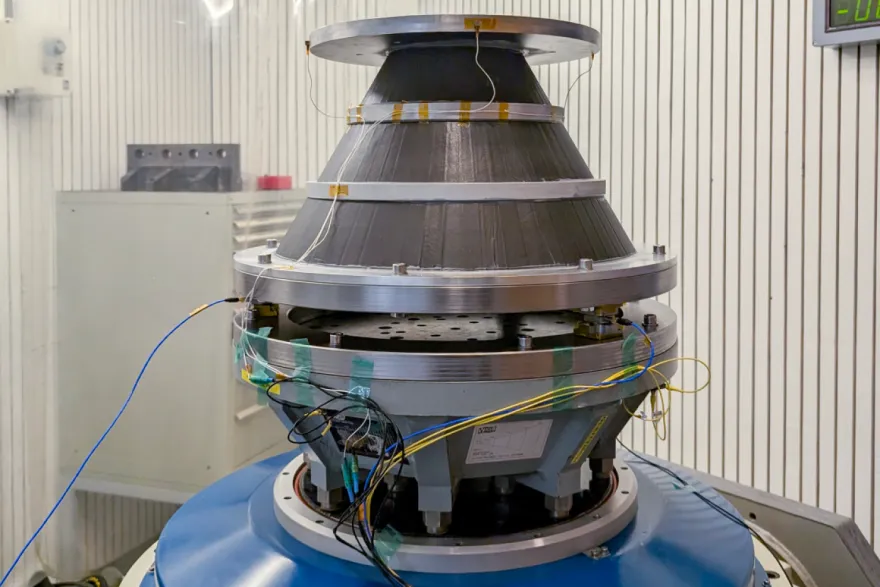
Engineers at Swiss research institutions have created an improved vibration isolation system designed to protect sensitive spacecraft components during the extreme stresses of launch. The new payload adapter shields delicate instruments, optical systems, and electronics from the violent accelerations and vibrations that occur when rockets accelerate to orbital velocity.
Rocket launches subject payloads to forces exceeding 5 g's during ascent, with additional shock loads from stage separations and engine throttling events. These stresses can crack optical coatings on telescope mirrors, fracture solder joints in circuit boards, and damage precision mechanisms before instruments ever reach space. A single launch failure caused by component damage represents a loss measured in hundreds of millions of dollars and years of development effort.
The Swiss team engineered an adapter that decouples the payload from the launch vehicle structure through an advanced isolation system. Rather than rigidly bolting satellites directly to rocket adapter rings, the new design incorporates elastomeric dampers and controlled compliance mechanisms. This approach absorbs shock energy and reduces peak accelerations transmitted to the spacecraft.
The prototype represents a refinement of existing isolation concepts used on some commercial and government missions. Previous systems relied on simple spring-damper combinations, often custom-tuned for individual missions. The Swiss design implements adaptive geometry and optimized material selection to broaden the frequency range of effective isolation. Engineers tested the prototype through simulated launch profiles replicating real acceleration histories and validated performance across multiple payload mass ranges.
The advantage extends beyond protection alone. By reducing structural loads, satellites can use lighter mounting hardware and frames. This mass savings enables either larger scientific instruments or additional fuel for orbital maneuvers and station-keeping. For commercial launch providers like SpaceX, Arianespace, and others, improved isolation systems increase confidence in payload integrity and reduce insurance costs associated with launch damage claims.
Missions expected to benefit include upcoming Earth observation satellites, deep-space probes requiring high-precision optics, and international space station resupply missions carrying sensitive experiments. Space agencies including ESA, NASA, and JAXA already employ isolation systems on high-value missions. European launch providers plan to evaluate the Swiss design for integration into future Ariane 6 and Vega missions.
The research builds on decades of aerospace shock analysis and damping theory. Universities and research centers across Switzerland contributed to computational modeling, testing, and validation. The work demonstrates how incremental engineering improvements compound to enhance mission reliability and reduce risk in space exploration.
Launch environments remain inherently hostile. Every spacecraft must withstand acoustic noise exceeding 140 decibels and random vibrations lasting several minutes. The Swiss contribution to payload protection removes one category of risk, allowing mission teams to focus engineering resources on science objectives rather than structural damage mitigation.