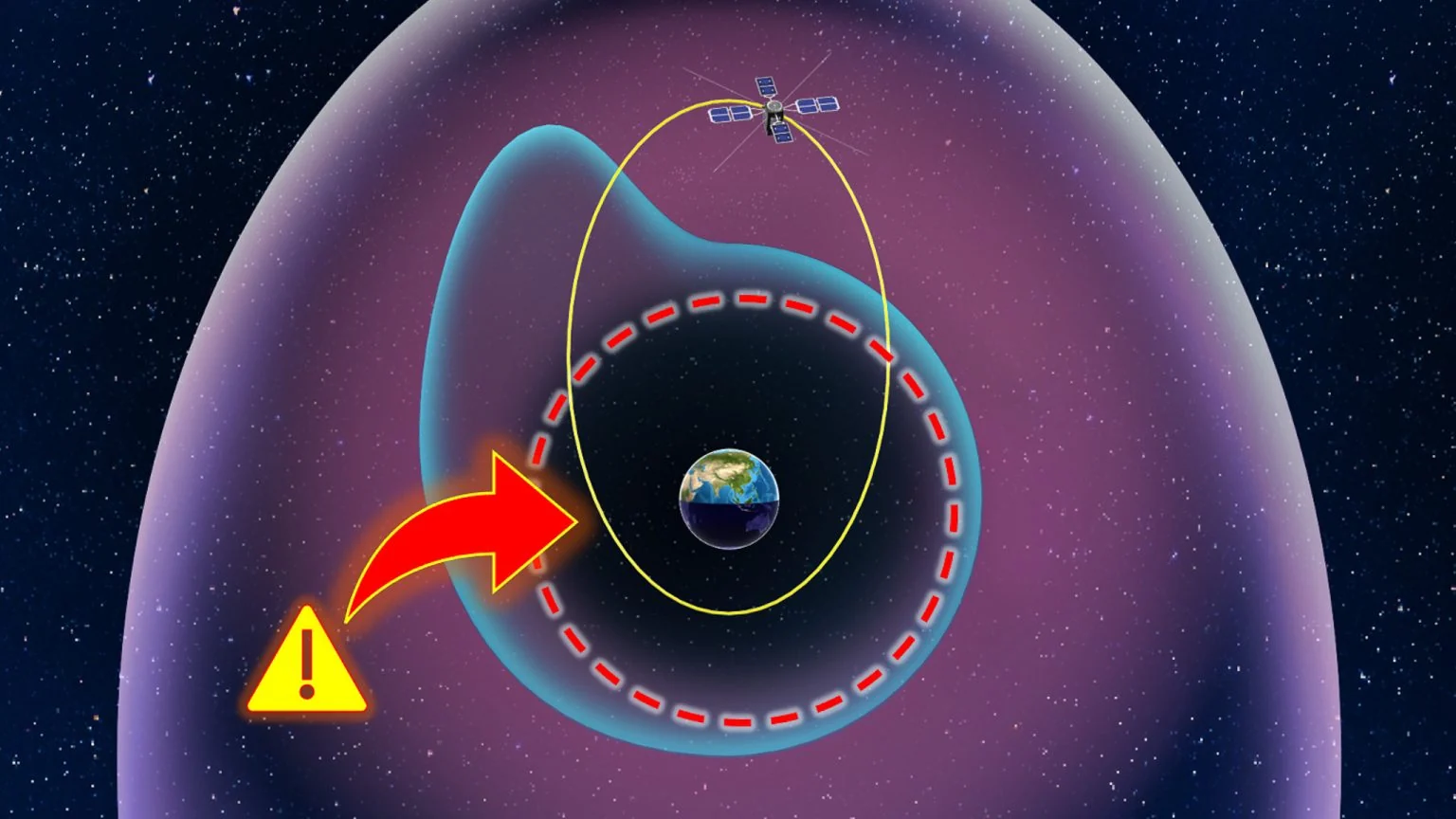
A May 2024 solar storm punched through Earth's radiation shield and accelerated electrons to near-light speeds inside what scientists thought was an impenetrable barrier.
Japan's Arase satellite, operating in Earth's magnetosphere since 2017, detected the breach. During the storm, solar wind gusts reached 1,200 kilometers per second and compressed Earth's magnetic field. The satellite counted ultra-relativistic electrons at levels 5,000 times higher than typical background radiation.
The Van Allen belts, discovered by Explorer 1 in the Space Age, form Earth's primary defense against high-energy particles from the Sun. NASA's Van Allen Probe mission found in 2014 that an ultra-relativistic "killer electrons" barrier existed around 11,500 kilometers above Earth's surface. Electrons moving near the speed of light seemed unable to penetrate deeper.
Until May 2024. Yoshizumi Miyoshi of Nagoya University and co-authors published their findings in Geophysical Research Letters, showing that chorus waves accelerated the electrons locally rather than allowing them to breach from outside.
When the storm hit, Earth's plasmasphere was crushed toward the planet, creating a void. A "negative ionospheric storm" depleted local plasma densities further. These conditions allowed chorus waves, low-frequency electromagnetic waves generated during magnetic storms, to transfer energy efficiently to surrounding electrons. The waves boosted electrons from sub-million electron volt energies to multi-MeV ranges within the normally protected zone.
The resulting radiation spread both toward and away from Earth and persisted for months. Arase continued detecting elevated radiation until another solar storm struck five months later in October 2024.
The discovery reveals a new space weather hazard: localized radiation created not by solar explosions but by the retreat of Earth's protective plasma sheath.