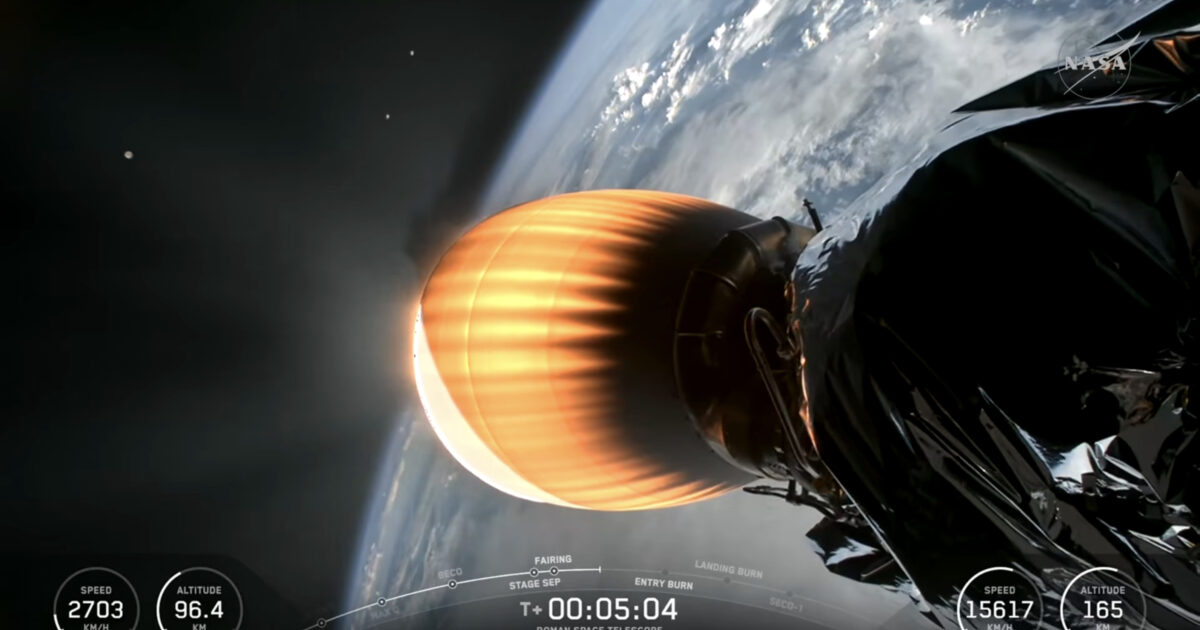
A SpaceX Falcon Heavy rocket launched the Nancy Grace Roman Space Telescope at 7:26 a.m. ET on Sunday, Aug. 30, 2026, from Launch Complex 39A at NASA's Kennedy Space Center. The observatory is headed to Sun-Earth Lagrange Point 2, approximately 1.5 million kilometers from Earth.
Roman is NASA's next flagship orbital observatory. It will discover thousands of exoplanets using transit detection and microlensing methods. Scientists predict the mission will detect between 60,000 and 200,000 candidate planets. Roman will also take direct photographs of planets using an onboard coronagraph at least 100 times more powerful than any existing facility, capable of detecting planets roughly 1 billion times dimmer than their host stars.
The telescope will conduct a survey of over 1 billion galaxies to investigate dark energy and dark matter. These remain mysteries in physics. Dark energy causes the accelerated expansion of the universe. Dark matter's nature remains unknown, though many researchers believe it does not interact with light.
Roman's imaging capabilities will surpass those of the Hubble Space Telescope at certain optical and infrared wavelengths. It will capture 100 times more sky in a single shot and survey the sky 100 to 1,500 times faster than Hubble. The James Webb Space Telescope also orbits near Lagrange Point 2 but operates in different orbits.
After approximately 90 days of commissioning, Roman will begin science operations in early 2027. Its primary mission is scheduled to last five years, though it could operate for more than twice that duration.
The telescope is named after Nancy Grace Roman, NASA's first chief of astronomy who advocated for the development of the Large Space Telescope in the 1970s, which became the Hubble Space Telescope. Roman is the first NASA space telescope named after a woman.