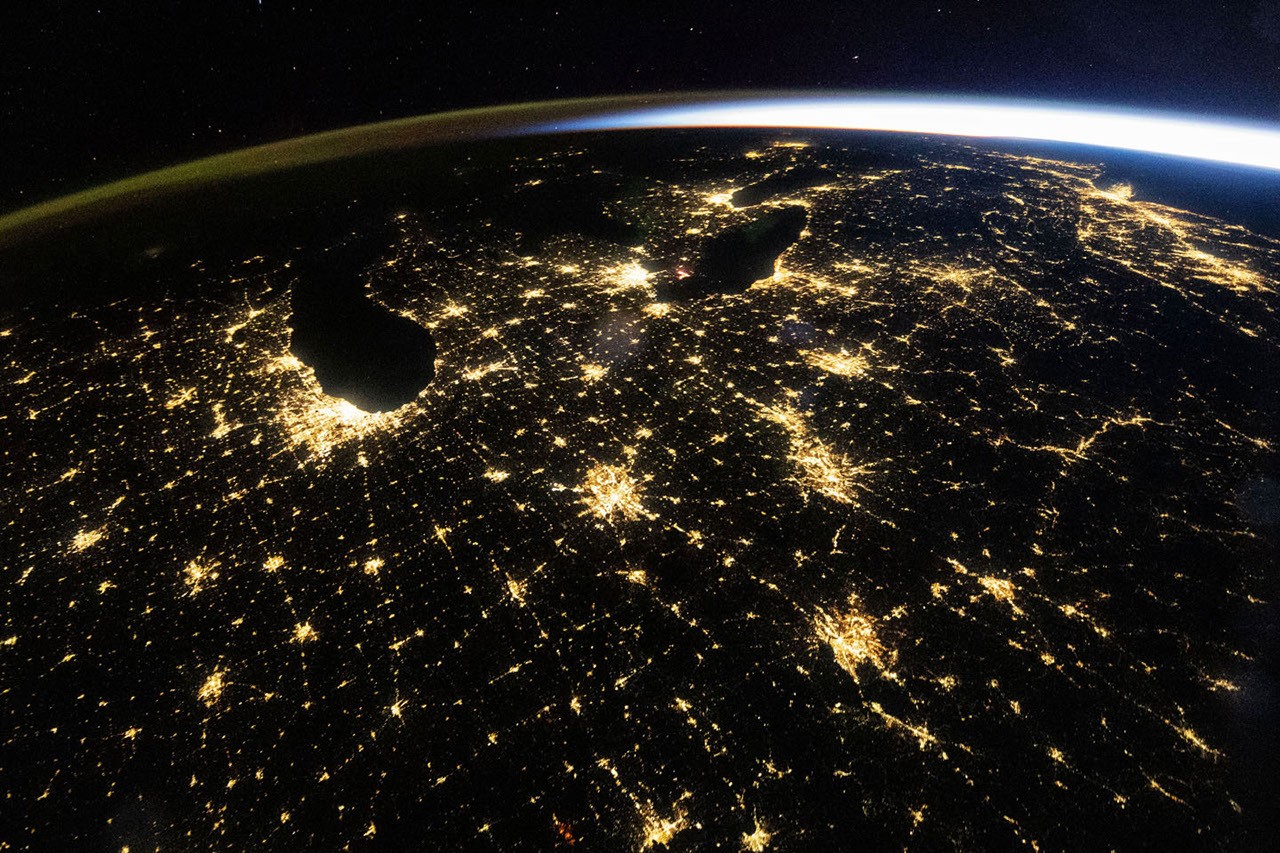
An astronaut aboard the International Space Station captured a wide-angle photograph of the eastern United States on October 18, 2026, at 4:54 a.m. Central Daylight Time. Clear skies revealed illuminated cities across the darkened landscape, with Chicago, Illinois and Detroit, Michigan standing out as the brightest features. Mid-sized cities including Indianapolis, Indiana, Cincinnati, Ohio, and Louisville, Kentucky also glowed brightly along state and interstate highways.
Above the nighttime lights, a band of green and orange airglow was visible along the horizon to the left. Airglow forms when sunlight strikes atoms and molecules in the upper atmosphere, causing them to emit photons. To the right, sunlight arced across the horizon, with sunrise about an hour away on the East Coast and two hours away in Chicago.
The photograph, ISS075-E-226709, was acquired with a Nikon Z9 digital camera using a 14-millimeter focal length. The Expedition 75 crew member took the image, which was provided by the ISS Crew Earth Observations Facility and the Earth Science and Remote Sensing Unit at NASA Johnson Space Center.
Astronaut photographs of nighttime lights serve scientific purposes in tracking changes to the built environment. Chicago's lightscape appears pale yellow in wide-angle views, but detailed photographs reveal different colors from different types of lighting. NASA's Black Marble nighttime lights product suite uses satellite observations to produce science-quality records of nighttime lights globally. Scientists have used these data to track power outages and restoration following major storms, lighting changes from new infrastructure, and transitions to LED lighting in the eastern United States.