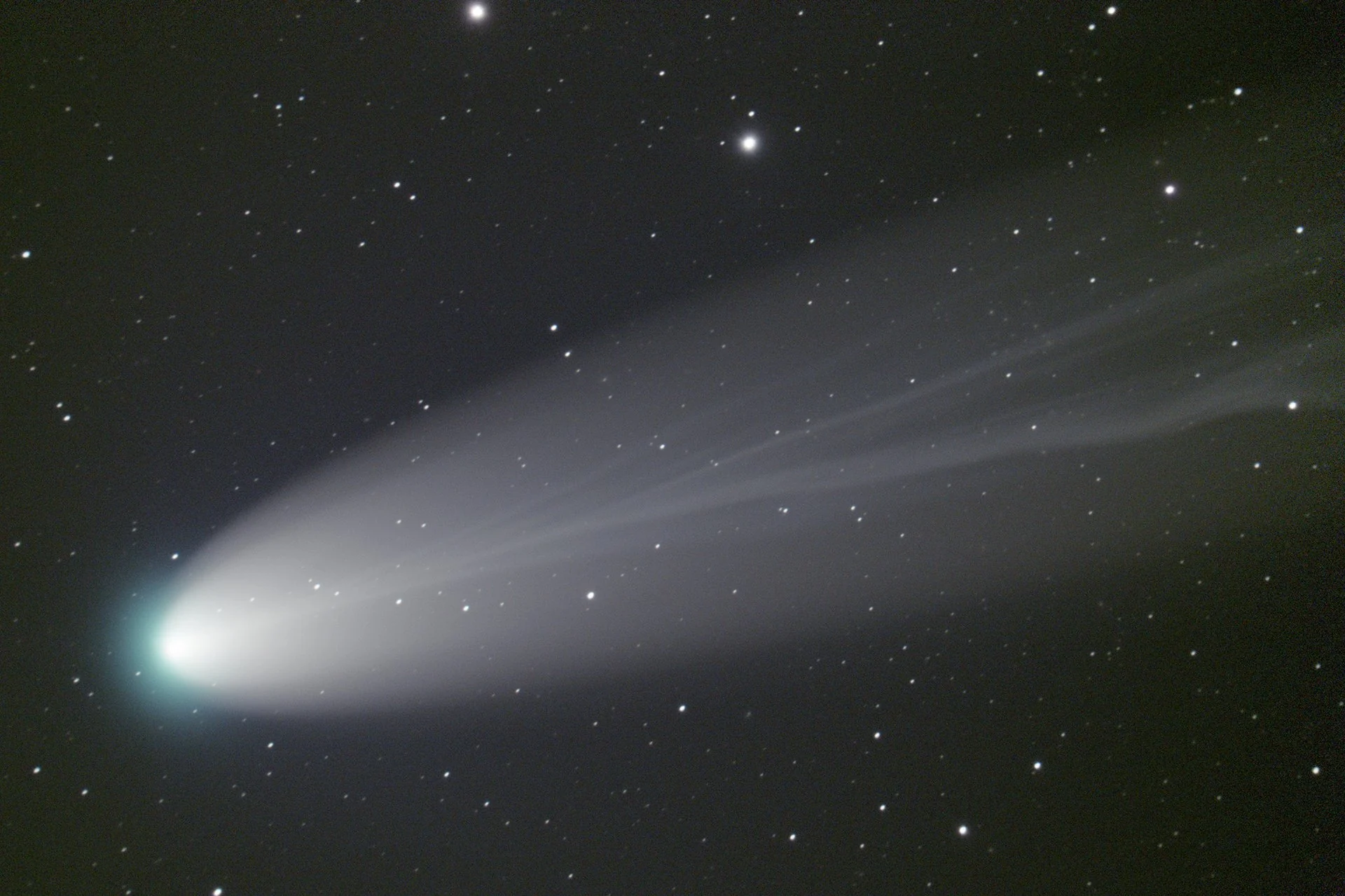
Richard Muller, professor emeritus of physics at UC Berkeley, proposes that a low-mass red dwarf star called Nemesis orbits our Sun around a common center of gravity. According to Muller, Nemesis periodically perturbs billions of comets in the Oort Cloud, sending them toward the inner solar system in episodes lasting roughly a million years.
Muller links this hypothesis to a 26-million-year periodicity in marine extinctions documented by paleontologists David Raup and Jack Sepkoski in a 1982 Science paper. One extinction peak occurred 66 million years ago at the K-T boundary, which killed the dinosaurs.
"Maybe there's a companion star that comes close in to the Oort Cloud every 26 million years, and then triggers a comet hitting Earth," Muller said.
Nemesis has not been directly detected. Muller explains that because the star orbits with our Sun around their common center of gravity, it shows insufficient proper motion to be observable. He estimates it must be at least five percent the mass of the Sun to perturb the Oort Cloud. As an eighth or ninth magnitude star likely positioned near the ecliptic plane, Nemesis would be lost among countless other stars in the sky.
"Despite what others seem to think, there is no clear evidence against this hypothesis," Muller states.
The Rubin Observatory, now coming online, may detect more long-period Oort Cloud comets and help characterize the cloud further. Muller notes the next potential comet shower capable of causing serious Earth damage should not arrive for another 12 to 15 million years.