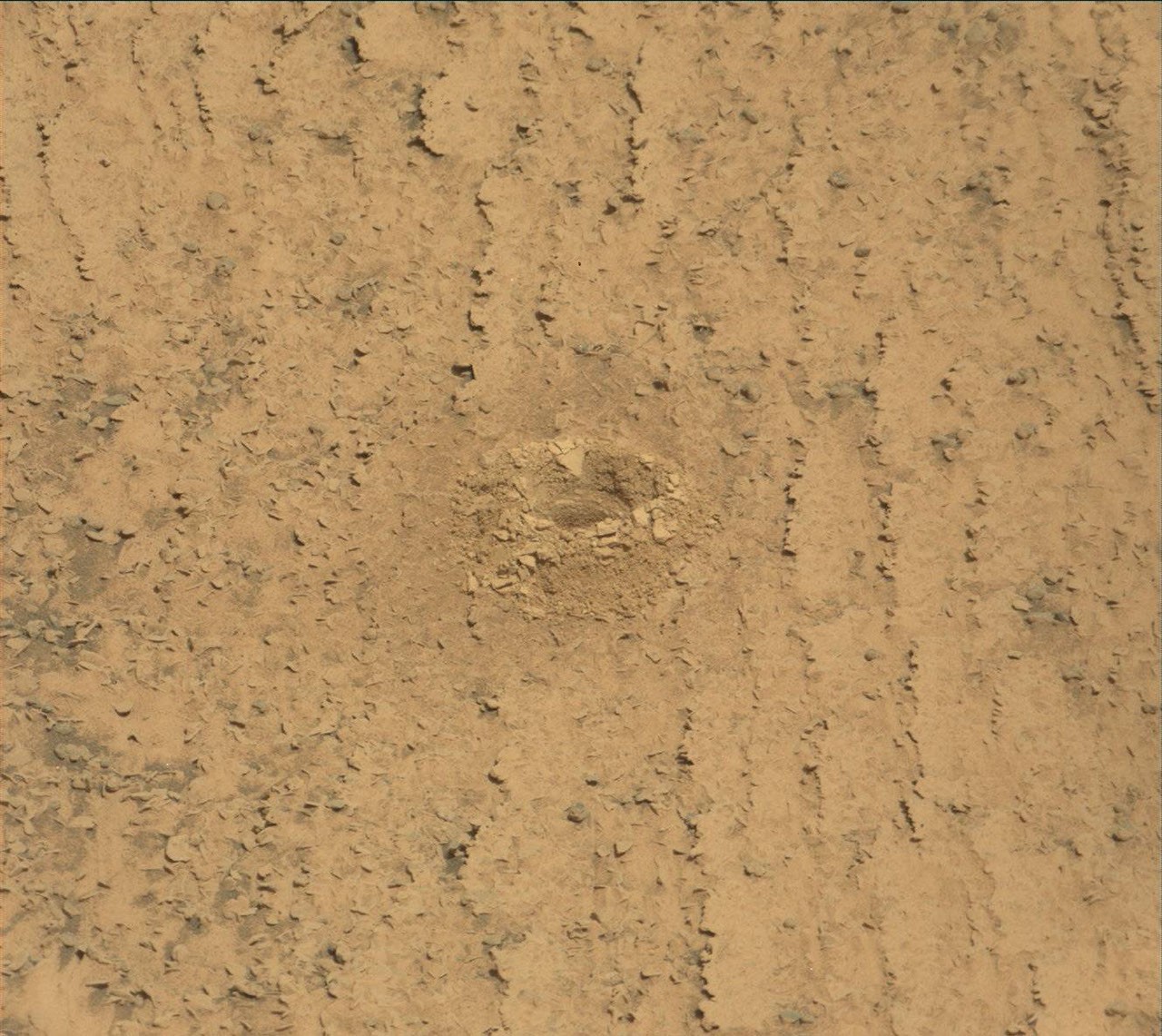
NASA's Curiosity rover completed its 49th drill hole on Mars during sols 5050-5055, targeting a rock formation called Nazca. The drill site was selected because it contains abundant disc-shaped inclusions that the team interprets as potential crystals, which could serve as indicators of past environmental conditions on Mars.
Before drilling, Curiosity passed stability tests for both rover placement and rock integrity. The rover's Alpha Particle X-Ray Spectrometer (APXS), Mastcam Hand-Lens Imager (MAHLI), and ChemCam instruments investigated the Nazca target. After drilling, the sample was delivered to CheMin for analysis, with results expected to arrive on Earth over the following weekend.
ChemCam conducted additional observations during the week. It obtained passive spectral data and Laser-Induced Breakdown Spectroscopy (LIBS) measurements of drill tailings and the drill hole wall. The instrument also analyzed dark pebbles, including targets named Palpala and Puna, to understand their composition and origin. ChemCam performed depth profile LIBS measurements on a target called Llama and observed the disc-shaped forms again at a target named Pacaya. Long-distance Remote Micro-Imager observations focused on two buttes, Mishe Mokwa and Cordillera, to study their sedimentary structures.