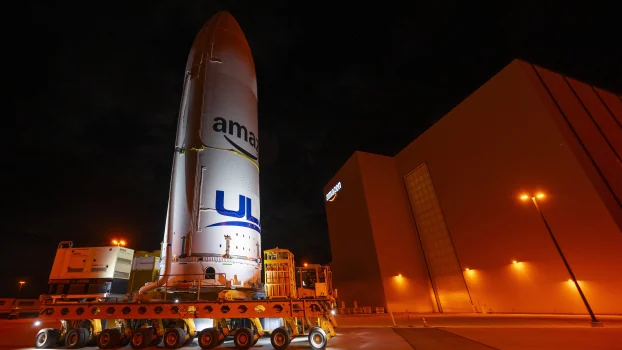
United Launch Alliance's Vulcan rocket returns to flight on Friday, Nov. 13, after eight months grounded by nozzle problems with its GEM-63XL solid rocket boosters. The Vulcan VC6L will launch Amazon Leo LV-01 from Space Launch Complex 41 at Cape Canaveral Space Force Station in Florida at 12:54 PM EST, carrying 40 Amazon Leo broadband satellites to low-Earth orbit. Launch weather is 90% favorable.
This is the first of up to 38 Vulcan flights booked by Amazon to build its broadband constellation, a competitor to Starlink. The 65-meter rocket generates 17.2 meganewtons of thrust using six GEM-63XLs and two Blue Origin BE-4 engines running liquid oxygen and methane. It will deploy the satellites across 21 separate events over about 25 minutes and 40 seconds into a 450-kilometer circular orbit inclined 51.9 degrees.
Once deployed, the Amazon Leo constellation will hold 432 satellites in orbit. Amazon needs 578 satellites at 630 kilometers altitude to begin initial regional service and plans up to 3,236 satellites for its first-generation network. The company obtained an FCC extension in June to complete the constellation by July 30, 2029.
Vulcan flew successfully on five missions before October 2024, when a nozzle "liberation" event occurred on the rocket's second flight, 37 seconds after liftoff. A second nozzle issue happened on USSF-87 in February 2025, 69 seconds after liftoff. Both times, the rocket compensated for the resulting asymmetry and loss of thrust to reach orbit. Northrop Grumman, the GEM-63XL contractor, investigated the failures and identified three credible causes. The company applied design and manufacturing fixes to the booster ahead of LV-01. NGC and ULA will gather data during this flight to improve the nozzle.
This is the first Vulcan mission processed at Amazon's new Vertical Integration Facility (VIF-A). Previous flights used the Vertical Integration Facility-Government (VIF-G), which will now integrate national security and Leo missions, allowing two rockets to be prepared at once. The Space Force and NASA are monitoring the flight, as Vulcan is slated to carry national security payloads and Boeing's Starliner crewed spacecraft.