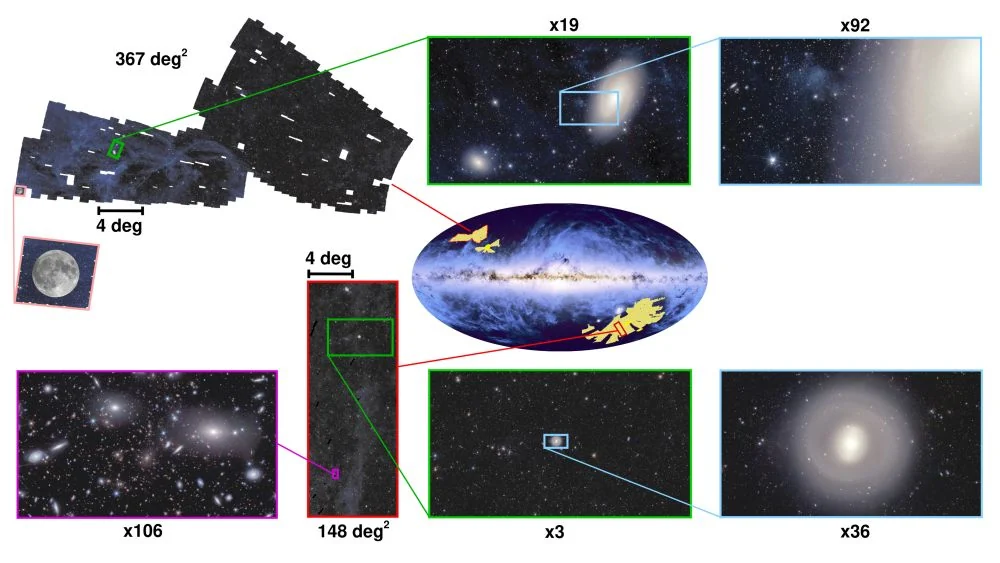
The European Space Agency's Euclid space telescope released its first major data set, DR1-Foundation, covering observations from more than one year of operation. The data encompasses 1,900 square degrees of sky and captures light from over one billion objects, representing about 14 percent of the sky Euclid will survey during its six-year mission.
The release combines data from Euclid's Wide Survey and Deep Survey, the two observational campaigns that form the backbone of its three-dimensional map of the universe. The Wide Survey covers almost half the galactic sky in visible and near-infrared light, designed to constrain dark energy and dark matter across a large volume. The Deep Survey targets smaller regions within the Wide Survey to detect fainter objects like dwarf galaxies and high-redshift quasars, while also serving to calibrate the Wide Survey.
Euclid's images included in the release show the core of the Messier 81 galaxy group, NGC 1291 (a ring galaxy 33 million light-years away), and Abell 3128, a galaxy cluster 800 million light-years distant containing hundreds of individual galaxies. Massive galaxy clusters serve as important gravitational lenses and probes for understanding dark matter distribution and testing Lambda-Cold Dark Matter theory.
The space-based observatory has advantages over ground-based surveys like DESI, the Dark Energy Survey Instrument, because it avoids atmospheric interference and achieves higher resolution. When complete, Euclid's 3D map will have greater depth and volume than DESI's current map, the largest three-dimensional map constructed so far.
Euclid has already discovered a new comet and identified the most ancient quasar in the universe.