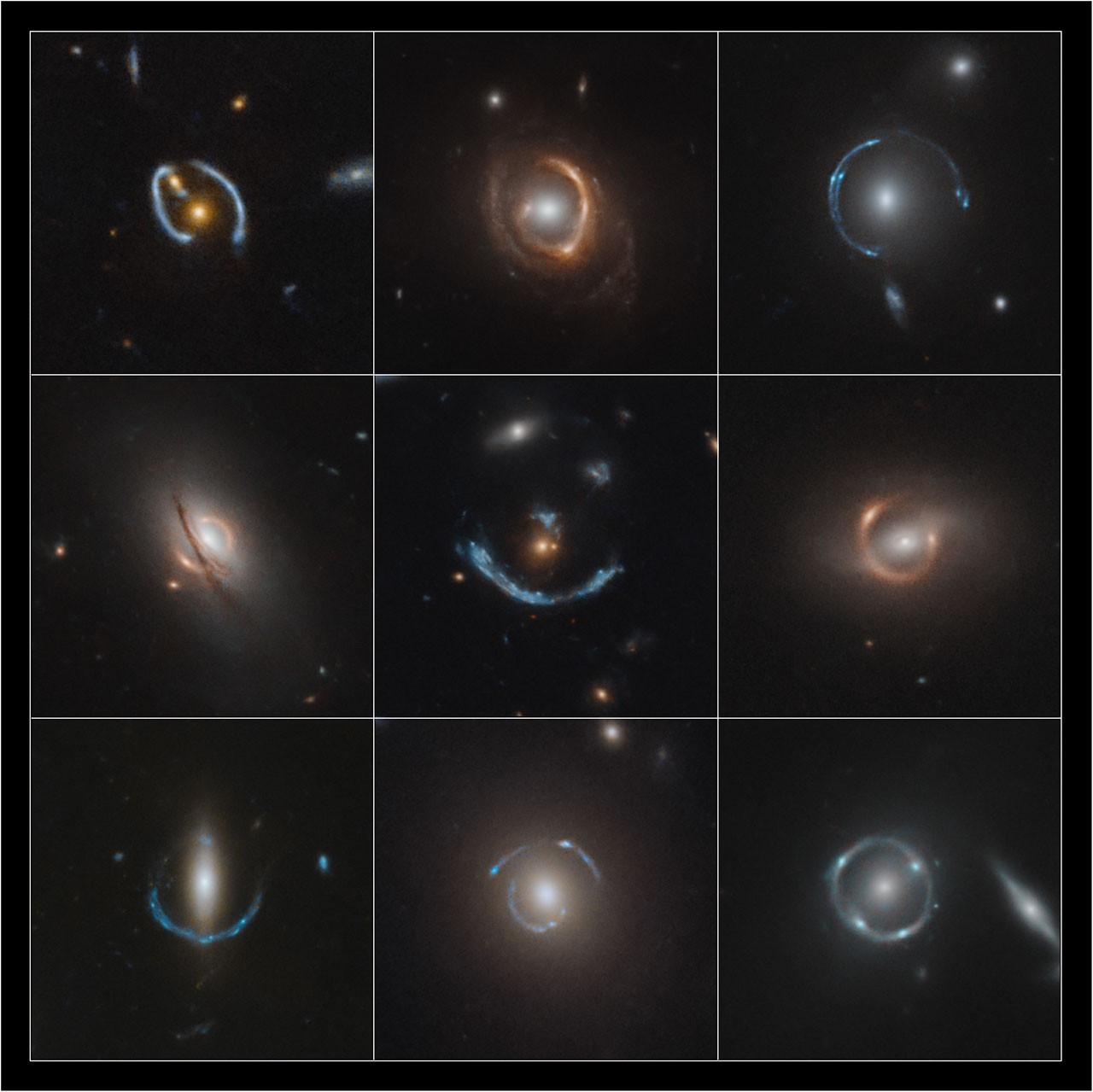
NASA's Hubble Space Telescope has compiled a gallery of gravitational lenses that will serve as targets for follow-up observations by the Nancy Grace Roman Space Telescope, which launched in August 2026.
Gravitational lensing occurs when massive foreground objects bend and magnify light from distant background galaxies, an effect predicted by Albert Einstein. The lenses in Hubble's images formed from the precise alignment of distant background galaxies with the mass of foreground galaxies, creating distorted and magnified images that appear as arcs.
Astronomers will use these observations to build lens models that determine the mass distribution in foreground galaxies, including invisible dark matter. By studying the amount of distortion in lensed background galaxies, researchers can map both visible and dark matter.
Hubble observes primarily in visible and ultraviolet light with some infrared coverage at high resolution. Roman observes primarily in infrared light with some visible coverage over a much larger field of view. While Hubble provides better views of individual lenses, Roman will capture more lenses across wider areas. If Roman identifies particularly interesting lenses, researchers may use Hubble for follow-up observations.
The collage displays multiple lens configurations. Panel A shows an arc-counterarc configuration with a duplicated pair of arcs. Panel F features an Einstein Ring, where the background galaxy almost fully encircles the foreground galaxy. Panels C and I show quadruply lensed galaxies with the background galaxy replicated four times.
By studying small imperfections in gravitationally lensed arcs, researchers aim to detect small clumps of dark matter between a million to a billion solar masses. These findings could confirm the cold dark matter theory. Most foreground lensing galaxies are elliptical galaxies, though some display spiral arms or dust lanes.
The Dark Energy Spectroscopic Instrument at Kitt Peak first detected these strong lenses. Hubble subsequently observed them, and Roman will provide further observations as part of collaborative efforts among NASA's Great Observatories.