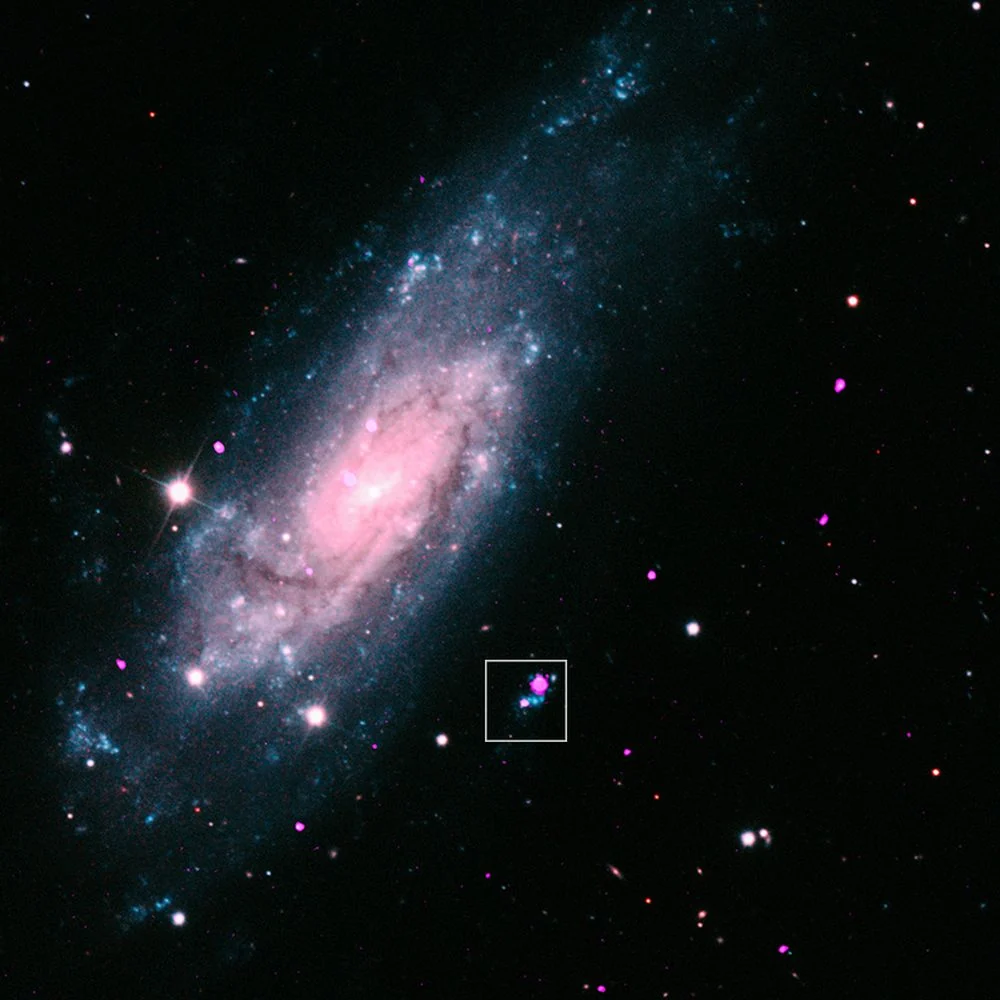
The Chandra X-ray Observatory revealed that AT 2016blu, initially detected as a supernova in 2016, is not a supernova at all but rather a luminous blue variable star in a binary system. The star resides in the spiral galaxy NGC 4559, approximately 30 million light years away, and has a mass of about 33 solar masses.
AT 2016blu exhibits periodic outbursts every 113 days, behavior impossible for a true supernova, which destroys itself in a single explosion. Astronomers classify it as a "supernova impostor" because luminous blue variables are often detected in supernova searches but produce less energetic outbursts and survive them.
Research led by Mojgan Aghakhanloo of the University of Virginia, published in The Astrophysical Journal, shows that a compact companion object, likely a neutron star or black hole, triggers the outbursts. As the two objects orbit each other, the luminous blue variable ejects material that spirals onto the companion at high speeds, generating X-rays that heat surrounding gas, which then glows in optical light.
Chandra observations in March 2026 caught AT 2016blu during an outburst, revealing it was 100 times brighter in X-rays than archival observations from 2001 to 2002. The researchers used Chandra's exceptional angular resolution to separate AT 2016blu's signal from a much brighter nearby ultraluminous X-ray source, NGC 4559 X7. Each outburst transfers about 2.7 percent of Earth's mass to the compact companion.
AT 2016blu represents the first observationally known luminous blue variable system with a compact companion.