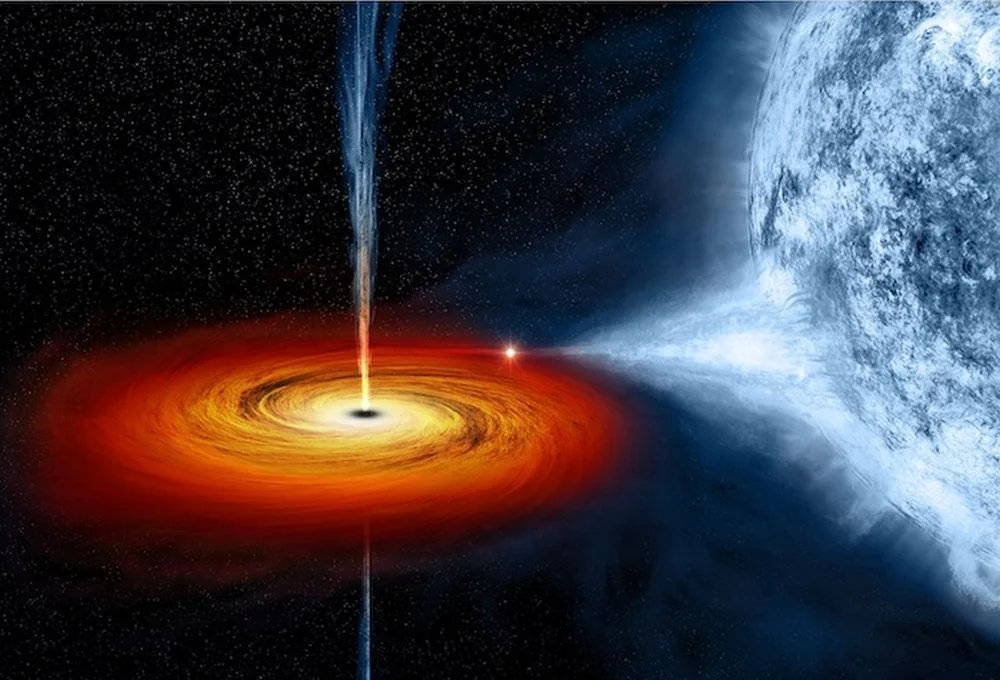
Astrophysicists Toshihiro Kawaguchi and Kazutaka Yamaoka have identified reliable precursors to black hole jet launches in stellar-mass black hole systems. Their research, published in The Astrophysical Journal, examined four x-ray binary systems and found that jets are launched when the inner edge of the accretion disk shrinks rapidly toward the innermost stable circular orbit (ISCO) while x-ray emission variability decreases simultaneously.
The researchers observed that all four sources showed drops in inner disk radius (R in) and x-ray variability (rms) between one and ten days before radio activities indicated jet ejection. These signals appear reliable enough to enable forecasting. "Monitoring of R in seems to be suitable for predicting the timing of jet ejections," Kawaguchi said.
Kawaguchi is from the Graduate School of Science and Engineering at the University of Toyama. Yamaoka works at the Institute for Space-Earth Environmental Research at Nagoya University. Their forecasting model would trigger alerts to other telescopes for Target of Opportunity observations when both R in and rms continuously decrease and R in approaches the ISCO.
The team found no large jumps in accretion rates before jet launches, though one system showed a hint of 20 percent enhancement. Notably, jets formed in two of the four systems below the Eddington limit, challenging models that require super-Eddington accretion for jet ejection. The researchers say better data will examine fine structures in accretion rate evolution around jet production events.