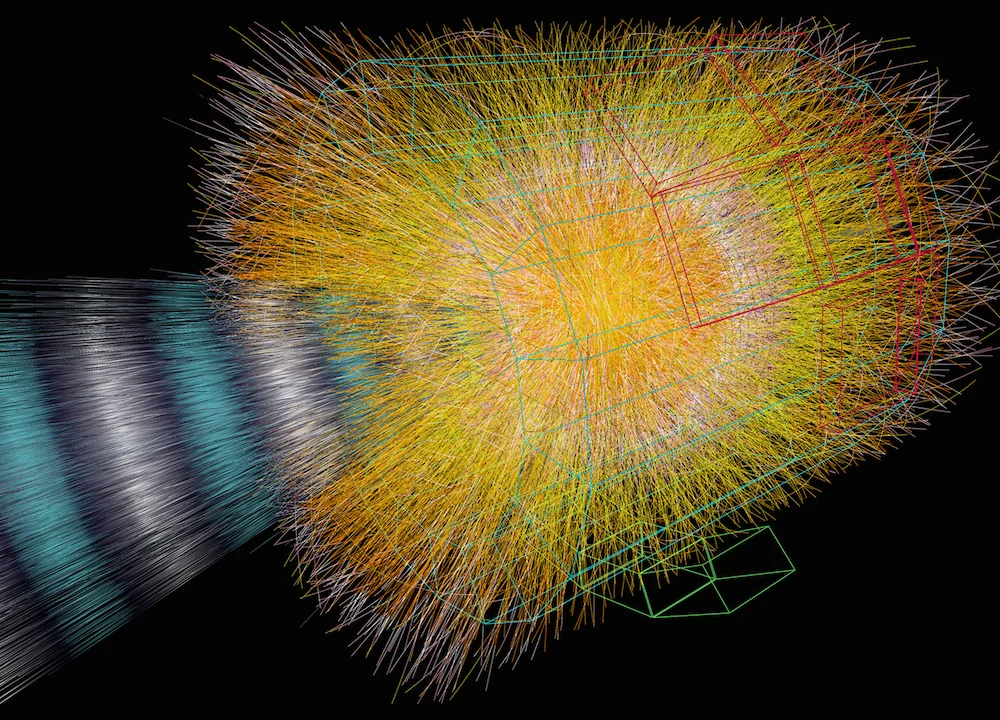
A new study of quark-gluon plasma reveals that heavy quarks do not always follow the random motion patterns physicists expected. Researchers simulated how this primordial fluid behaves when heavy particles pass through it, the kind of conditions created when protons collide with heavy nuclei in particle accelerators.
Quark-gluon plasma is the dense, energetic matter that filled the earliest moments of the universe. Scientists recreate it briefly in colliders by slamming particles together at near light speeds, then study the resulting particles to understand the original fluid's properties.
Physicists anticipated that heavy quarks moving through this plasma would display Brownian motion, the random jiggly movement observed when smaller particles collide with a larger one. In a truly random system, the speed distribution should be Gaussian, symmetrical around an average. Most particles would have speeds close to average, with equal numbers moving much faster as moving much slower.
The study found this expectation holds at slower speeds. But at near-light speeds, the distribution becomes skewed. High-energy quarks are much more likely to be struck in ways that slow them down than to receive kicks that speed them up. This bias pushes the distribution away from the Gaussian pattern.
The researchers, Du Plessis and Bruno Scheihing-Hitschfeld, published their findings in Physical Review Letters 137.19 (2026): 192302.
This non-Gaussian behavior means particle accelerator experiments must account for this bias when analyzing quark-gluon plasma, potentially improving understanding of how the hot dense state of the Big Bang evolved into the universe observed today.