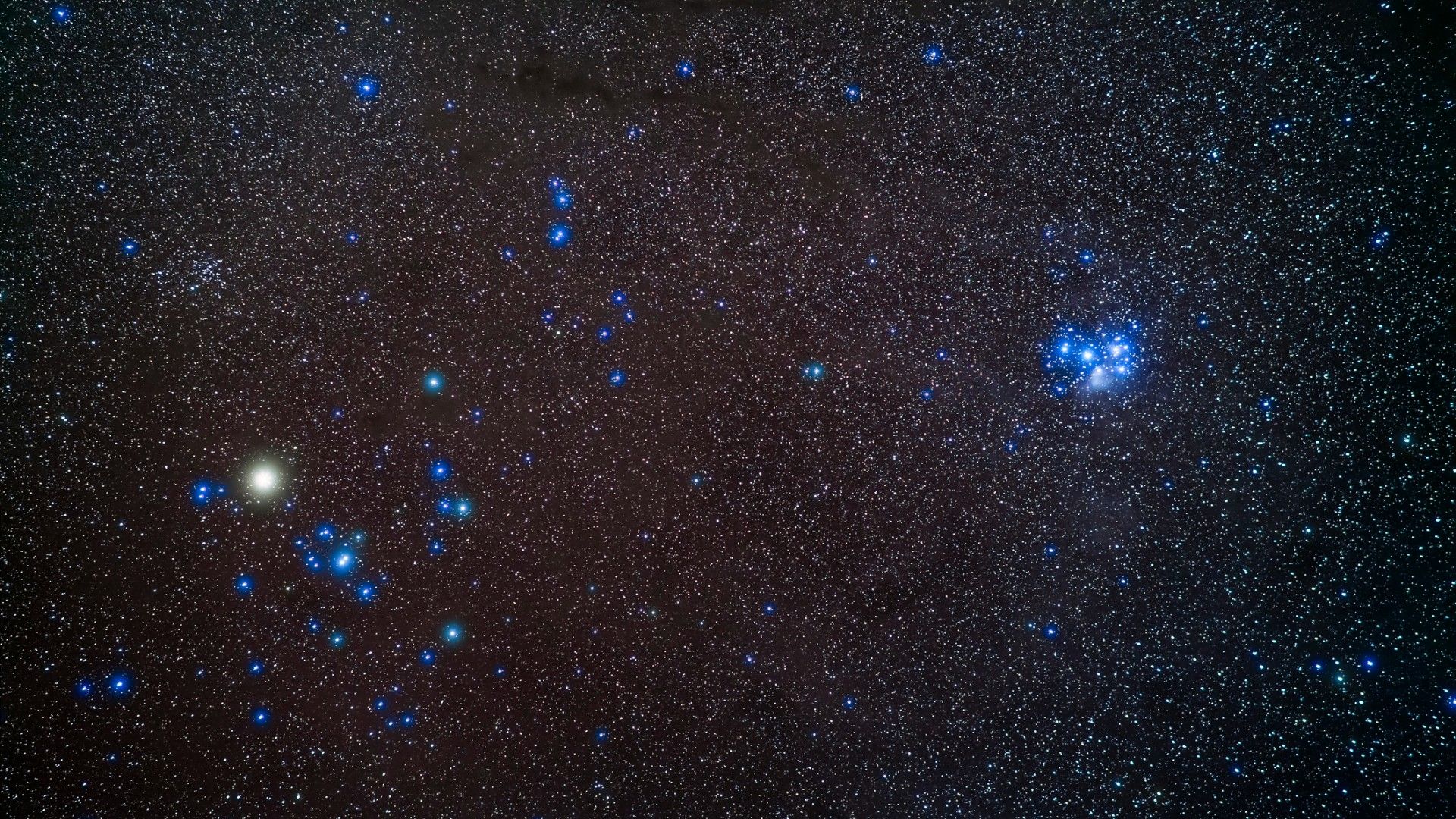
Aldebaran appears to sit within the Hyades star cluster in the constellation Taurus, but it is an impostor. The orange star lies roughly 65 light-years from Earth, while the Hyades cluster sits about 150 light-years away. Aldebaran merely happens to align with our line of sight toward the Hyades.
The Hyades is a real open star cluster, the nearest such cluster to Earth. Its stars formed together in the same nebula and remain gravitationally bound as they move through the galaxy. The cluster's name means "the rainmakers" in ancient Greek, derived from when their rising and setting coincided with wet weather.
Aldebaran, the 14th-brightest star in the night sky, is a foreground interloper. The difference between the two distances exposes a fundamental limitation of human perception. The night sky appears flat, but it has tremendous depth. Constellations themselves are not physical objects but merely line-of-sight arrangements created by our viewpoint in the Milky Way. Stars that appear side by side can be separated by enormous distances.
From a different location in the galaxy, Aldebaran would no longer sit in the bull's face, and Taurus would not resemble a bull at all. The constellation's familiar pattern exists only from Earth's specific vantage point. Learning to mentally separate Aldebaran from the Hyades teaches a broader lesson about understanding the three-dimensional structure of the night sky. Binoculars reveal additional stars in the Hyades cluster, but knowing the correct distances changes the observation more than magnification does.