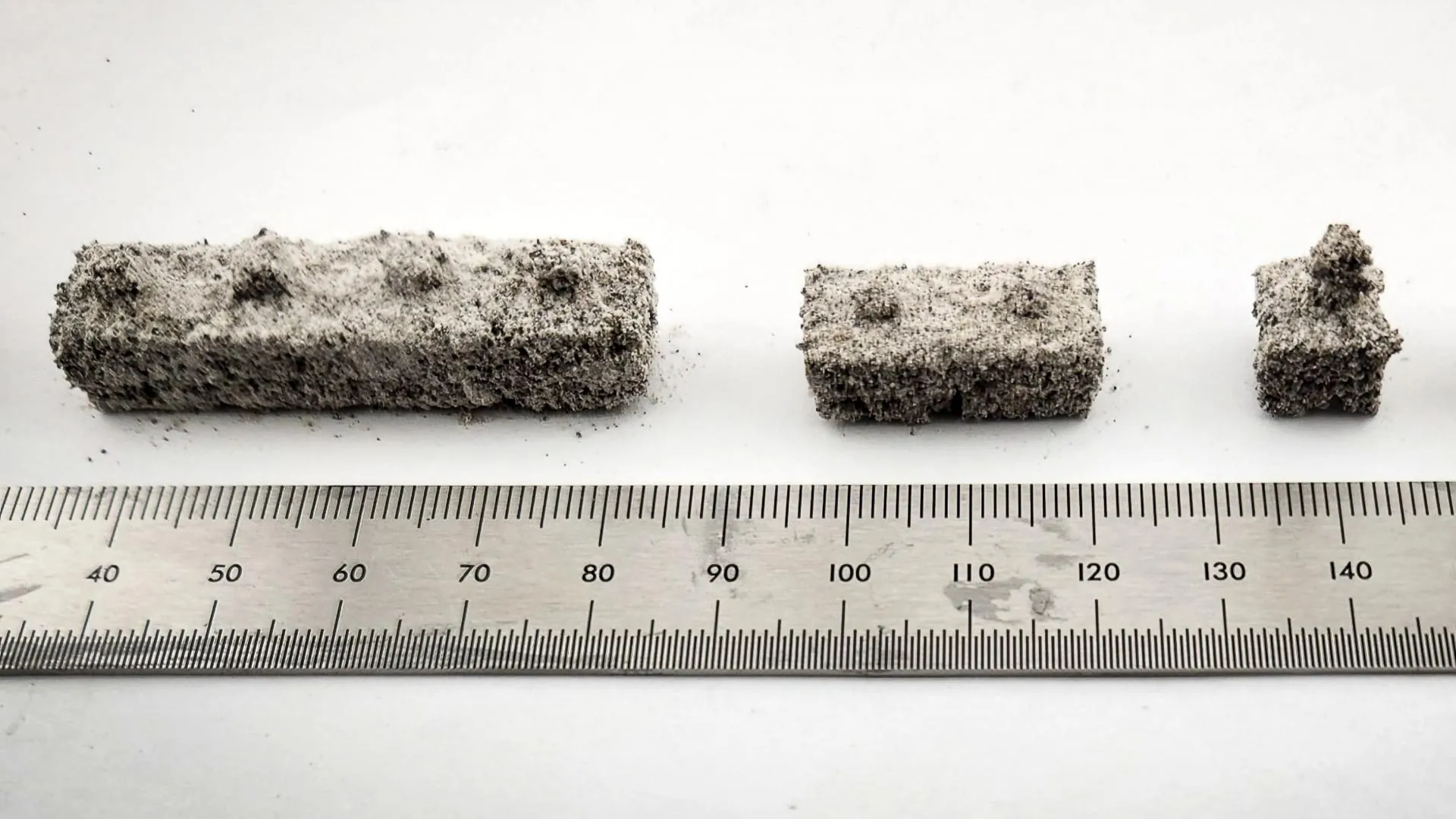
Researchers at the University of Arkansas have 3D printed interlocking bricks from simulated lunar dust without using binding agents. The study, published in NPJ Advanced Manufacturing, used laser powder bed fusion to fuse particles of Lunar Highlands Regolith Simulant directly together into self-supporting LEGO-like blocks.
The team, led by undergraduate Cole McCallum and senior author Wan Shou, produced small bricks a few centimeters across in shapes including crosses and the letter H. The particles bond to themselves rather than to an external binder, addressing a logistical challenge that would arise if construction materials needed to be shipped from Earth to the Moon.
"There's nothing else it's binding to. The regolith powder is binding to itself," McCallum said.
The experimental bricks contain more internal pores and have lower structural strength than objects made with binders. McCallum noted the team could produce self-supported structures but would hesitate to use them for load-bearing applications in their current state.
Before this technology could support actual lunar construction, several unknowns remain. Scientists must determine how the printing process performs under the Moon's low-gravity conditions and in a vacuum, and they need to improve the strength and durability of the finished bricks.
Shou believes the technique could eventually enable efficient manufacturing of construction components and larger structures for permanent lunar settlements as NASA works toward sustained human presence on the Moon.