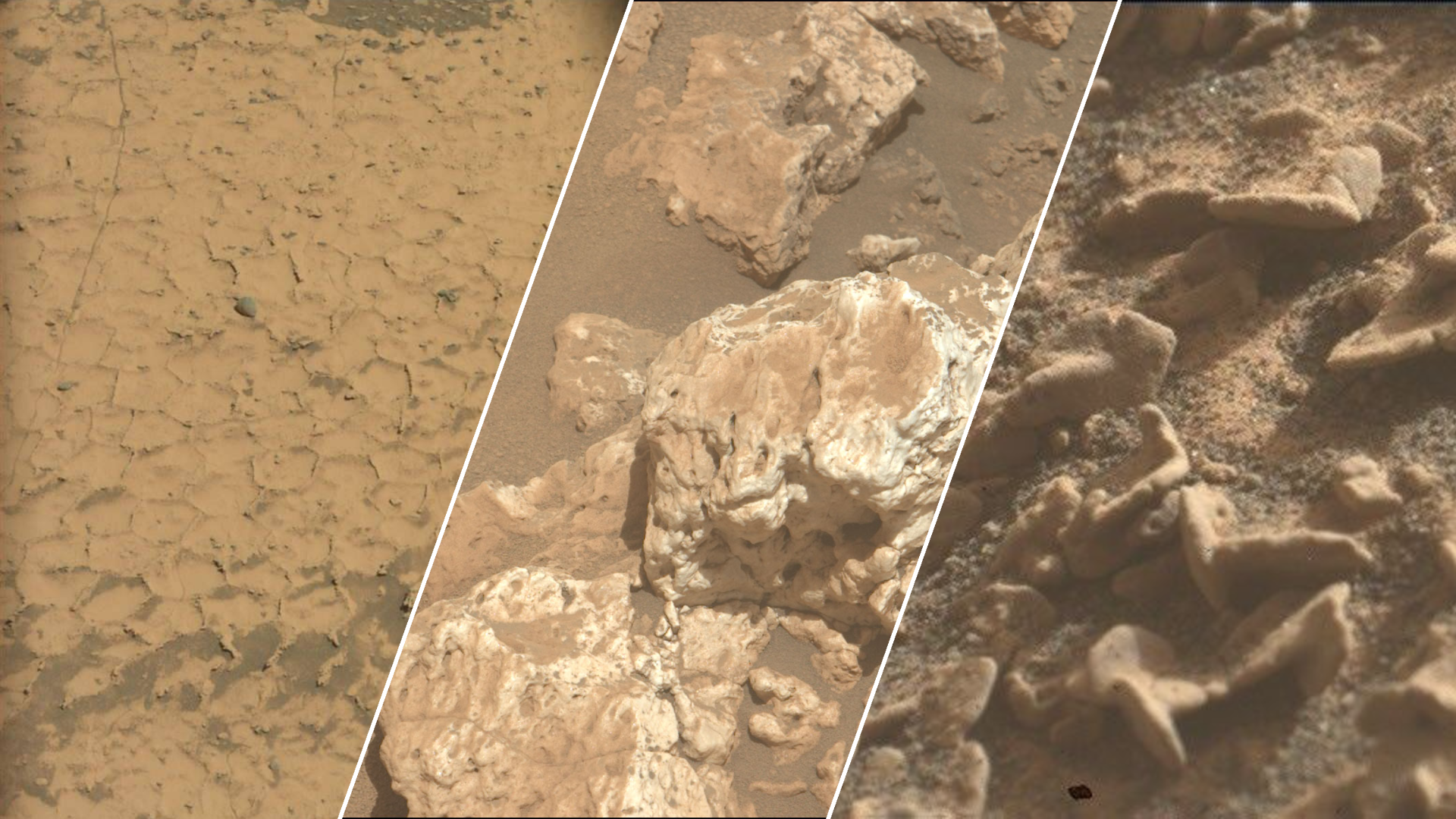
NASA's Curiosity rover has completed a drilling campaign at a location called Nazca, where it discovered disk-shaped crystal formations embedded in Martian bedrock. The formations are so thin and flat that NASA's mission team compared them to potato chips. Curiosity captured close-up images using its Mars Hand Lens Imager (MAHLI) on Nov. 7, 2026 (Sol 5067). The rover also used its ChemCam instrument to analyze the rocks' chemical composition, while samples were delivered to the rover's onboard Sample Analysis at Mars (SAM) instrument for further study.
Meanwhile, NASA's Perseverance rover investigated unusually bright rocks in an area called Idubi, located outside Jezero Crater in the Lac de Charmes region. Perseverance captured images on Oct. 29, 2026 (Sol 2023). Data from Perseverance's SuperCam revealed the rocks are rich in hydrated silica rather than typical igneous rocks. On Earth, hydrated silica forms in environments with hydrothermal activity or groundwater and can preserve microscopic fossils. Perseverance is now conducting closer investigation to determine how the rocks formed and whether they preserve signs of past microbial activity.
Curiosity also spotted polygon-shaped patterns outlined by raised ridges in Martian bedrock on Nov. 13, 2026 (Sol 5073). Scientists say these formations could have developed through mineral shrinkage as water evaporated, temperature changes, or expansion and compaction of buried sediments. By studying rock composition and the material cementing the raised ridges, researchers hope to determine which processes shaped the terrain.