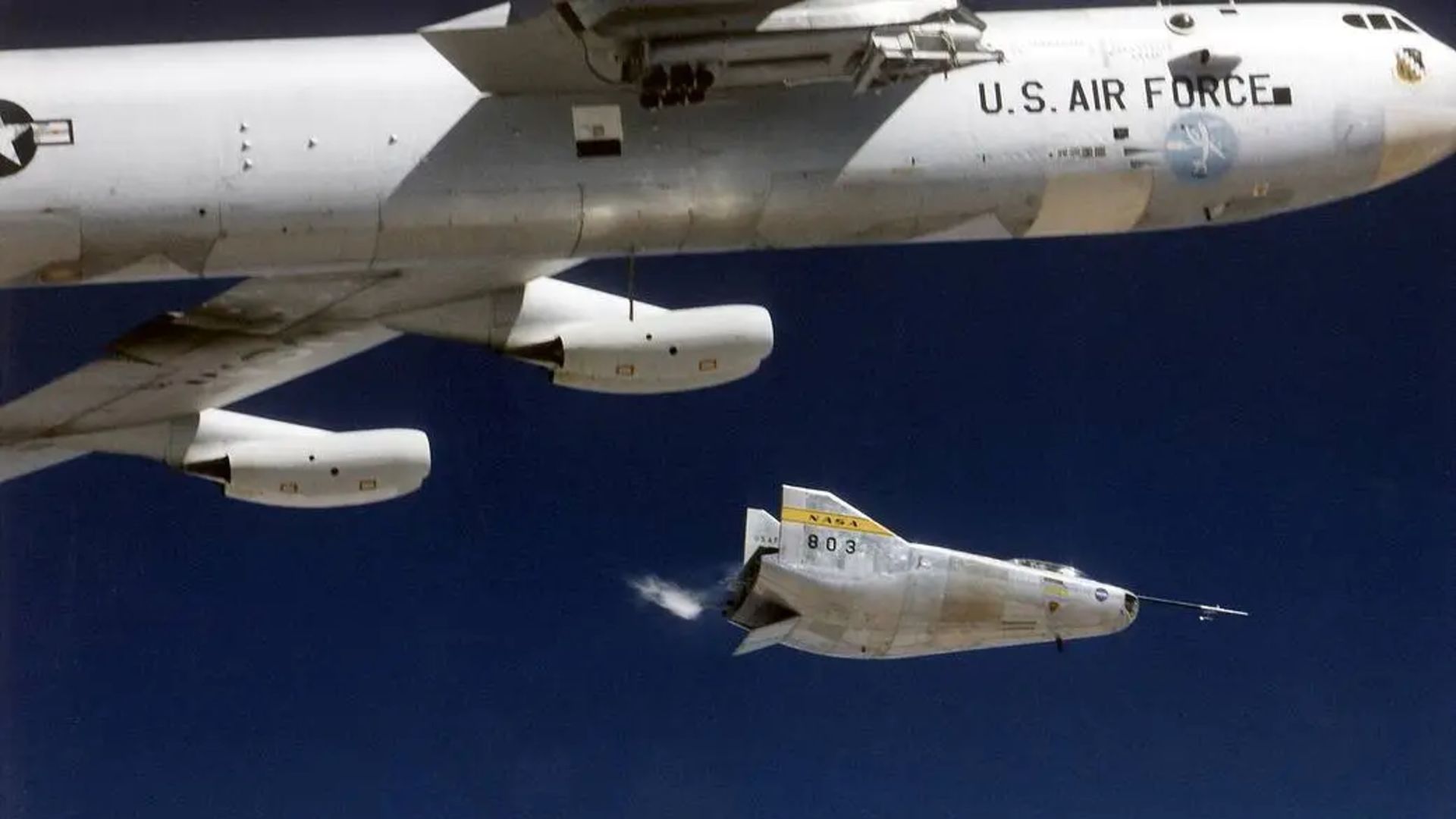
On Nov. 25, 1970, NASA's Northrop M2-F3 lifting body aircraft completed its first powered flight under Air Force test pilot Bill Dana. The M2-F3 was designed to produce lift primarily through its fuselage rather than wings, earning it the description "wingless" aircraft. Dana reached an altitude of 45,000 feet in a flight lasting just over 6 minutes.
The M2-F3 represented a rebuild of its predecessor, the M2-F2, which crashed during an unpowered test flight in California's Mojave Desert. The rebuilt aircraft received three vertical fins instead of two to improve control characteristics. Unpowered glide flights began in June 1970, but the November 25 mission marked the first time the vehicle's rocket engine fired during flight testing.
The M2-F3 included reaction control thrusters similar to those used on orbiting spacecraft to maintain vehicle orientation. NASA later evaluated a rate command augmentation control system and side-arm control stick on the vehicle, designs that influenced modern aircraft controllers. Over three years, the M2-F3 flew 27 total missions, reaching a maximum speed of 1.6 times the speed of sound and an altitude of 71,500 feet.
The M2-F3 is now on display at the National Air and Space Museum in Washington, D.C., after NASA donated it to the Smithsonian Institution.