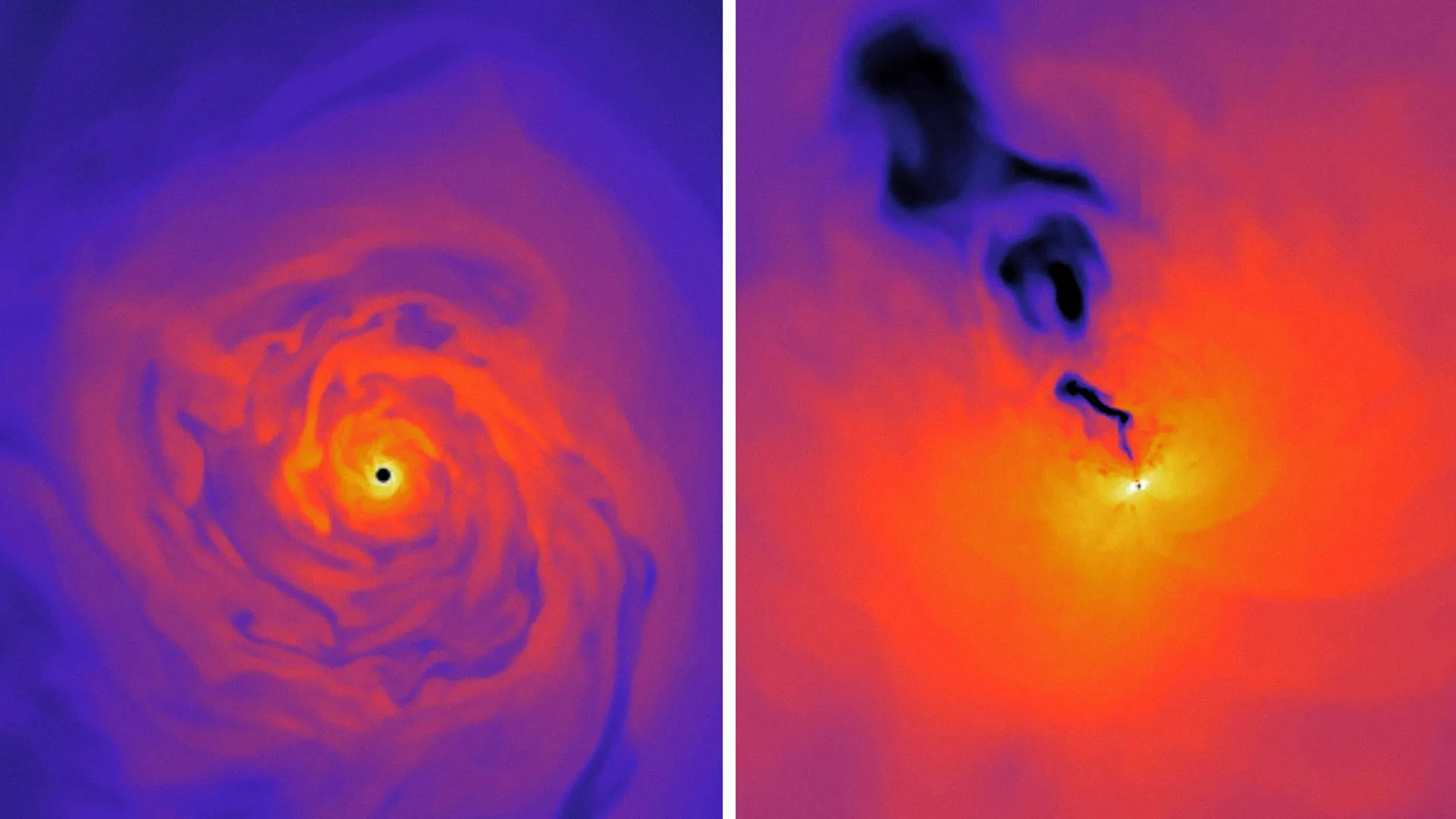
Researchers at MIT and other institutions have identified a way primordial black holes, objects theorized to have formed in the first fraction of a second after the Big Bang, could be detected.
Their study, published in The Astrophysical Journal, describes how a black hole no larger than an atom but carrying the mass of an asteroid could become trapped inside a star like our Sun. Using theoretical calculations and three-dimensional computer simulations, the team investigated what happens when such an object sinks toward a star's center and begins consuming it from within.
Over millions of years, the growing black hole could accumulate roughly 1 percent of the star's total mass. If the star rotates rapidly enough, material falling toward the black hole would form a spinning disk around it. The extreme rotation would twist the magnetic field threading the surrounding material, generating exceptionally powerful jets from the black hole's poles that could cause the star to explode within seconds.
"Once the disk forms, this is essentially a death sentence for the star," says lead author Ore Gottlieb, an assistant professor of physics at MIT.
The researchers calculated what these explosions might look like to astronomers, predicting a recognizable sequence of emissions beginning with intense blue and ultraviolet light, along with gamma rays and X-rays. Gottlieb says the resulting outburst could be visible to existing telescopes. "We expect this to be visible, and it's something we should look into."
Identifying such an explosion as evidence of a primordial black hole would require examining additional characteristics of the exploding star. One revealing clue would be an explosion involving a star not ordinarily expected to meet such a violent end.
The research team also included Matteo Cantiello of the Flatiron Institute, Cameron Norton and Matthew Kleban of New York University, and Ken Van Tilburg of Stanford University.