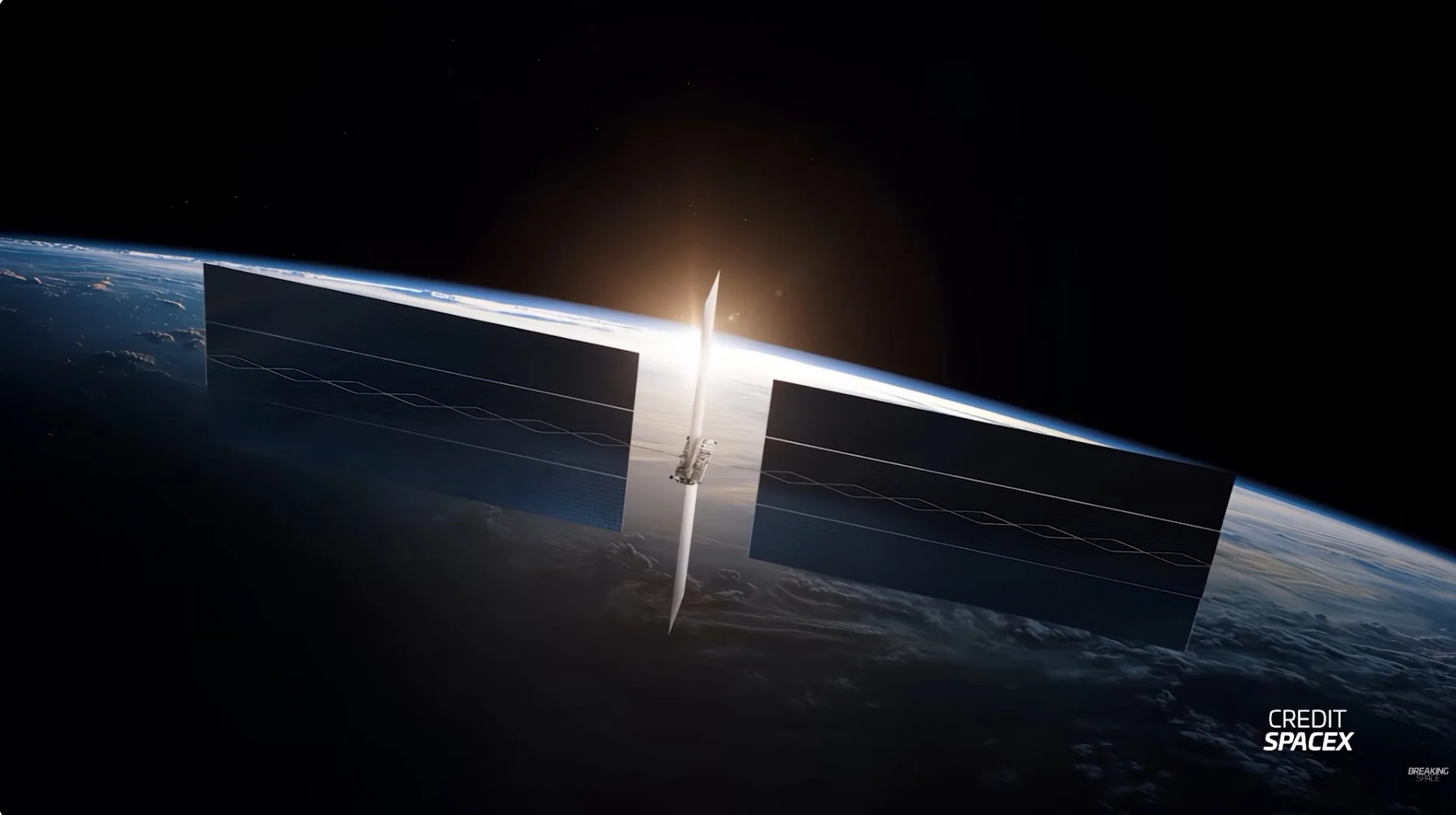
The Federal Communications Commission authorized SpaceX on November 25 to deploy up to 1 million Starmind satellites designed as orbital data centers for artificial intelligence computing. The order marks the first U.S. authorization of this kind and sets a 14-year window for the full network deployment in low Earth orbit.
The first-generation AI1 satellite is substantially larger than current Starlink vehicles. With solar arrays and radiators deployed, the spacecraft spans roughly 70 meters in one axis and 20 meters in the other.
If fully built, Starmind would dwarf every satellite launched in the history of spaceflight. As of November 18, roughly 28,800 satellites have been placed in orbit since Sputnik in 1957, with about 17,200 remaining active. More than 11,100 of those active satellites are Starlink spacecraft. Starmind would multiply that scale by nearly two orders of magnitude.
The satellites will rely primarily on optical laser links to the existing Starlink constellation for data return. Ka-band spectrum is authorized only for backup and emergency telemetry, tracking, and command.
The FCC approved six orbital shells between approximately 500 and 1,002 kilometers altitude. Three shells sit at inclinations of around 26 to 32 degrees, while the other three occupy sun-synchronous orbits between roughly 97 and 99 degrees.
The authorization includes hard deployment deadlines. SpaceX must have at least one operational Starmind satellite on station by November 25, 2033. The company must then reach 100,000 satellites by November 25, 2035, and 500,000 by November 25, 2038. The full 1 million must be in orbit by November 25, 2040. Missing any milestone voids the authorization.
Reaching these milestones would require unprecedented launch tempos. Getting 100,000 satellites to orbit by 2035 would average well over a hundred AI satellites per day. Completing the constellation by 2040 would push that to several hundred per day. Because the AI1 design is large, that volume would translate into multiple Starship flights per day for years. SpaceX is currently working toward higher Starship flight rates but has not yet demonstrated the weekly, let alone daily, cadence a full Starmind deployment would demand.
The FCC denied petitions filed by Amazon Leo, Viasat, and the American Astronomical Society. Other companies including Blue Origin, Google, and Nvidia-backed Starcloud are pursuing orbital computing concepts. SpaceX is the first to receive a U.S. license of this scale.
The authorization clears the regulatory path and sets the conditions under which SpaceX may attempt the constellation. It does not guarantee the constellation will be built to its full size. The first real test comes by November 2033, when at least one AI1 satellite must be operating in orbit.