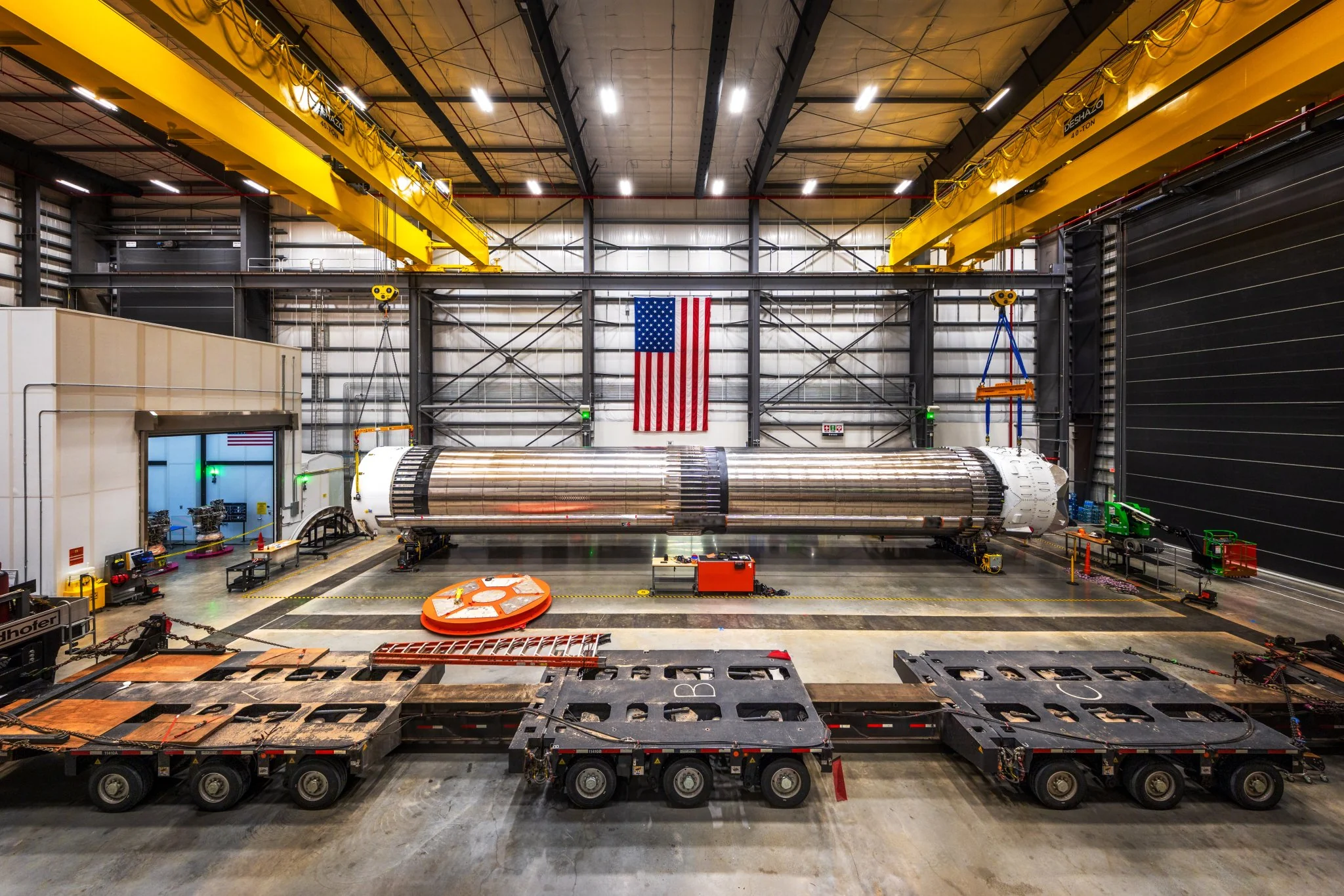
Stoke Space's Nova Pathfinder first stage arrived at Space Launch Complex 14 at Cape Canaveral Space Force Station on Nov. 22 following a 17-day journey from Washington. The booster entered the Horizontal Integration Facility for a pad-in-the-loop wet dress rehearsal campaign ahead of an early 2027 inaugural launch. The test campaign will activate SLC-14 for the first time since the 1960s.
The first stage will undergo wet dress rehearsals that fill the vehicle with cryogenic propellants and test launch infrastructure including tank farms. After completing those tests, the stage will return to the facility for integration of its remaining Zenith engines, then conduct a static fire before mating with the second stage.
Reaching this point required months of structural qualification. In May, the flight stage completed a three-week proto-qualification campaign at Moses Lake Test Site, where it met 46 structural test objectives under loads of 115% of expected flight conditions. Engineers used hundreds of strain gauges to verify the vehicle's behavior. Earlier testing included material coupons subjected to heated and cryogenic temperatures to verify weld integrity, then progressed to full-diameter "Tiny Tank" test articles. Tiny Tank 1 burst at failure in 2025, while Tiny Tank 2 qualified the aft barrels within design margins.
Stoke has qualified seven full-flow staged combustion Zenith engines for the first stage. Four of seven flight engines completed acceptance testing, with three remaining in testing. Over two years, Zenith progressed through four block configurations covering turbopumps, valves, and thrust chambers. Stoke conducted nearly 10,000 seconds of hot-fire testing over five months. Two qualification engines accumulated 7,647 seconds across 91 starts, demonstrating approximately ten times the engine's initial 760-second service-life requirement.
The second stage completed its structural proof testing in early November, taking oxidizer tank, common dome, and fuel tank each to 110% of design pressure and holding for five minutes with no anomalies observed. It then conducted a full wet dress rehearsal with liquid hydrogen and liquid oxygen propellants filled to flight loads. Stage 2 will conduct a December static fire once mated with its Andromeda engine.
Andromeda, the second stage's engine, integrates a hydrolox propulsion system into an actively cooled, ductile metallic heat shield rather than using ablative materials or tiles. Cryogenic propellant circulates through the shield during reentry to endure repeated thermal cycles with minimal inspection between flights. Stoke first fired a 30-thruster development version in February 2024. The program has since progressed through 50 hardware configurations and 242 total starts. The last 15 months included three engines, 30 hardware configurations, 72 starts, and 10,825 seconds of hot-fire time. The qualification campaign reached twice the engine's rated flight life.
Pathfinder's first flight will serve as a proving ground for Nova Block 2, a heavy-lift variant targeted for first flight in 2029. Block 2 scales Pathfinder's architecture by doubling the booster to 14 Zenith engines and moving the upper stage to a 24-thruster Andromeda with a five-meter fairing. The company designed Block 2 to lift 15 metric tons to low Earth orbit in a fully reusable configuration. Stoke signed a multi-launch agreement with Planet Labs for high-cadence commercial constellation deployments.
Space Launch Delta 45 granted Stoke Right of Entry to expand north of SLC-14 for engineering studies, site surveys, and environmental assessments toward building a second pad for Nova.