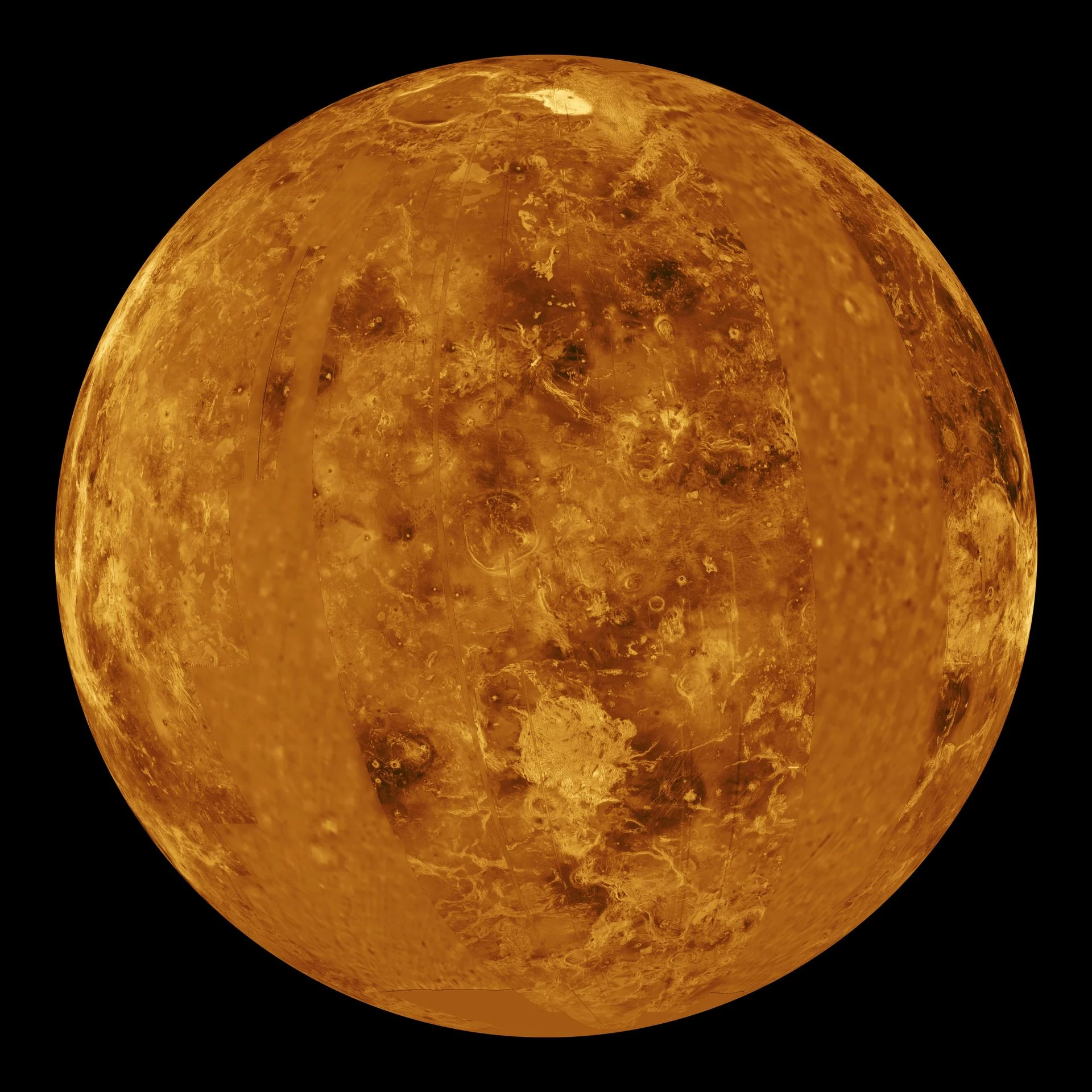
Sara Taeko Port, a postdoc researcher at the University of Texas San Antonio, led a study published in The Planetary Science Journal that examined whether minerals on Venus could preserve evidence of a watery past. The research team used NASA's Glenn Extreme Environment Rig (GEER) at Glenn Research Center in Cleveland, an 811-liter pressure vessel that replicates Venus' lower atmosphere conditions, to test how carbonate and water-bearing minerals behave under the planet's extreme environment.
Temperatures on Venus average around 460 degrees Celsius. Atmospheric pressure reaches 93 times Earth's ocean-level pressure. The air consists of carbon dioxide topped by sulfuric acid clouds.
Port's team placed samples of three carbonate minerals (siderite, calcite, and magnesite) and three water-bearing minerals (phlogopite, brucite, and muscovite) inside the chamber for sixty days. Many planetary scientists theorize that Venus was once Earth-like before a runaway greenhouse effect boiled away its oceans. A high deuterium/hydrogen ratio in Venus' atmosphere supports this theory.
The experiment produced two notable findings. Brucite, a magnesium-rich mineral formed in liquid water on Earth, dried out, cracked, and transformed into magnesite, a carbonate mineral that remained stable afterward. This means magnesite on Venus could indicate past water, depending on surrounding geology.
Micas, flaky water-bearing minerals, typically break down in Venus' heat and sulfur dioxide. However, hydrogen fluoride gas present in trace amounts in Venus' atmosphere swapped fluorine atoms for the water-associated hydroxyl groups in the minerals' chemical structure, creating fluorophlogopite and fluoromuscovite. This transformation protected the minerals from heat and allowed them to survive for billions of years.
The paper provides additional evidence for active volcanism on Venus. Nearly every sample absorbed sulfur or fluorine to form outer crusts. If this process occurred over millions of years since Venus' last major resurfacing event 500 million years ago, those gases would have disappeared from the atmosphere unless continuously replenished. Volcanoes represent the most logical explanation.
Archival radar data from NASA's Magellan spacecraft showed a volcanic vent on Maat Mons, Venus' tallest volcano, reshaped itself over eight months in 1991. Upcoming missions, including NASA's DAVINCI and VERITAS and the European Space Agency's EnVision, will test these findings.