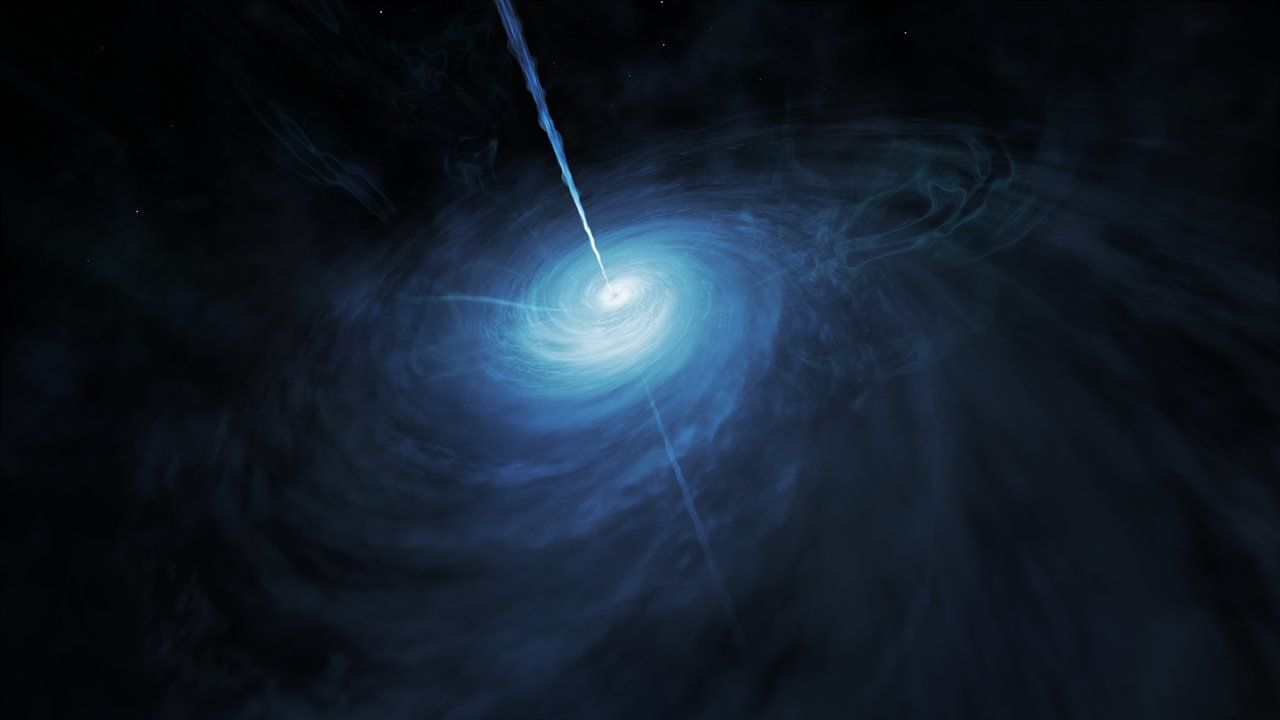
Astronomers have discovered a record-breaking ancient quasar that existed 12.9 billion years ago, offering fresh insights into how supermassive black holes formed and grew so rapidly in the early universe.
The quasar's extreme age places it among the most distant objects ever observed, dating to when the universe was less than a billion years old. At that epoch, conventional models suggested supermassive black holes should not yet exist or should remain relatively small. Yet this quasar harbors a black hole of extraordinary mass, indicating that these cosmic monsters aged far faster than current theories predict.
Supermassive black holes power quasars, violent objects that outshine entire galaxies as matter spirals into the black hole's gravity well. The discovery of such massive black holes so early in cosmic history presents a fundamental puzzle. Standard accretion models require extended feeding periods to build up the billion-solar-mass black holes observed in ancient quasars. The compressed timeline in the early universe leaves insufficient time for this growth through conventional means.
This record-breaking quasar suggests several possibilities. Black holes may have grown through unusually efficient accretion in the early universe, consuming surrounding material at extreme rates. Alternatively, seed black holes themselves may have formed through different mechanisms than those operating today, potentially through direct collapse of massive gas clouds rather than stellar-mass black hole mergers.
Observations of ancient quasars like this one rely on infrared and radio telescopes capable of detecting light that has traveled across cosmic distances, its wavelengths stretched by the universe's expansion. Each discovery of an unexpectedly mature black hole in the early universe tightens constraints on black hole formation theories.
The finding underscores how the deepest cosmic history remains poorly understood despite decades of observation. Understanding black hole formation pathways informs broader questions about how galaxies assembled and structured the universe we observe today.