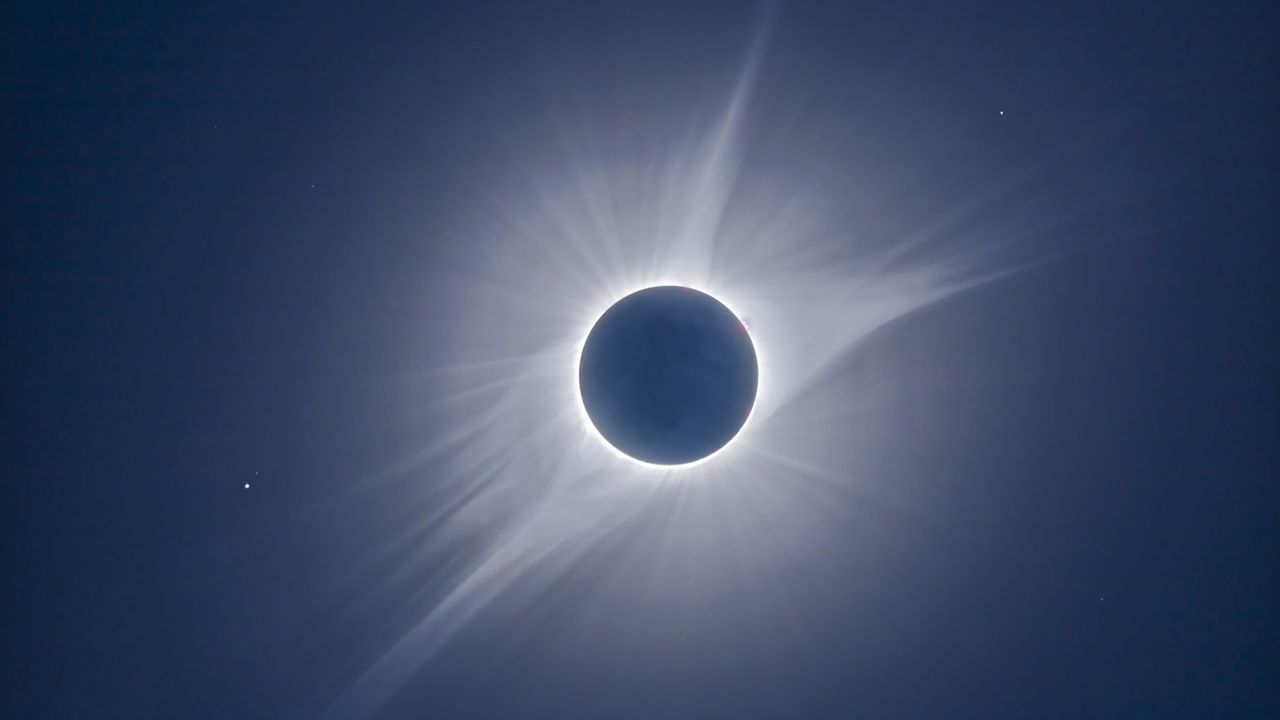
On August 12, observers within the eclipse path will witness the solar corona in its natural state during totality. The sun's outer atmosphere, normally invisible against the sun's brilliant photosphere, becomes visible only when the moon blocks direct sunlight. Each eclipse reveals the corona's structure in real-time, displaying prominences, loops, and streamers shaped by the sun's magnetic field.
This particular eclipse offers astronomers a fresh dataset on coronal structure at a specific point in the sun's 11-year activity cycle. The corona changes appearance dramatically between solar minimum and maximum. Its shape, brightness distribution, and extension into space vary with solar activity levels. Scientists photograph and analyze these features to refine models of how magnetic fields drive solar phenomena like flares, coronal mass ejections, and solar wind patterns.
Eclipse chasers position themselves along the path of totality to capture both wide-field views and detailed observations of the corona's fine structure. Professional astronomers use specialized instruments mounted on telescopes to measure coronal temperatures, density variations, and magnetic field strengths during the brief minutes of totality. Amateur observers document the corona's appearance from different geographic locations, providing ground-based verification of space-based satellite observations.
The August 12 eclipse crosses a landmass that permits observations from multiple scientific stations. This geographic advantage allows teams to deploy coordinated instruments and conduct simultaneous measurements. Ground-based observations during totality complement data from solar observatories like the Solar Dynamics Observatory and the Solar Orbiter spacecraft, which observe the sun continuously but lack the clarity that blocking the photosphere provides.
Understanding the corona remains one of solar physics' central challenges. The temperature paradox—why the corona reaches millions of degrees while the photosphere sits at 5,500 Kelvin—drives ongoing research. Eclipses provide rare opportunities to observe coronal dynamics directly, revealing mechanisms that telescopic observations from Earth cannot