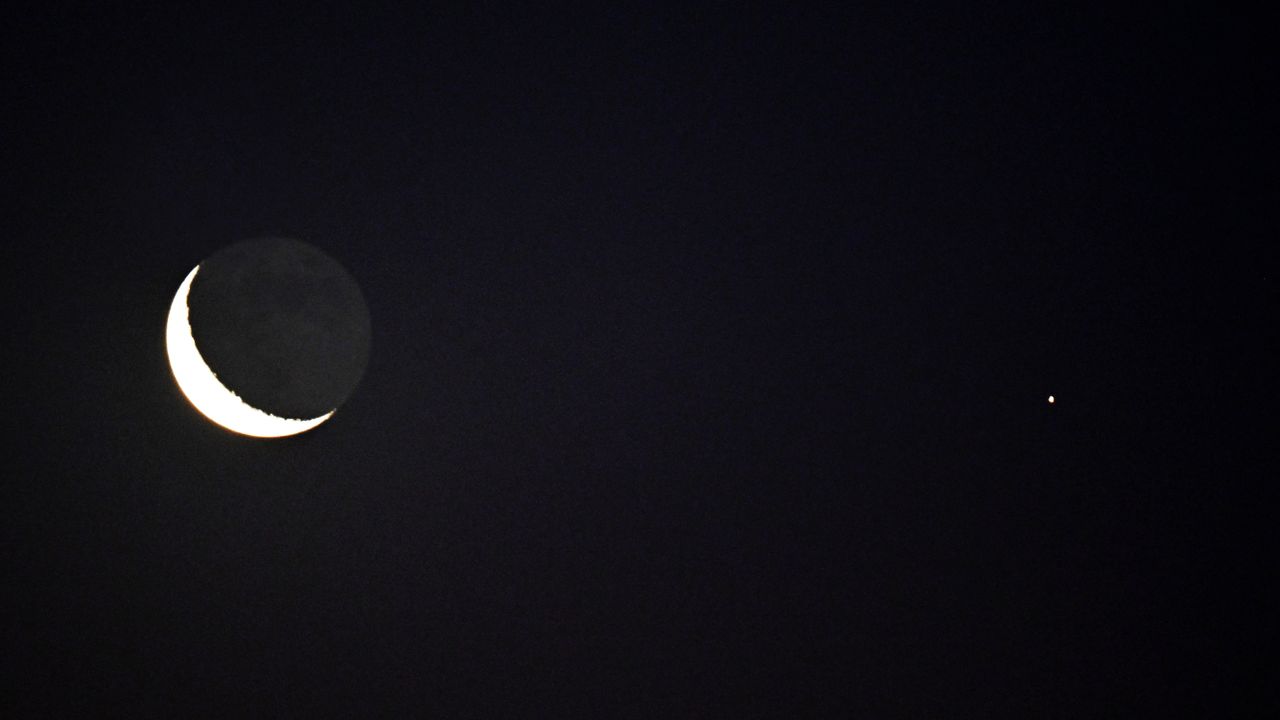
A crescent moon and Mars will stage a rare celestial conjunction on the morning of August 9, visible to skywatchers in the predawn hours. The thin crescent will pass close to Mars, the red planet appearing distinctly ruddy against the background stars of Taurus. This alignment offers naked-eye observers an accessible view of two of the solar system's most recognizable objects in proximity.
Mars, currently near opposition relative to Earth, shines at magnitude 0.8 with its characteristic copper-red hue produced by iron oxide on its surface. The waning crescent moon, just days before the new moon, will frame the view with its distinctive curved shape illuminated by Earthshine on its dark side. The two bodies will occupy the same region of sky, creating a natural pairing that photographers and casual observers alike can capture without optical equipment.
Observers should position themselves with a clear view toward the eastern horizon before sunrise. The exact timing and separation depend on local latitude, but the conjunction remains visible across multiple time zones. This kind of planetary encounter with the moon happens regularly through the lunar month, yet each occurrence provides a straightforward demonstration of orbital mechanics. Mars orbits at roughly 1.5 times Earth's distance from the sun, completing its journey every 687 days. The moon completes its circuit in just 27.3 days, occasionally crossing the paths of planets visible to our unaided eyes.
Such conjunctions serve observers interested in tracking planetary positions and understanding celestial mechanics without instrumentation. Mars remains a focal point for amateur astronomers given the planet's dramatic variations in brightness and apparent size as Earth and Mars orbit the sun. These predawn viewing sessions also offer accessible entry points for those new to observing the night sky, requiring no telescopes or special equipment beyond clear skies and early morning alertness. The August 9 event presents one such opportunity before dawn breaks across