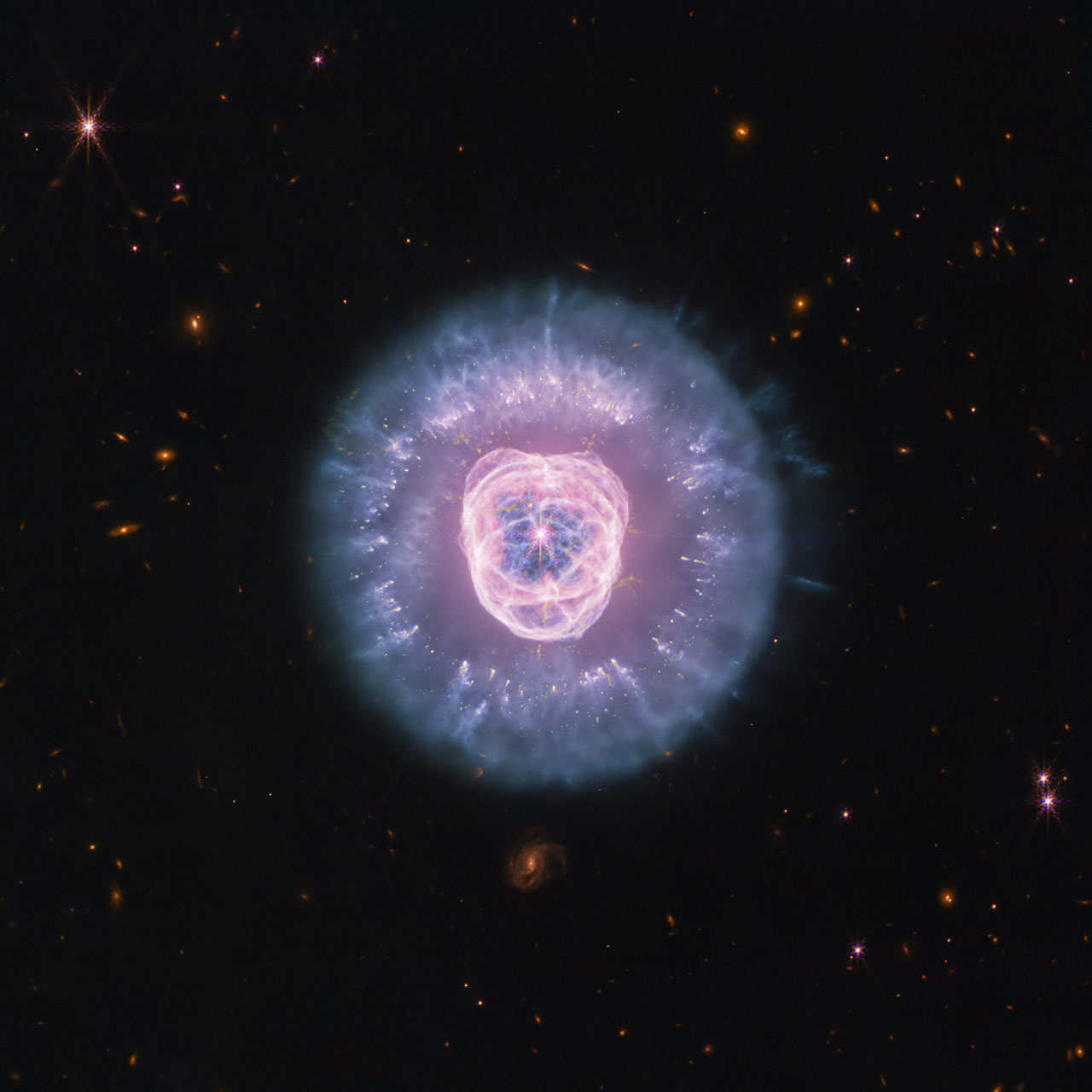
NASA's James Webb Space Telescope has imaged NGC 2392, a planetary nebula 5,000 light-years away in the constellation Gemini, revealing new details invisible to previous observations. The object earned its nickname, the Lion Nebula, from its distinctive face-shaped structure dominated by a flowing "mane" of comet-shaped gas filaments ejected from a dying star.
Webb's infrared capabilities expose structures that Hubble's 2000 visible-light observation could not detect. The space telescope peers through dust that blocks visible wavelengths, unveiling the true architecture of gas and stellar material surrounding the nebula's central white dwarf. This dead stellar core glows intensely as ultraviolet radiation heats the surrounding hydrogen and helium envelope.
Planetary nebulae form when sun-like stars shed their outer layers at the end of their lives. The expelled gas expands outward, sometimes reaching speeds of 25,000 miles per hour. Over thousands of years, this material disperses into space, eventually forming the building blocks for new stars and planets. Studying these objects provides astronomers with direct evidence of stellar death and the recycling of elements across the galaxy.
Webb's infrared observations distinguish between different types of gas and trace the density variations that shape the nebula's structure. The telescope resolves fine details in the mane structures, revealing how the star's magnetic field and stellar wind have sculpted the expanding shell into these distinctive formations. The infrared data also reveals embedded dust grains that trace the nebula's internal temperature and composition.
NGC 2392 represents one of hundreds of planetary nebulae studied by Webb as part of broader efforts to understand stellar evolution. By comparing Webb's infrared images with historical Hubble data, astronomers track how these nebulae change over decades and centuries. The Lion Nebula's dramatic structure makes