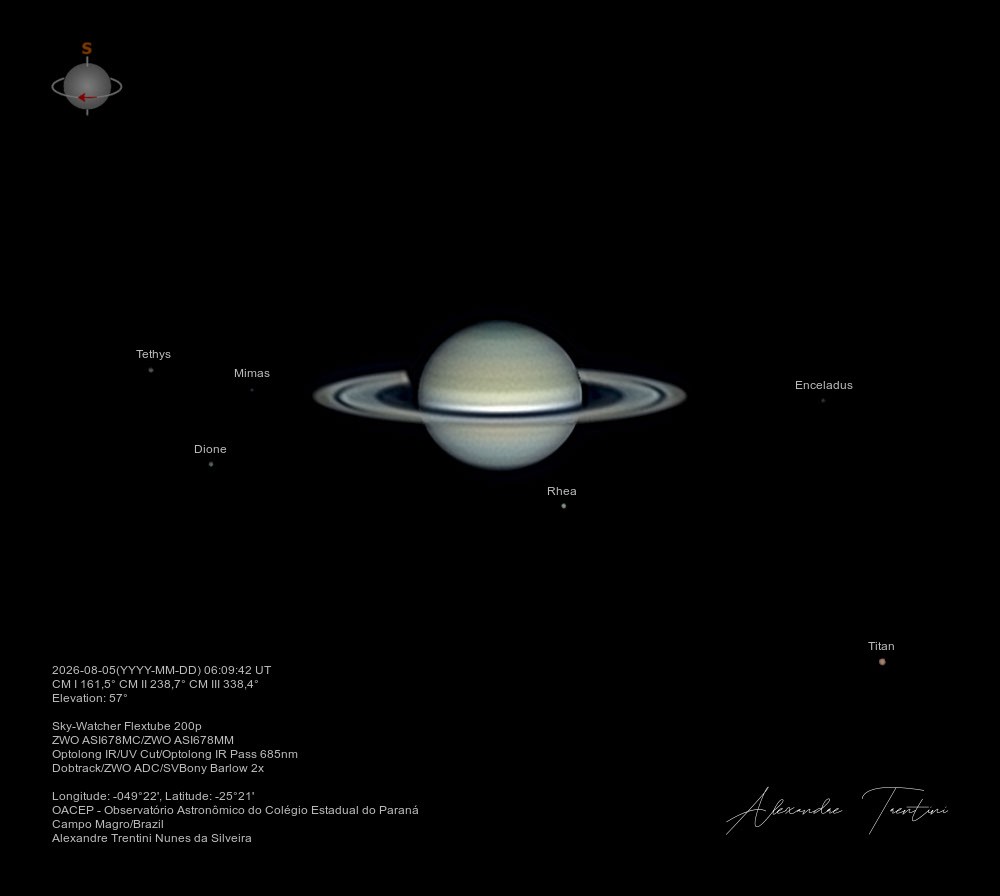
Saturn's six largest moons appear together in a single astronomical photograph, showcasing the diversity of icy worlds orbiting the gas giant. The image captures Titan, Iapetus, Rhea, Dione, Tethys, and Enceladus in their respective orbital positions around Saturn.
Titan dominates as Saturn's largest moon and the only known world beyond Earth with a dense atmosphere. This nitrogen-rich envelope shrouds a surface of hydrocarbon lakes and organic chemistry that rivals Earth's complexity. Scientists rank Titan among the highest-priority targets for future astrobiology missions.
Enceladus, despite its smaller size, represents a major focus for ocean-world research. Observations from the Cassini spacecraft revealed geysers of water vapor erupting from its south pole, indicating a subsurface ocean beneath the icy crust. The presence of organic compounds and chemical energy sources makes Enceladus a prime candidate for microbial life.
Iapetus presents a striking two-toned appearance, with its leading hemisphere significantly darker than the trailing side. This unusual coloration likely results from impacts with dark material and thermal processes that concentrate darker dust on the warmer side.
Rhea, Dione, and Tethys round out Saturn's major moon system. Rhea ranks as Saturn's second-largest satellite. Dione displays evidence of past geological activity through its fractured terrain. Tethys carries the massive Odysseus impact basin, one of the solar system's largest impact craters relative to the moon's size.
The Cassini-Huygens mission fundamentally transformed our understanding of Saturn's moon system between 2004 and 2017. The mission's discoveries revealed that Saturn's moons harbor far greater complexity than earlier telescopic observations suggested. Future missions, including potential NASA or ESA efforts