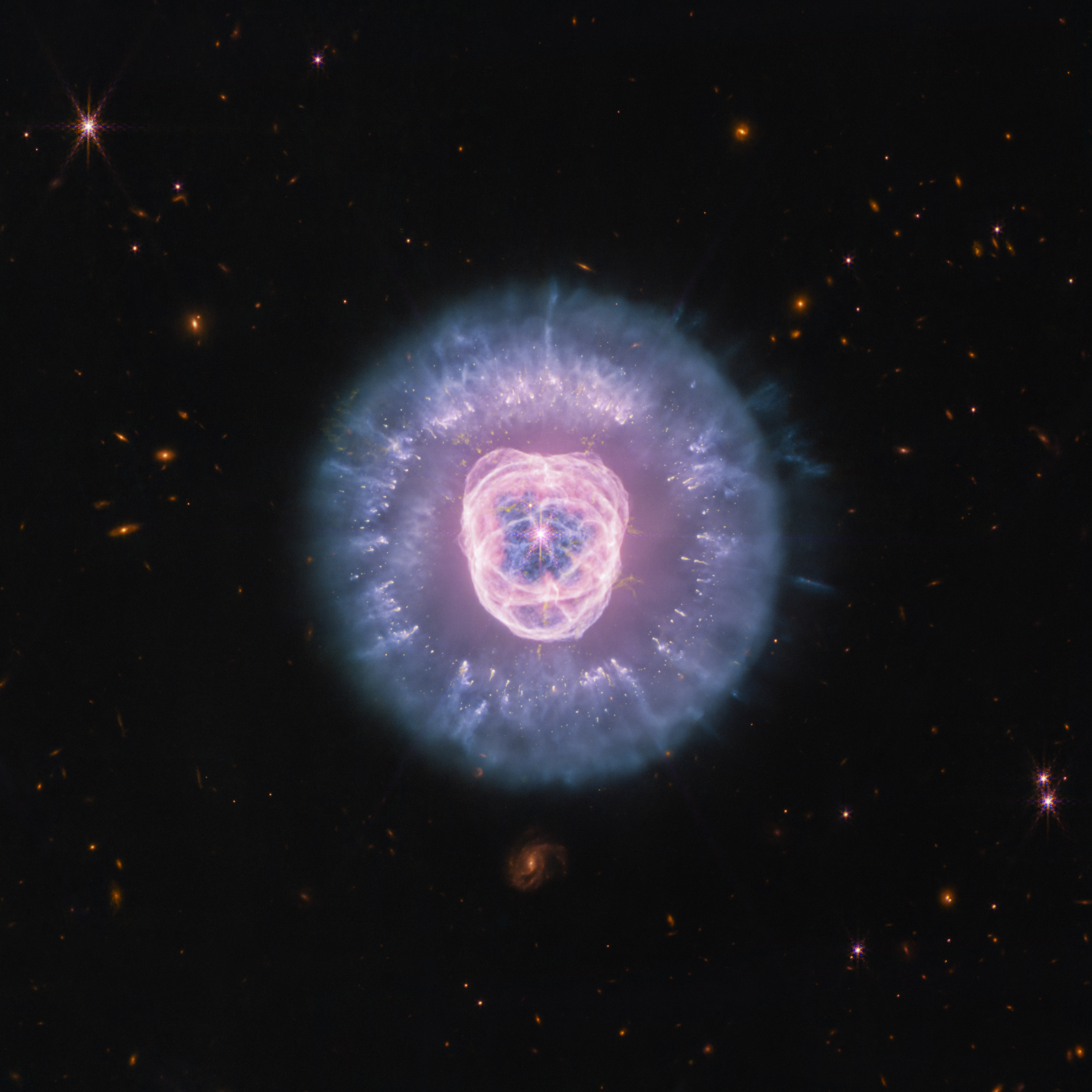
NASA's James Webb Space Telescope has captured unprecedented details of NGC 2392, a planetary nebula located thousands of light-years from Earth and commonly known as the Lion Nebula. The telescope's infrared instruments resolved the structure with clarity that ground-based observatories cannot match, revealing the nebula's distinctive "mane" of ejected stellar material in sharp definition.
Planetary nebulae form when dying stars shed their outer layers into space. NGC 2392 represents a relatively young example of this process, with the expelled gas still expanding outward and illuminated by radiation from the hot stellar remnant at its center. Webb's infrared capabilities penetrate dust that would obscure visible-light observations, allowing astronomers to map the composition and temperature of the expanding shells with precision impossible from previous surveys.
The Lion Nebula's lion-like appearance results from its symmetrical structure. Two distinct lobes of material extend from the central star, creating the characteristic "face" that inspired the nickname. Detailed imaging reveals filamentary structures within these lobes, showing how stellar winds shaped the ejected material into complex patterns over thousands of years.
Webb observed NGC 2392 across multiple infrared wavelengths, enabling spectroscopic analysis of the gases involved. This data reveals information about elemental abundances, densities, and velocities within the nebula. Such observations refine models of how stars evolve in their final stages and how they distribute heavy elements back into the interstellar medium, enriching future generations of stars and planets.
The planetary nebula lies approximately 4,000 light-years away in the constellation Gemini. Its relatively bright and compact structure makes it an ideal target for Webb's fine spatial resolution. These observations demonstrate the telescope's capability to resolve small-scale structures in distant objects, crucial for understanding stellar evolution across the cosmos.