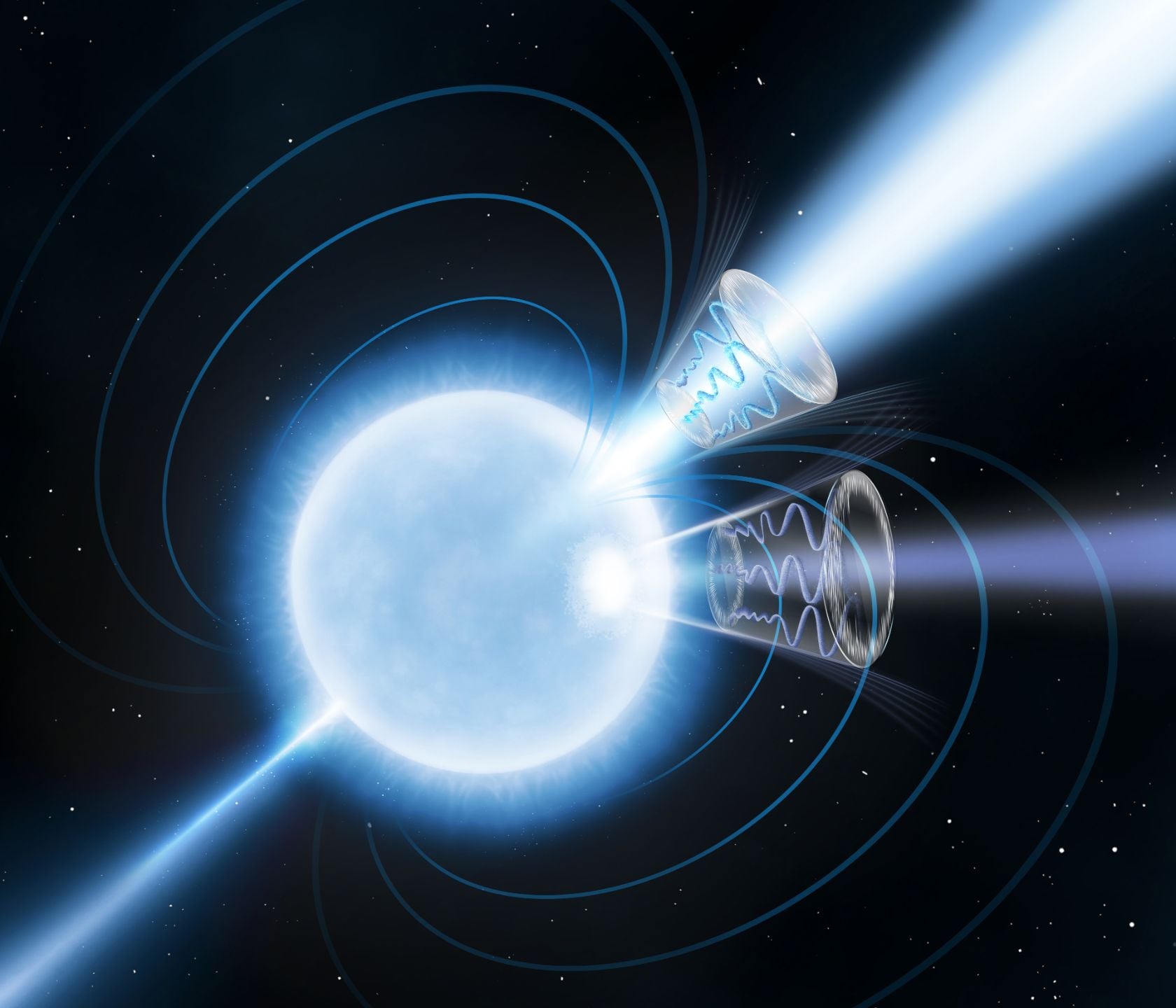
An international team of astronomers reports the first potential detection of vacuum birefringence using NASA's Imaging X-ray Polarimetry Explorer (IXPE) orbiting Earth. The observation centers on the magnetar 1E 1547.0–5408, an exotic neutron star with a magnetic field so intense that it fundamentally warps the quantum vacuum itself.
Vacuum birefringence describes a counterintuitive quantum mechanical effect where empty space behaves like a polarizing filter when exposed to extreme magnetic fields. Light passing through such a region splits into two rays with different polarization states, traveling at different speeds. This phenomenon sits at the intersection of quantum electrodynamics and general relativity, predicted by theory but never directly observed until now.
The magnetar 1E 1547.0–5408 inhabits a unique laboratory for testing quantum physics. Magnetars represent the most magnetic objects known in the universe, with surface magnetic fields reaching 10 to the 16th power Gauss. By comparison, Earth's magnetic field measures less than 1 Gauss, and the strongest laboratory magnets on Earth reach only about 45 Tesla, or roughly 450,000 Gauss. The extreme conditions around magnetars compress matter to densities where quantum effects dominate the classical physics humans normally experience.
IXPE arrived at the International Space Station in June 2021, marking NASA's first space-based X-ray polarimetry mission. The observatory measures the polarization of X-rays from cosmic sources, revealing information hidden from traditional imaging telescopes. Polarimetry acts as a diagnostic tool, exposing the structure of magnetic fields and the physics operating near exotic compact objects.
The team observed 1E 1547.0–5408 during an active outburst, when the magnetar emitted substantial X-ray radiation. The X-rays originating near the magnetar's surface traveled through the intense magnetic field, where quantum vacuum effects should alter their polarization signature. The IXPE data revealed polarization patterns consistent with vacuum birefringence predictions, suggesting light had indeed been modified by the quantum properties of empty space itself.
This result opens multiple research pathways. Confirming vacuum birefringence experimentally validates a core prediction of quantum electrodynamics, the theory describing how light and charged particles interact. The detection also demonstrates IXPE's capability for studying magnetars and other compact objects, potentially revealing the internal structure and magnetic geometry of these stellar remnants. Future observations of additional magnetars could strengthen the evidence or reveal variations in how different objects manifest the effect.
Magnetars themselves remain poorly understood. Scientists believe they form from massive stars that explode as supernovae, collapsing their cores into neutron stars with unusually strong magnetic fields. The magnetic energy released during magnetar outbursts occasionally rivals the total energy output of the Sun across all wavelengths for brief periods. Understanding the physics near magnetar surfaces requires pushing theoretical models to their limits.
The observation represents collaboration across multiple institutions and nations, reflecting how modern astrophysics tackles fundamental questions. By using extreme cosmic environments as natural laboratories, astronomers continue testing the boundaries between quantum mechanics and gravity, exploring regimes inaccessible to any Earth-based experiment. This magnetar study demonstrates how space telescopes reveal not just what the universe contains, but how the deepest laws of physics operate under the most extreme conditions imaginable.