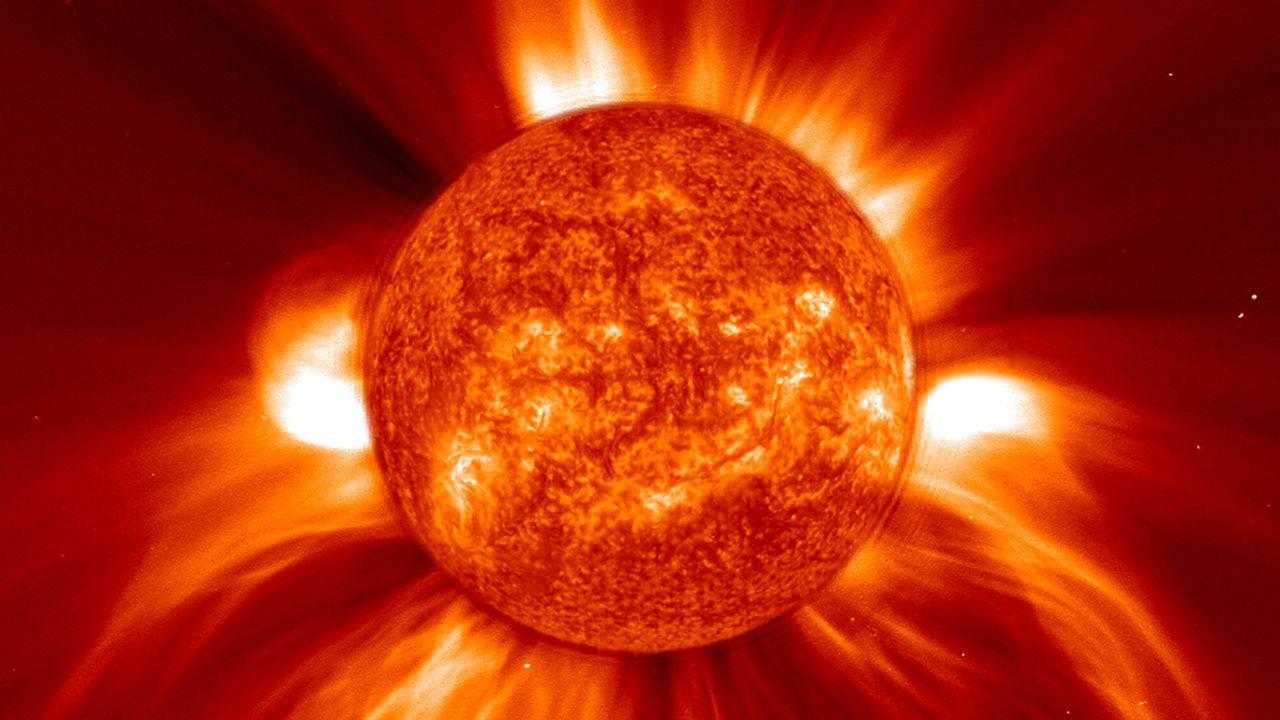
A coordinated observation campaign involving 17 spacecraft has revealed new physics about coronal mass ejections, the most violent eruptions on the Sun's surface. By positioning multiple missions across vast distances in the solar system, scientists captured a single CME from radically different angles, yielding measurements that ground-based observations and single-spacecraft data could never provide.
The fleet included NASA's Parker Solar Probe, positioned closest to the Sun, along with the Solar Dynamics Observatory in Earth orbit. The European Space Agency's Solar Orbiter, Japan's Hinode, and NOAA's DSCOVR spacecraft at the Sun-Earth Lagrange point L1 added their perspectives. Additional instruments aboard STEREO-A, China's ASE-S satellite, and numerous other missions filled in the gaps. This distributed network transformed how scientists understand CME geometry and energy release.
The key discovery centered on the true spatial scale of the eruption. When viewed from a single vantage point, CMEs appear to expand in one direction, creating the illusion of a localized event. Multiple simultaneous observations revealed the eruption's actual three-dimensional structure. The CME proved far larger and more complex than traditional single-spacecraft measurements indicated. Different regions of the same eruption moved at different velocities, a detail invisible to isolated observers.
This heterogeneity matters for space weather forecasting. Solar eruptions hurl billions of tons of plasma and magnetic field toward Earth. When a CME arrives at our planet, it can trigger geomagnetic storms that disrupt power grids, damage satellites, and degrade GPS systems. Accurate prediction requires understanding the true velocity and structure of incoming material. Previous models relying on data from one or two spacecraft systematically underestimated these parameters.
The Parker Solar Probe provided unprecedented data from its vantage point deep in the solar corona, measuring the eruption's properties where the event originated. Solar Orbiter, positioned at a different angle, showed how the CME evolved as it expanded outward. DSCOVR at L1, stationed between Earth and Sun, captured the moment before impact. This temporal and spatial tapestry allowed researchers to reconstruct the eruption's birth, childhood, and maturation.
The coordination required extraordinary logistics. These missions operate under different space agencies with different mission timelines and objectives. Yet when a significant eruption occurs, controllers pivot instruments toward the target. Scientists from NASA, ESA, NOAA, JAXA, and international partners share data in real time. The infrastructure supporting this collaboration, built over decades, proved its value.
The findings reshape our understanding of magnetic reconnection, the process that powers CMEs. The distributed observations suggest that eruptions involve multiple reconnection sites operating simultaneously, not the singular event previous theory proposed. Energy release distributes across larger scales than models predicted. This restructuring of fundamental solar physics will influence how the next generation of solar missions collect data.
Future space weather forecasts will incorporate these three-dimensional measurements. The National Oceanic and Atmospheric Administration's Space Weather Prediction Center, which issues warnings to utilities and satellite operators, will benefit from improved models. Humanity's increasing dependence on space-based infrastructure means that understanding solar eruptions with precision now translates to practical resilience.
The study represents a milestone in distributed space science. Rather than relying on flagship missions costing billions, coordinated networks of smaller, diverse spacecraft yield breakthroughs. This model shapes the future of solar physics and space weather research.