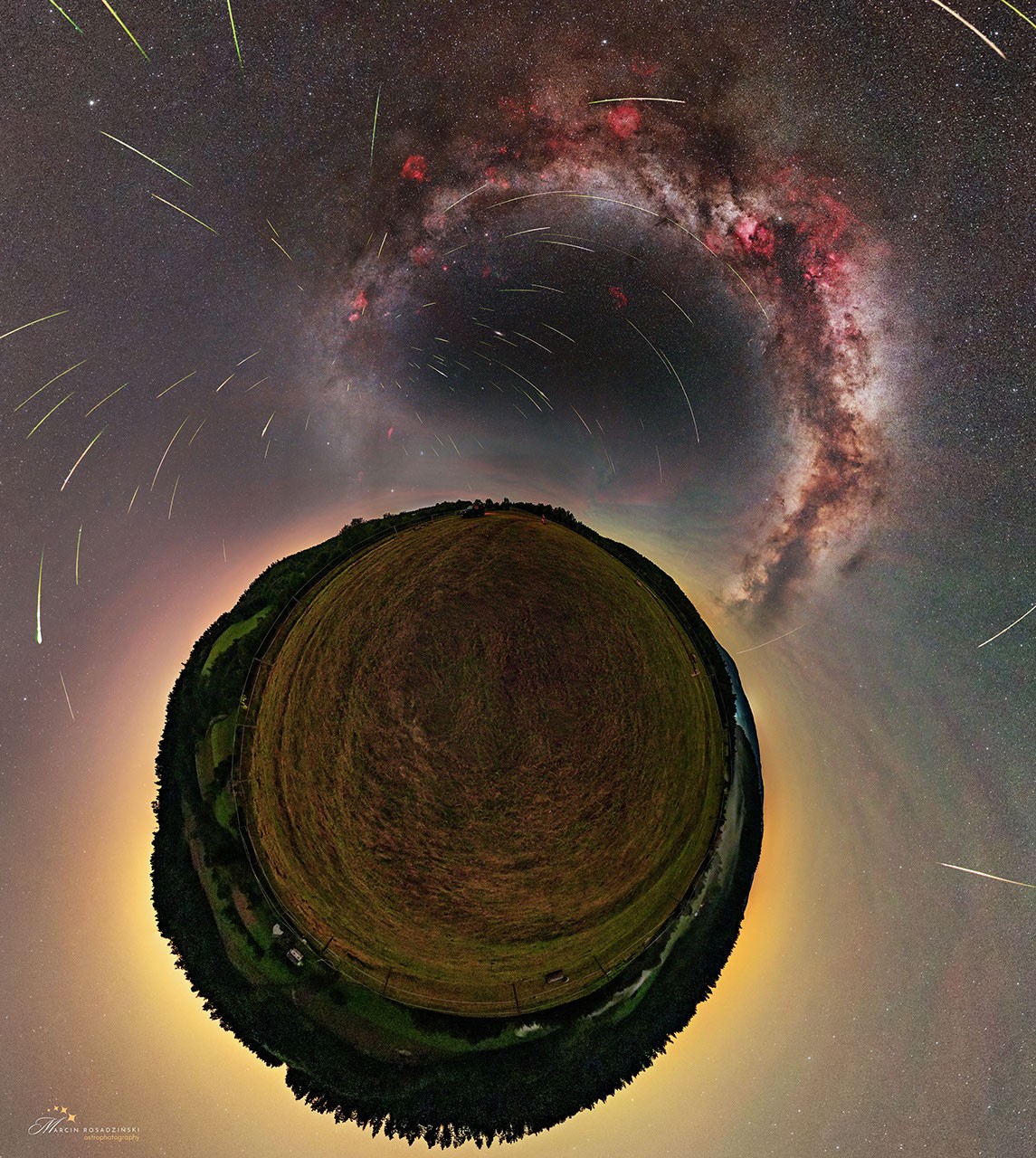
The Perseid meteor shower dominates Earth's night sky each August as our planet plunges through the debris trail of Comet Swift-Tuttle. NASA's Astronomy Picture of the Day captured this phenomenon in a panoramic view titled "Perseids over a Little Planet," showcasing dozens of meteors streaking across the firmament in a single composite image.
The Perseids rank among the year's most reliable meteor showers, producing 50 to 100 visible meteors per hour at peak activity. These fragments of Swift-Tuttle, a periodic comet with an orbital period of 133 years, strike Earth's upper atmosphere at approximately 59 kilometers per second. The collisions ionize atmospheric molecules, creating the brilliant streaks observers see from the ground.
The "little planet" framing technique used in this image transforms a wide-angle panorama into a spherical perspective, warping the landscape and sky into a compact globe. This creative approach emphasizes the radiant point of the Perseid shower, the region in Perseus from which meteors appear to originate due to Earth's motion through the debris stream.
Peak viewing occurs around August 11-13 each year, with the best displays happening after midnight when your location faces the direction of Earth's orbital motion. Dark skies away from light pollution reveal the shower's full intensity. Binoculars and telescopes are unnecessary, as the naked eye captures the full extent of these streaks across the sky.
The Perseid shower carries scientific value beyond its visual spectacle. Radar and optical observations of meteors help astronomers refine models of how cometary dust evolves in space and contributes to the interplanetary medium. The shower also provides public engagement opportunities, as the Perseids remain consistently visible from populated regions across the Northern Hemisphere.
Comet Swift-Tut