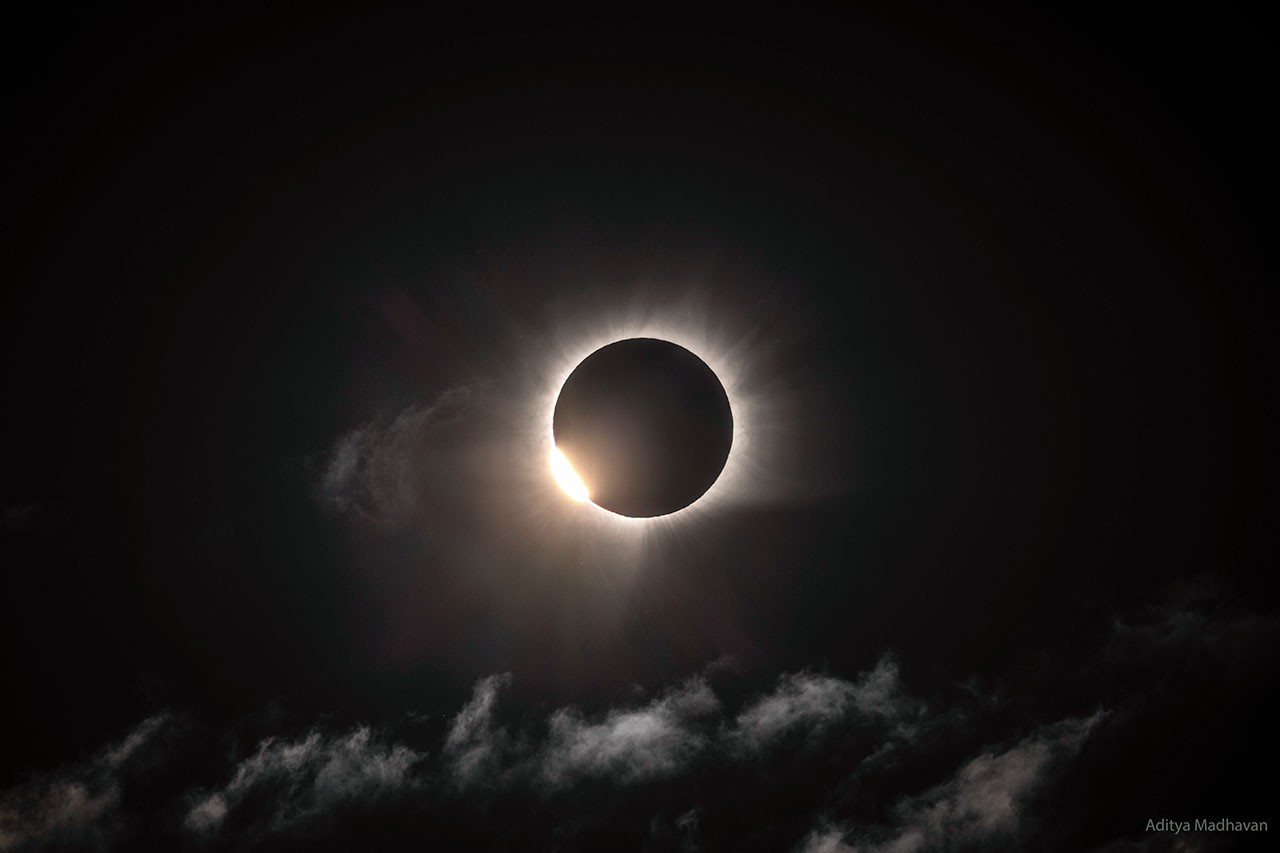
# Total Solar Eclipse Crosses Greenland in August 2026
A total solar eclipse will sweep across Greenland on August 14, 2026, offering scientists and eclipse chasers a rare opportunity to observe the Moon's shadow racing across the Arctic landscape. NASA's Astronomy Picture of the Day program has highlighted this upcoming event as a major astronomical occurrence for the coming years.
The 2026 eclipse path will cross Greenland during the daytime hours, allowing observers positioned along the trajectory to witness totality. The Moon will completely block the Sun's photosphere, revealing the solar corona, the Sun's outer atmosphere that remains invisible during normal daylight conditions. This corona becomes the primary target for eclipse science, as researchers use these rare windows to study the Sun's magnetic field structure and understand why the corona reaches temperatures exceeding one million Kelvin, a phenomenon that remains one of solar physics' enduring puzzles.
Total solar eclipses occur when the Moon passes directly between Earth and the Sun, casting its shadow on Earth's surface. The geometry works because the Moon and Sun appear nearly identical in size from Earth's perspective, despite vast differences in their actual dimensions and distances. The Moon's umbra, the region of complete shadow, traces a path across the globe. For the 2026 eclipse, this path spans roughly 250 kilometers wide and travels at speeds exceeding 1,500 kilometers per hour in some regions.
Greenland's location presents both challenges and opportunities for eclipse observations. The remote Arctic setting limits infrastructure, yet the region's high latitude means the Sun hangs relatively low on the horizon during August, creating unique photographic and scientific opportunities. The ice sheet's reflective surface and minimal light pollution also enhance observational conditions compared to populated regions.
NASA and international astronomical organizations typically coordinate ground-based observations during total solar eclipses. Scientists deploy spectroscopes, coronagraphs, and specialized cameras to capture the corona's structure in unprecedented detail. Space-based observatories including the Solar Dynamics Observatory and Parker Solar Probe often coordinate their observations to provide complementary data from orbit. The combination of ground and space-based measurements yields insights into solar wind acceleration and coronal mass ejection mechanisms.
The 2026 Greenland eclipse follows the 2024 total solar eclipse that crossed North America, allowing the eclipse research community time to refine instrumentation and observational strategies. Each total solar eclipse provides scientists roughly four minutes of totality, a precious window for collecting data that ground-based instruments cannot gather during the Sun's normal state.
Eclipse tourism has grown substantially, with thousands of people traveling to totality paths specifically to witness these events. Greenland's remote location will limit casual viewers, but dedicated eclipse expeditions are already organizing expeditions to position observers and scientific equipment. The combination of harsh Arctic conditions and limited daylight access makes the 2026 eclipse a logistics challenge that separates serious eclipse chasers from casual observers.