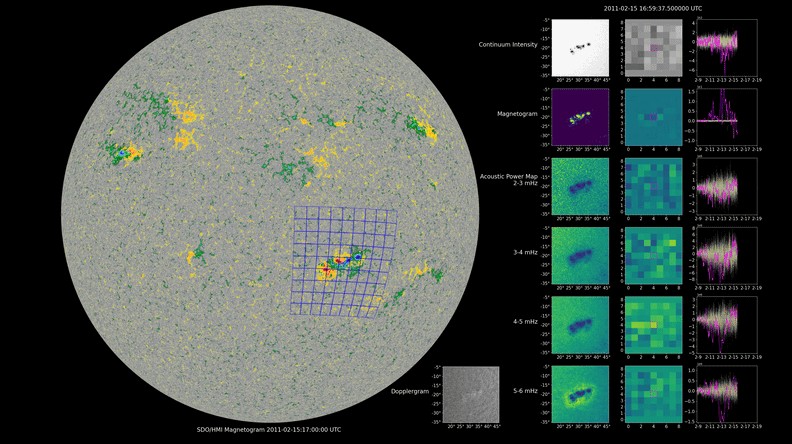
NASA's COFFIES project has deployed artificial intelligence to forecast solar active regions before they produce dangerous space weather events. The system represents a leap forward in predicting coronal mass ejections and solar flares that threaten spacecraft, communications infrastructure, and astronauts beyond Earth's protective magnetosphere.
COFFIES stands for Consequence Of Fields and Flows in the Interior and Exterior of the Sun. The collaboration brings together astrophysicists and data scientists to understand the mechanisms driving solar storms. Their AI model analyzes patterns in solar magnetic field data to identify which active regions will erupt violently in the coming hours and days.
Space weather poses real operational hazards. Solar flares and coronal mass ejections can disable satellites, degrade GPS signals, and expose crews on the International Space Station to elevated radiation. As NASA plans longer-duration lunar missions and eventual Mars expeditions, forecasting these events becomes essential for crew safety and mission planning. Astronauts on the lunar surface or in transit will lack the magnetic shield that protects people on Earth.
The COFFIES team trained their machine learning algorithm on years of solar observations from NASA's Solar Dynamics Observatory and other spacecraft. The model learns to recognize magnetic configurations that precede major eruptions. Rather than waiting for flares to occur and then issuing warnings, the AI identifies dangerous active regions while they're still developing on the solar disk.
Previous space weather forecasting relied heavily on human expertise and simpler statistical methods. Those approaches achieved reasonable accuracy but required significant manual effort and remained limited by what individual forecasters could monitor simultaneously. The AI system processes vast datasets continuously and detects subtle patterns humans might miss.
The work builds on decades of solar physics research. NASA's Heliophysics Division studies the Sun's influence on the inner solar system through multiple missions and ground-based observatories. Understanding the Sun's magnetic field behavior underpins everything from protecting power grids on Earth to enabling safe deep-space exploration.
Accurate space weather prediction also serves commercial interests. Satellite operators, power utilities, and airlines benefit from advance notice of hazardous conditions. The space industry increasingly recognizes that space weather represents an operational reality rather than a theoretical concern.
COFFIES researchers continue refining their models to improve prediction lead times and accuracy. Future versions may integrate data from additional solar observatories and employ more sophisticated neural network architectures. The team also works to make their predictions actionable for space weather forecasters at NOAA's Space Weather Prediction Center, which issues official alerts and warnings.
This work exemplifies how NASA's scientific missions generate practical applications beyond basic research. The same observations that unlock secrets of stellar physics also provide tools for protecting human spaceflight and Earth-based infrastructure. As solar activity fluctuates through natural cycles, reliable forecasting becomes increasingly valuable. COFFIES demonstrates that combining computational power with domain expertise in solar physics produces tools that serve both scientific discovery and operational needs.