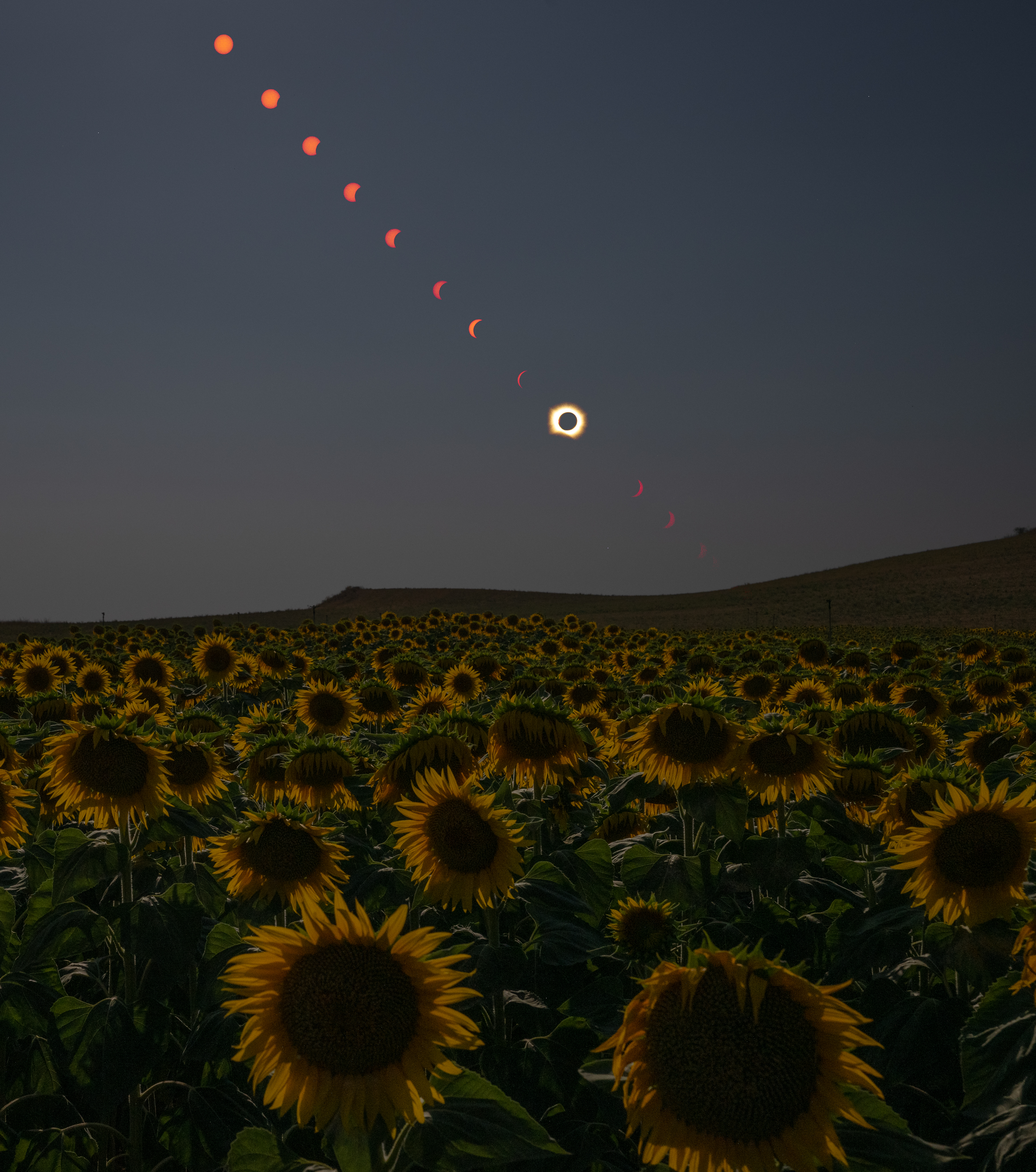
# NASA Captures Total Solar Eclipse Across Spain in August 2026
NASA documented a total solar eclipse that swept across northern latitudes in August 2026, with a composite image captured over San Millán de los Caballeros, Spain revealing the moon's journey in front of the sun. The eclipse path traced across Greenland, Iceland, northern Russia, the Atlantic Ocean, Spain, and a small corner of Portugal, while observers across parts of the United States witnessed a partial eclipse.
The August 12, 2026 eclipse represents one of the rare celestial events when the moon passes directly between Earth and the sun, casting a shadow across the planet's surface. During totality, the moon blocks the sun's photosphere entirely, revealing the ethereal corona, or outer atmosphere of the sun, to observers within the path of totality. This astronomical alignment occurs only when the moon reaches the correct distance from Earth and positions itself precisely between our planet and the star at its center.
The composite image from NASA shows sequential phases of the eclipse progression, documenting the moon gradually occluding the solar disk. Such images serve astronomers and space agencies in multiple ways. They provide timing records of eclipse events, validate prediction models used for future eclipse forecasting, and offer educational resources for public understanding of solar geometry and orbital mechanics.
Total solar eclipses remain invaluable for solar physics research. The brief window of totality, typically lasting just a few minutes at any given location, allows scientists to observe the sun's corona without the overwhelming glare of the photosphere. Instruments deployed during eclipses have historically revealed solar prominence structures, coronal mass ejection patterns, and dynamics of the solar atmosphere that remain difficult or impossible to observe during normal conditions. Space-based solar observatories like the Solar Dynamics Observatory (SDO) and the Parker Solar Probe complement ground-based eclipse observations, but the natural eclipse provides an unobstructed view unique among observational techniques.
The geographic distribution of eclipse visibility across 2026 positioned the Atlantic as a central feature of the event corridor. Spain's location within the totality zone made it a major destination for eclipse chasers, scientific teams, and amateur astronomers. The partial eclipse visible across the United States allowed millions more to participate in the astronomical event, even though they would not experience totality.
NASA's documentation of this eclipse contributes to the agency's ongoing catalog of solar events and supports the Next Generation Solar Physics program. Understanding eclipse paths and visibility zones requires precise orbital calculations maintained by NASA's Planetary Data System and related reference databases. These records become references for planning future observations, coordinating international research efforts, and refining computational models of celestial mechanics.
The August 2026 eclipse joined a continuing sequence of total solar eclipses visible from Earth over the coming decades. The 2024 North American eclipse preceded this European event by two years, demonstrating the relatively frequent occurrence of totality somewhere on Earth, even as any specific location experiences totality only rarely, sometimes separated by centuries.