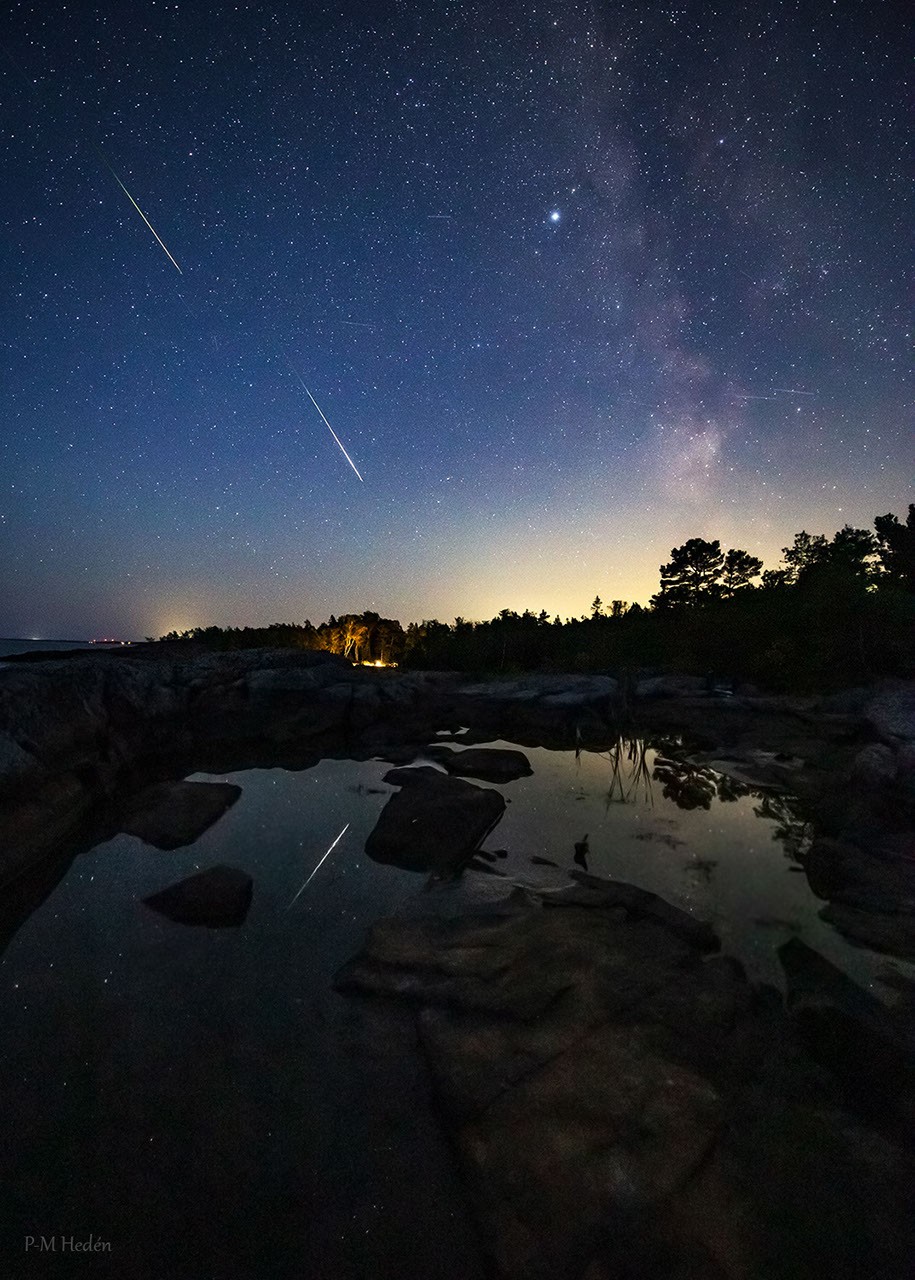
# Perseid Meteor Shower Peaks in August with Spectacular Display from Sweden
The Perseid meteor shower delivers one of the year's most reliable celestial displays, and observations from Sweden captured the phenomenon at its brightest. This annual event occurs when Earth passes through debris left behind by Comet Swift-Tuttle, a periodic visitor to the inner solar system that last approached closest to the sun in 1992.
The Perseids appear to radiate from the constellation Perseus in the northern sky, though meteors actually strike the atmosphere across the entire celestial sphere. Each August, between roughly the 10th and 13th of the month, Earth's orbit intersects the comet's debris stream, creating a window for viewing. Peak activity typically generates 50 to 100 visible meteors per hour under dark skies, making it accessible to observers without telescopes or binoculars.
Swift-Tuttle's orbital period spans approximately 133 years. The comet measures roughly 26 kilometers across, making it one of the largest objects known to cross Earth's orbit. When it last passed perihelion in December 1992, amateur astronomers and space agencies tracked its trajectory carefully. Swift-Tuttle will not return until 2126, yet the meteoroid stream persists along its path through space, offering annual opportunities for observation.
The brightness of this year's display from Swedish locations reflects favorable viewing conditions. Northern latitudes provide extended twilight during summer months, allowing observers to track meteors across wider portions of the night sky. The absence of lunar interference during peak hours in 2026 enhances visibility. Dust particles shed by Swift-Tuttle over centuries accumulate along the comet's orbital path, creating a debris field roughly 9 million kilometers across.
Perseid meteors typically strike the atmosphere at velocities exceeding 210,000 kilometers per hour. This extreme speed generates friction that superheats air molecules, producing the characteristic bright streaks visible from Earth's surface. Larger meteoroids create fireballs bright enough to cast shadows momentarily on the ground. The phenomenon provides valuable scientific data about the composition and density of ancient cometary material.
NASA's Meteoroid Environment Office at the Marshall Space Flight Center monitors meteor shower activity through multiple methods. Ground-based optical observation networks combine with satellite detectors and radar systems to catalog meteor frequencies and brightness distributions. This systematic approach has refined predictions of shower intensity and timing over decades.
Observers planning to view the Perseids benefit from dark locations away from artificial light pollution. The shower requires no special equipment beyond patience and a clear sky. Lying flat on a reclining chair or blanket allows the eyes to scan the largest possible portion of the sky without neck strain. Peak viewing occurs after midnight, when an observer's location faces directly into the debris stream.
The 2026 Perseid display represents another chapter in humanity's long observation of this recurring celestial event. Ancient Persian astronomers documented meteors centuries before modern science explained the mechanism. Today's data collection continues that tradition while adding quantitative rigor to prediction and understanding.