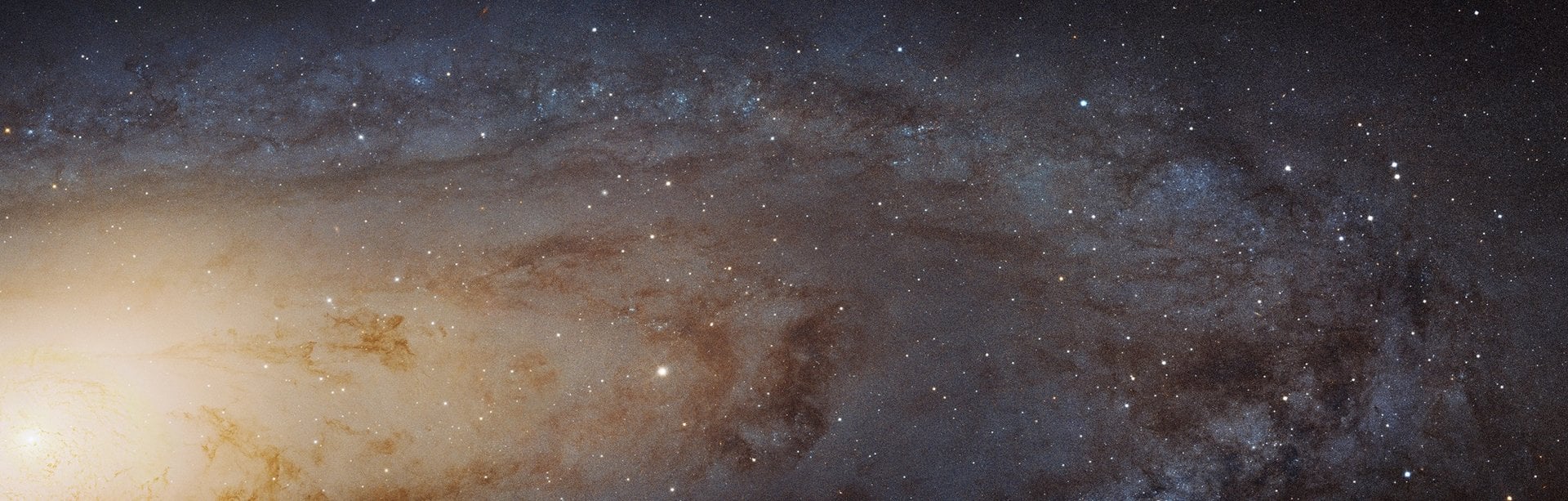
The Hubble Space Telescope has documented a dramatic slowdown in star formation across Andromeda, our nearest galactic neighbor at 2.5 million light-years away. Researchers at the University of Washington used data from the Panchromatic Hubble Andromeda Treasury (PHAT) survey to map this galactic decline, assembling 7,398 individual Hubble exposures across 411 separate observations to create an unprecedented portrait of stellar birth rates across Andromeda's disk.
The findings reveal that Andromeda produces far fewer new stars today than it did billions of years ago. This decline tracks a broader pattern observed in large galaxies across the universe. Andromeda, a spiral galaxy similar in structure to the Milky Way but slightly larger, has exhausted much of its gas reserves needed to forge new stars. Without sufficient hydrogen and helium, the galaxy cannot sustain the vigorous star formation that characterized its youth.
The PHAT survey operates as a galactic archaeology tool. By analyzing ultraviolet, visible, and infrared light captured by Hubble, the team reconstructed the star formation history of Andromeda's outer regions and spiral arms. This approach allows astronomers to date when individual stars were born, building a timeline that stretches billions of years into the past. The survey's scope proved transformative. Previous observations could only sample small regions. PHAT mapped a continuous swath spanning 6,000 light-years of Andromeda's expanse.
The data shows star formation peaked roughly 6 to 7 billion years ago. Since then, the rate has plummeted by roughly 75 percent. Current star formation in Andromeda averages about 0.3 solar masses per year, a pace that pales against the galaxy's productive era. The depletion stems from physical processes within the galaxy itself. Supernovae explosions heat and expel gas, preventing it from collapsing into new stars. Radiation from massive young stars strips away remaining gas clouds. Over time, these feedback mechanisms create a self-regulating system that eventually stalls star formation.
This pattern holds implications for understanding galaxy evolution across cosmic time. Most large galaxies in the present-day universe form stars at modest rates. The universe's peak era of star formation occurred roughly 10 billion years ago, when galaxies throughout the cosmos burned brightly with stellar nurseries. Andromeda's decline mirrors this cosmic trend, showing that massive galaxies inevitably exhaust their fuel supplies.
The Milky Way follows a similar trajectory. Our galaxy currently forms roughly 1 to 3 solar masses of stars annually, also a fraction of its historical peak. Both galaxies face eventual quiescence, where star formation essentially ceases. The fate of Andromeda grows more complex when accounting for its predicted collision with the Milky Way in roughly 4.5 billion years. That merger will redistribute gas and potentially reignite star formation temporarily, though both galaxies will eventually settle into dormancy.
The Hubble observations underscore the instrument's enduring value for resolving individual stars across nearby galaxies. By measuring the brightness and color of millions of stars in Andromeda, astronomers reconstruct its stellar census and birth history. This technique remains impossible for distant galaxies, where individual stars blur together. Andromeda serves as our laboratory for understanding how galaxies age and change.