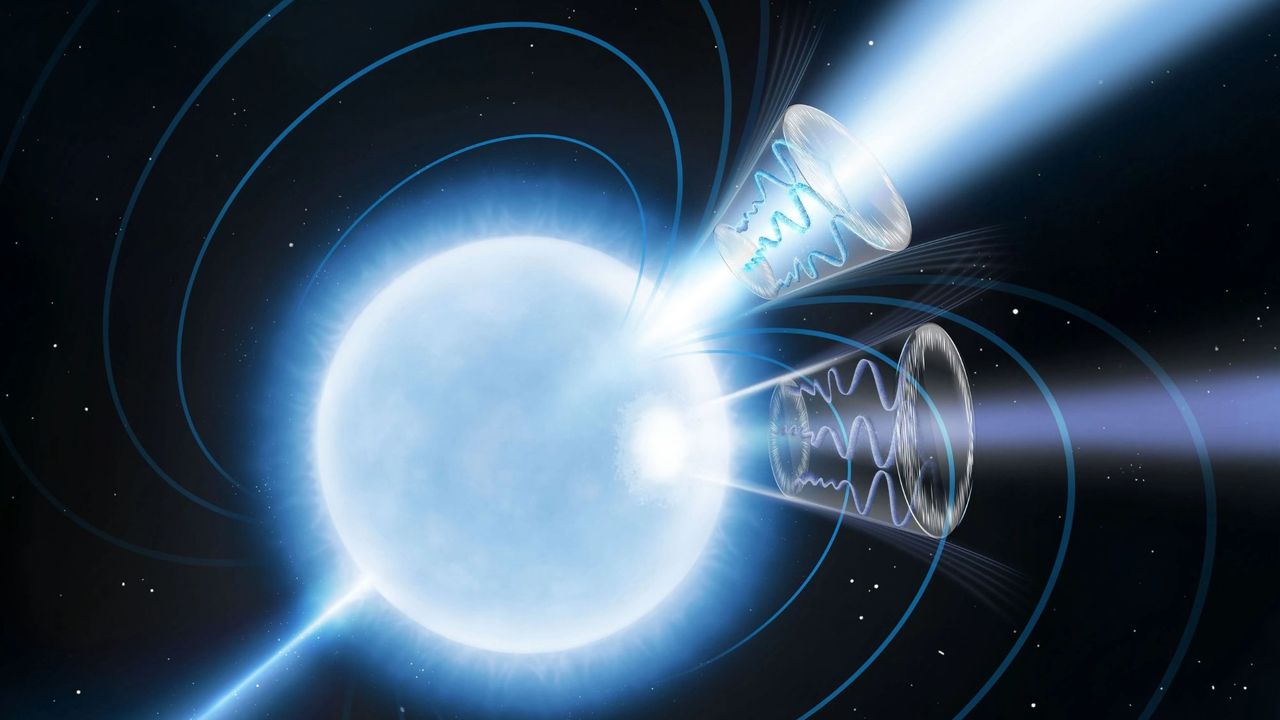
# Magnetic Star Tests Whether Vacuum Is Truly Empty
A neutron star with an extraordinarily powerful magnetic field has become a laboratory for one of physics' deepest puzzles: what exists in seemingly empty space. Astronomers are using observations of this magnetar to probe quantum vacuum, a phenomenon predicted nearly a century ago but never directly confirmed.
The mystery traces to 1930s quantum mechanics. Physicist Paul Dirac proposed that what appears to be nothing is actually seething with particle-antiparticle pairs constantly blinking in and out of existence. These virtual particles should affect how light behaves when traveling through the universe. Yet detecting this effect requires extreme conditions. A sufficiently strong magnetic field bends light in ways that reveal the quantum vacuum's true nature.
Enter the magnetar. These neutron stars, remnants of dead massive stars, possess magnetic fields billions of times stronger than Earth's. Some magnetars generate fields so intense they would shred any physical object from billions of kilometers away. Within such an environment, the quantum vacuum's effects become measurable.
Researchers have identified magnetars capable of producing what physicists call "vacuum birefringence." This phenomenon causes polarized light to shift its angle of polarization as it passes through an extremely strong magnetic field. The effect derives directly from those virtual particles Dirac theorized about. When light encounters a sufficiently intense field, the vacuum itself acts like a crystal, bending light rays in ways classical physics cannot explain.
The significance extends beyond pure theory. Confirming vacuum birefringence validates quantum electrodynamics, one of the most precise theories in physics. It also addresses fundamental questions about the universe's structure at the smallest scales. If confirmed, it proves that empty space is not empty at all, but rather a quantum foam of fleeting particles and fields.
Observing this effect requires detecting faint light from distant magnetars and measuring minute changes in its polarization. Ground-based and space telescopes now hunt for these signals. The challenge lies in distinguishing genuine vacuum birefringence from other effects that alter light polarization as it travels through the cosmos.
Scientists are targeting magnetars known to emit across multiple wavelengths, from radio to X-ray frequencies. Different wavelengths interact with the quantum vacuum differently, allowing researchers to separate real effects from noise. Several candidate magnetars sit within telescope range, making observations feasible within the next few years.
This research transforms how astronomers use the cosmos. Rather than merely cataloging celestial objects, scientists now employ extreme environments as physics laboratories. Magnetars become instruments for testing quantum mechanics. Neutron stars verify gravitational wave predictions. Black holes probe spacetime curvature at limits Einstein's equations still describe accurately.
Finding direct evidence of vacuum birefringence would rank among the most important confirmations in modern physics. It bridges quantum mechanics and relativity, two frameworks that govern opposite scales of reality. A 90-year-old prediction rooted in abstract mathematics would finally gain observational proof, written across the violent magnetic fields of a dead star.